Negotiating in uniform
Bilateral relations
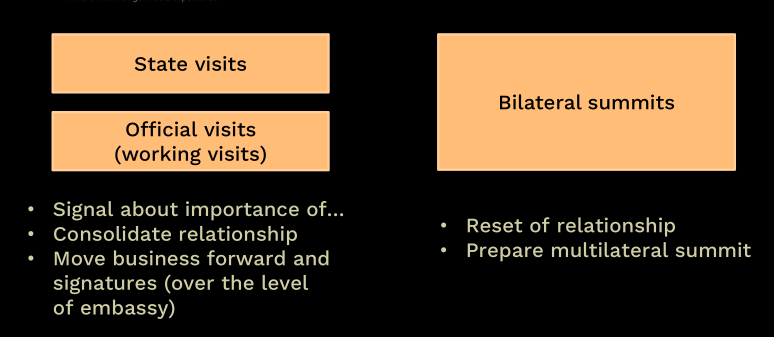
- At the heart of international relations (numerical standpoint).
- Favoured platform for agreements reached internationally (reinforcement since 2006: Newmann & al, 2006).
- Roles:
- Promoting national interests.
- Structuring international negotiations.
Heads meetings
Embassy
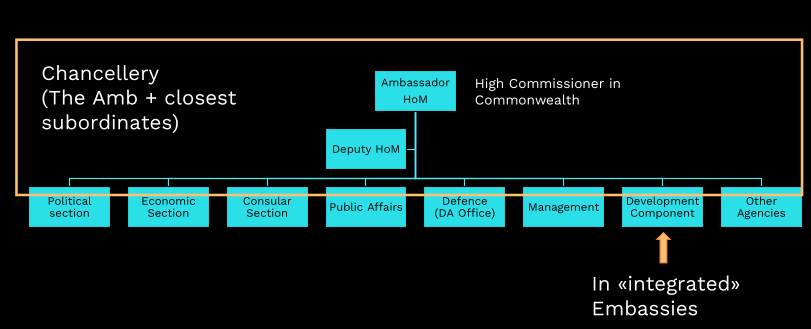
- Major factor in structuring and developing relationships (forward or backward). Ambassador represents the whole government of the sending country.
- Normally divided into departments by activity sector:
- Overall supervised by Ministry of Foreign affairs and/or
- By so-called technical ministries (environment, transportation, economy, defence, development, education, research, health, justice, culture etc.).
- Spheres of action:
- Economy and trade.
- Defence & military.
- Politics.
- Secret services (information gathering according to Vienna conventions).
Typical organisation of an Embassy
Other actors
Evolution
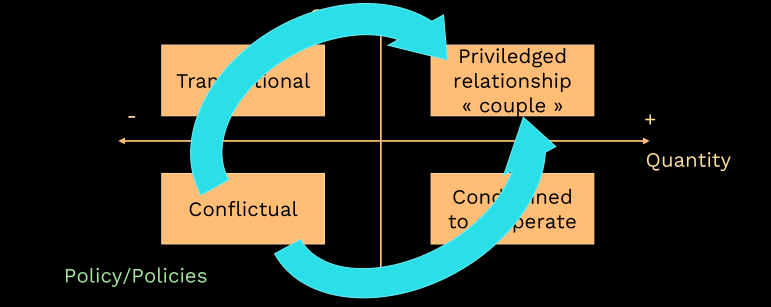 The job of diplomats is getting to privileged relationship. Quantity=amount of shared interests or negotiation opportunities. Quality=capacity to agree.
Multilateral relations
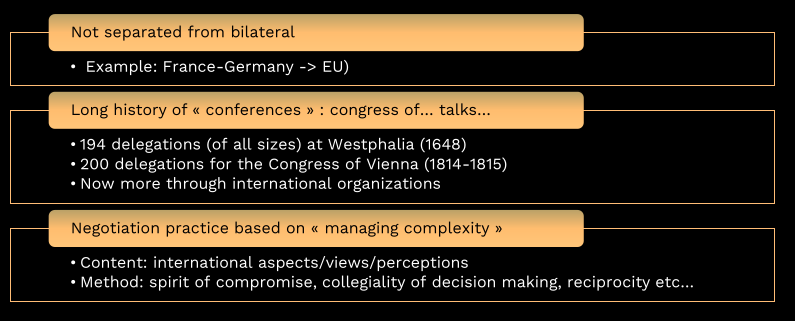
Multilateral/bilateral relations
Negotiations:
- Relational configurations in which one agrees to gain less to gain together.
- Integrative (negotiators provide the means to increase the potential for collective profits→you add more to the total pie/gain together) or
- Distributive (negotiators have a fixed amount of profit to share.
Paradiplomacy
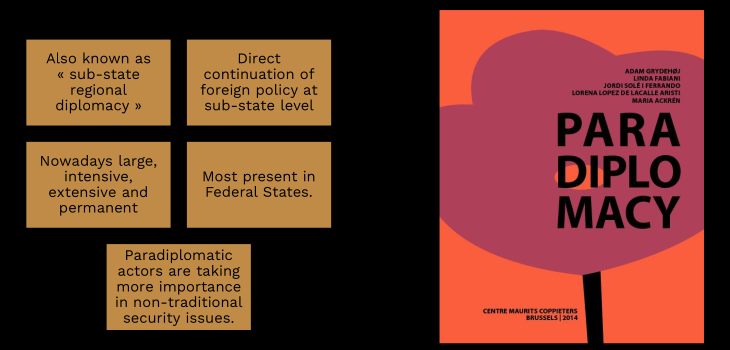 Like cantons negotiating with foreign departments.
Diplomacy 2.0 or eDiplomacy
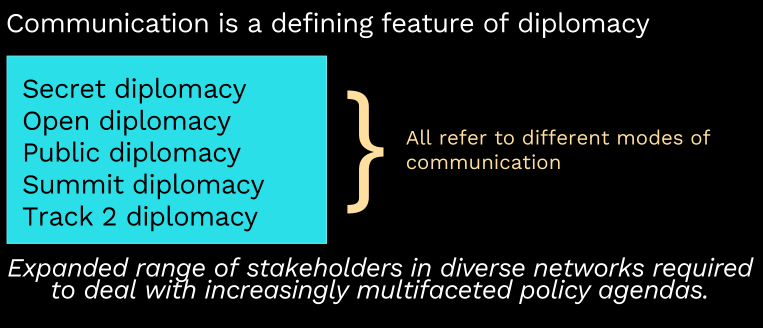 Military diplomats involved in all these aspects. Agendas are very diverse and so are actors, many aren’t so well trained (Ethiopian defence appointed because of personal links to president).
Main differences
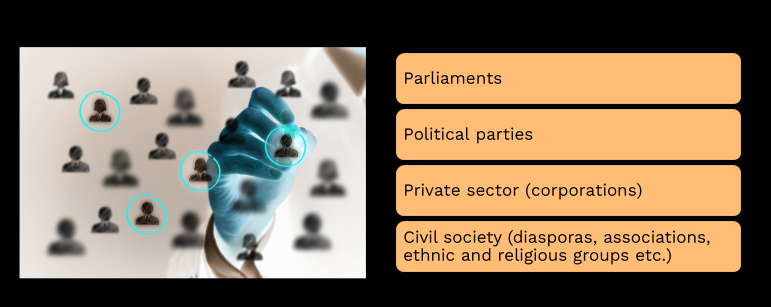
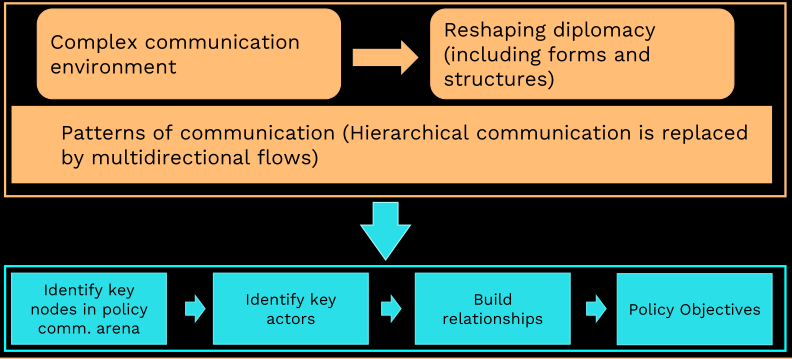 Nowadays less receptional and fancy invitations but channels targeted at concrete objectives. Very diverse, even civil society included.
Forms of diplomacy or sectors of diplomacy
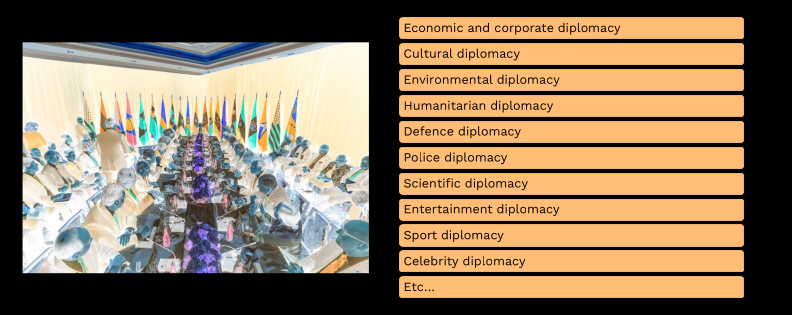 Police diplomacy and scientific diplomacy, as well as entertainment diplomacy recently developed (example of swiss dj at the same time he was a diplomat for NATO that got connections going further than the contacts HC had access to as a partner). We also have celebrity diplomacy, like UN ambassadors that have to pass messages.
Security/Defence/Military Diplomacy
- Military diplomacy → end of cold war (military rel. concept of the past).
- Defence diplomacy → post cold war era (cooperation).
- Security diplomacy ?
- Result of H&H Security developments.
- Now responsability of whole embassies, definition has evolved.
- Result of diplomacy development (WoG Diplo, Diplo 2.0).
- Result of H&H Security developments.
6 domains
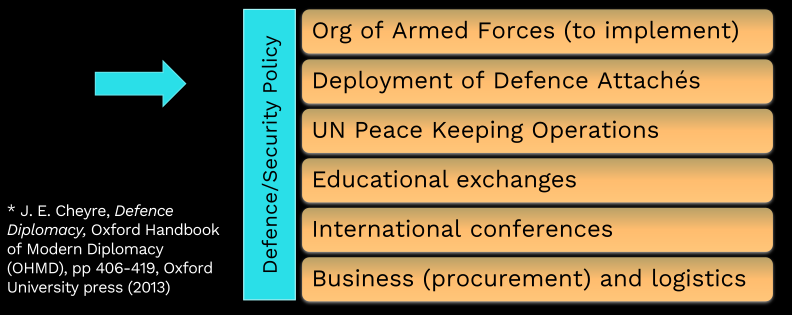 These actions show signals, send a message.
Defence Diplomacy now
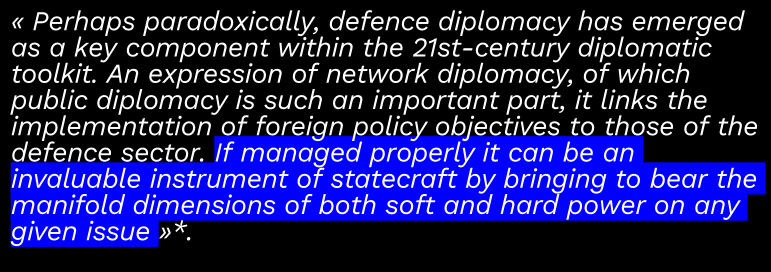
Perhaps paradoxically, defence diplomacy has emerged as a key component within the 21st-century diplomatic toolkit. An expression of network diplomacy, of which public diplomacy is such an important part, it links the implementation of foreign policy objectives to those of the defence sector. If managed properly it can be an invaluable instrument of statecraft by bringing to bear the manifold dimensions of both soft and hard power on any given issue.
D&D Organisation
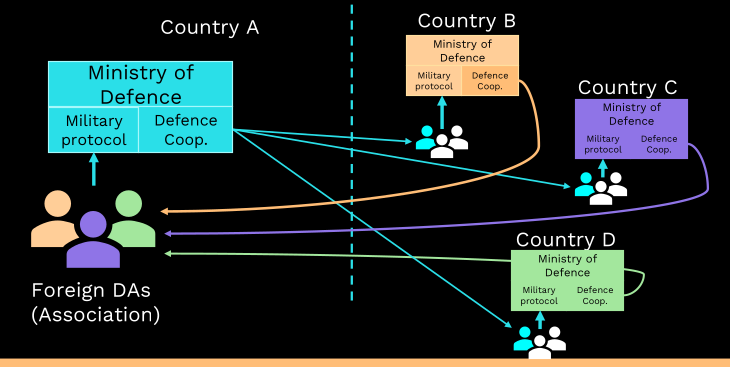
Cooperation
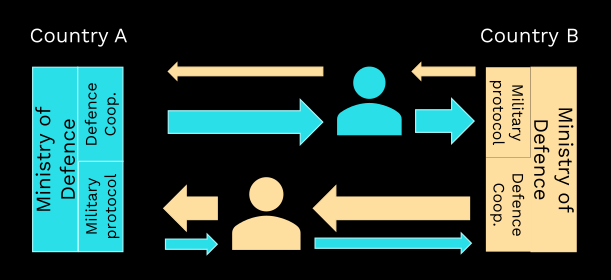
Defence attaché tasks
- Member of the Embassy.
- Direct adviser to the Ambassador in military and security questions.
- Representative of the MoD and own armed forces.
- Write reports about military, defence and security issues in Host Nations.
- Security / Defence / Military relations to host nation, including negotiation:
- cooperation / training / support / help / etc.
- Procurement facilitator
- (Early) Crisis Detection, Management and Reporting.
Security today
Forms of security
- Classical (state centred).
- Modern → Human security.
- economic security, food security, health security, environmental security, personal security, community security, and political security.
- The first organisation to publish the definition of human security with the seven domains was the United Nations Development Programme (UNDP) in its landmark 1994 Human Development Report.
- Other forms of security:
- Energy security, transport security.
- Global security.
National - Regional - Global
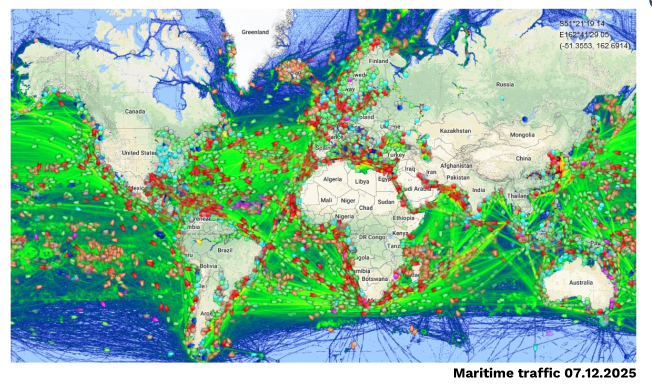 Many offices also have an air and navy attaché, as security isn’t land-only.
Peace Operations 2024/2025
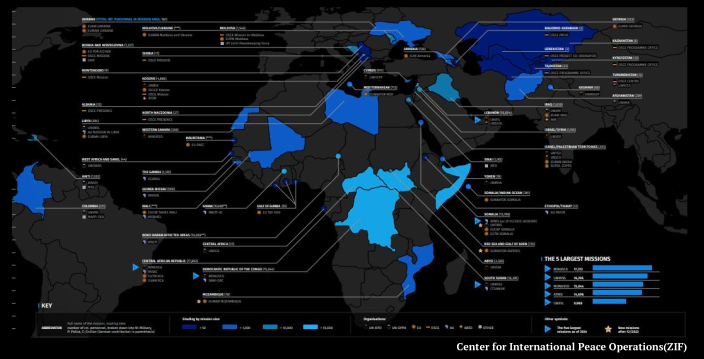
Why regional security matters?
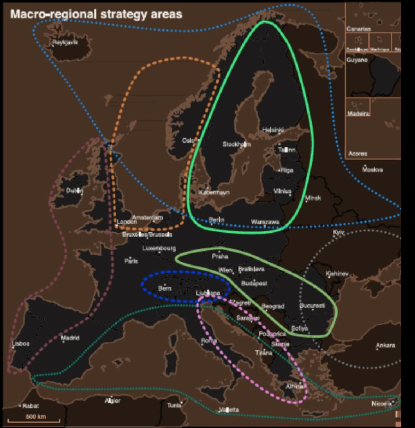
Basically attachés have a regional task, they have to take into account the strategic regions of europe for example such as the blue banana or HC or Austria for energy?…
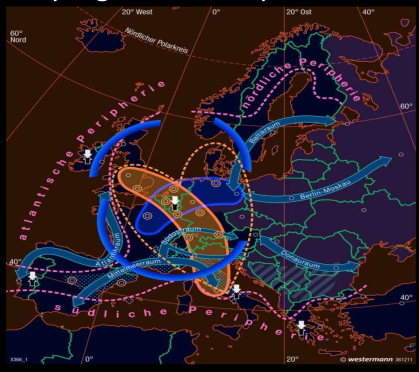
Strategic regions in Europe
Convention of Vienna 1964
Throughout the history, diplomats have enjoyed special status and privileges for their function to negotiate agreements. A diplomat sent from another nation:
- Is treated as a guest.
- Has his/her communications treated as confidential.
- Should be free from coercion.
- Enjoys immunity (criminal, civil and administrative with exceptions) 193 states signed and ratified the Convention (as of June 2021, Palau).
Not parties (UN members):
- Solomon islands.
- South Sudan.
Parties (non UN)
- Holy See.
- (Palestine).
Functions of the mission according to the text
Nothing in the present Convention shall be construed as preventing the performance of consular functions by a diplomatic mission (Art 3-2). But it's not a function at the core pf any mission!
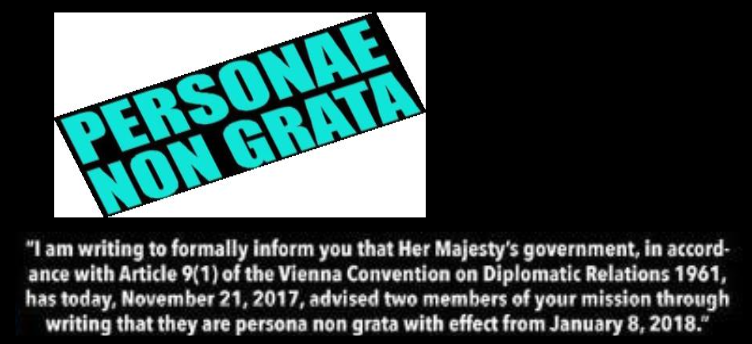
Personae non grata
Other Vienna Conventions
- On law of treaties (between states, 1969).
- On law of treaties (between states and intl org or between intl org, 1986).
- On consular relations (1963).
Networking
Are you a good networker ?
- Communication.
- Active listening.
- Social skills.
- Public speaking skills.
- Nonverbal communication.
- Interpersonal skills.
- Empathy.
- Positivity.
- Humor.
- Focus.
Network definition and objectives
- Sharing of information or services between people, businesses, or groups/organisations.
- connections or a network can be built.
- Networking helps !
- beneficial to all involved parties.
Quality of a good network
- Open.
- Diverse.
- Deep.
Latent vs. Active networks
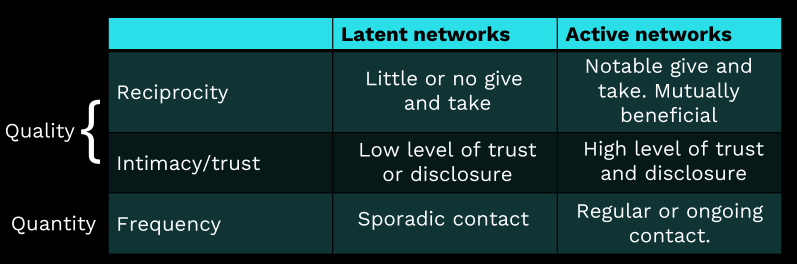 +15 people→latent. Every member of an embassy manages his own network weekly.
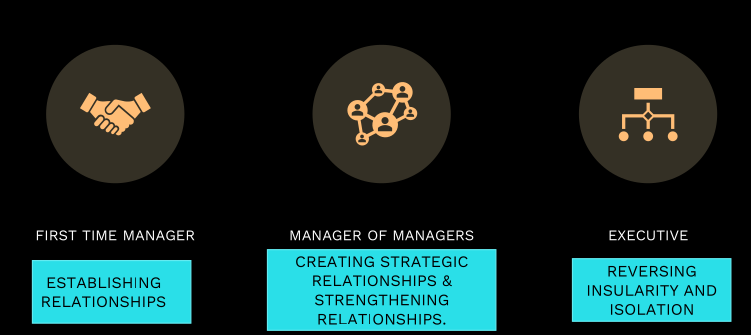
Levels of leadership
Protocol
What is protocol
- Intended to reduce tedious discussions on who must sit where, in what order or in what manner flags are displayed, or in what order people must walk, stand , or greet guests.
- Means of avoiding unnecessary conflicts and misunderstandings.
- To cultivate a climate in which everyone feels comfortable and lends itself to positive decision making.
- Diplomatic protocol is used as a tool for mutual communication in order to minimise the possibility of diplomatic blunders as much as possible.
Etiquette/Good Manners
- Etiquette is characterised as being a strict set of rules for behaviour and appearance.
- Manners on the other hand are not determined by rules, as there is more than one correct way to behave when you are among friends. Kindness is the number one rule of manners- so they make sure that it is their number one goal when entertaining.
- The convention we just looked at doesn’t forbid certain things but e.g. if your DA serves as head of mission you send a weird signal→military regime, violence, etc… This can happen for a short time as DA is 3rd in chain of command in a mission but it’s not ideal.
Intelligence
Is the Defence Attaché a Spy?
Vienna Convention on Diplomatic Relations of 18 April 1961 Art. 3d / page 2:
- The tasks of a diplomatic mission include ascertaining by all lawful means conditions and developments in the receiving state, and reporting thereon to the government of the sending state.
Under international law, the act of spying, or espionage, describes an act of information gathering that is clandestine or takes place under false pretenses (API Art. 46).→ if you do this=spy.
Sensors
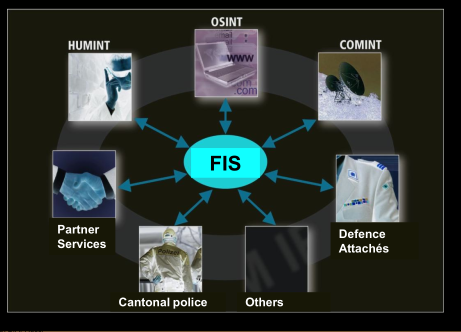 The host country checks.
DA an Intel Service by himself (OSINT)
- Adds value to the collected data in each processing step and produces insights and knowledge.
- He is a «multi-source» service (from open sources to sensitive sources).
- He is the/a security policy/military sensor abroad.
- He answers question of the HQ, supports the anticipation and early warning, by following the situation.
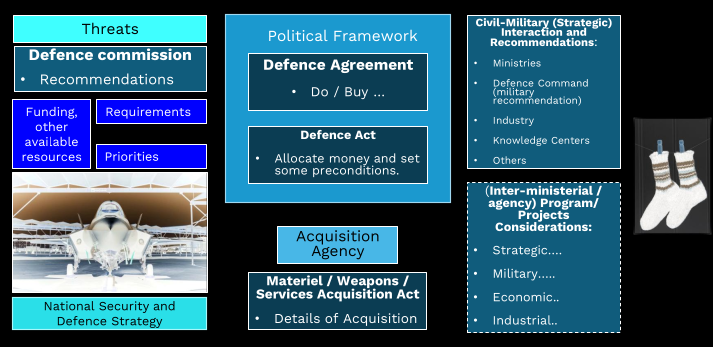
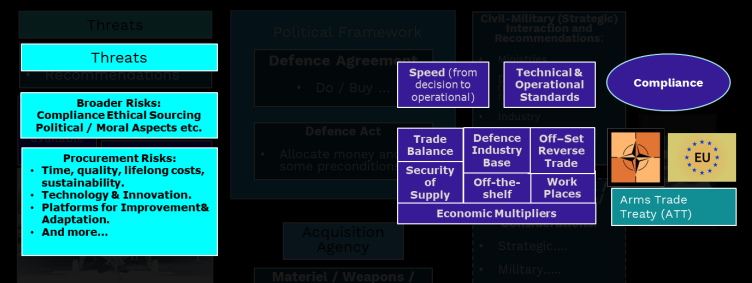
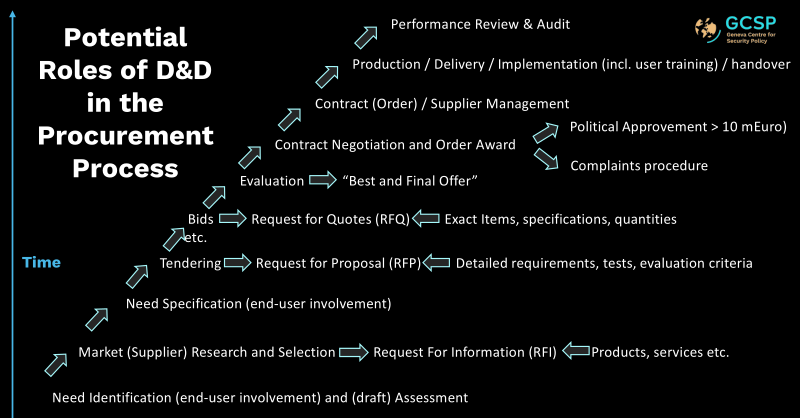
Procurement process (political)
Examples: Key successes of Military/Defence diplomacy
Camp David Accords (1978)
The U.S. military presence and security guarantees were crucial in persuading Egypt and Israel to sign a peace treaty. Military diplomacy provided the credibility needed for both sides to trust the agreement.
Role of D&D:
- Military-to-political translation: Negotiators reframed military concerns (troop deployments, bases, borders) into diplomatic language. This allowed leaders to discuss security arrangements rather than raw military dominance.
- Sinai demilitarisation: Defence diplomacy produced a phased Israeli withdrawal from Sinai, coupled with strict limits on Egyptian military presence there. This balance reassured Israel while restoring Egyptian sovereignty.
- Verification and monitoring: The accords included provisions for international monitoring (later by the Multinational Force and Observers). This was a defence diplomatic innovation: military verification embedded in a peace treaty. U.S. role as security guarantor: American defence diplomacy was pivotal.
- The U.S. offered military aid packages, security guarantees, and even technical arrangements (e.g., airbase relocation, oil supply agreements) to make the peace sustainable.
Cold War Arms Control (1987–1991)
Treaties like the INF and START were negotiated directly by military and strategic delegations from the U.S. and USSR. These talks reduced nuclear arsenals and built trust, helping to end the Cold War.
Balkans (1990s)
NATO combined military pressure with diplomatic negotiations in Bosnia and Kosovo. The credible threat of airstrikes forced parties to accept peace agreements, showing how military diplomacy can compel dialogue.
Colombia Peace Process (2016)
The disarmament of FARC rebels was supervised by international military observers. Their role ensured compliance and gave legitimacy to the peace deal.
Syrian Ceasefires (2016–2017)
U.S. and Russian military officers coordinated local ceasefires. Although fragile, these talks highlighted the importance of military-to-military channels in managing conflict.
Conclusion
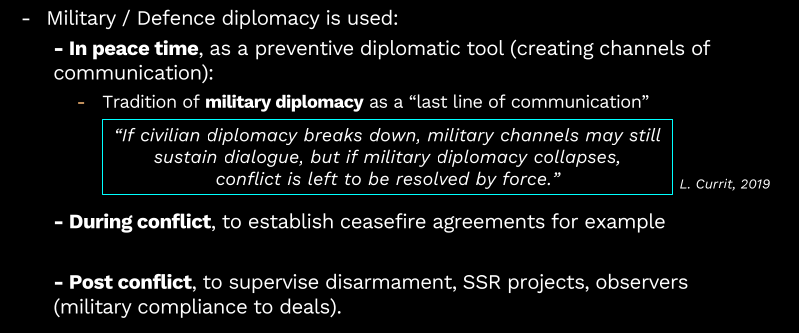
Why D&D matters?
- Direct communication between armed forces prevents misunderstandings and accidental escalation.
- Credibility and deterrence: military involvement signals seriousness and commitment. Implementation and monitoring: peacekeepers and observers ensure agreements are respected.
Now