The Centre of Competence on Humanitarian Negotiation
About the CCHN
- Founded in 2016 as a joint initiative of four major humanitarian agencies to provide guidance and expertise to the humanitarian community as a whole.
- A leading center of expertise and professional exchange on humanitarian negotiation and diplomacy at the global level.
- Largest capacity-building provider of its kind: 8,300 humanitarian professionals trained in the past eight years.
The community of practice of frontline negotiators
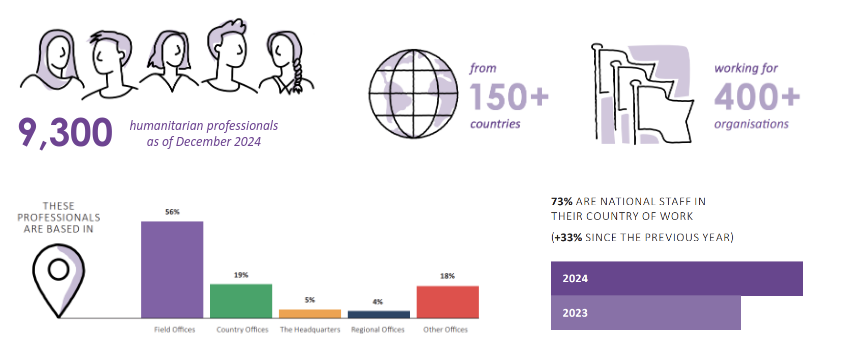 Most of these are in the frontline (conflict zones such as Palestine).
Discussion
Humanitarian Negotiation vs. Traditional Negotiation
What is humanitarian negotiation?
Negotiation isn’t only for diplomats. It is necessary to manage advocacy and humanitarian principles. We don’t negotiate on the law or compromise it, instead we focus on implementation and how to respect it. It’s a set of interactions between a humanitarian organisation and – state or non-state – actors, both civilian and military, to an armed conflict aimed at:
- Establishing organisations in conflict setting (maybe not only armed conflicts but also natural disasters at the same time).
- Make actors understand what your organisation is, your purpose, etc… E.g. the ICRC isn’t christian despite wearing a cross and doesn’t provide humanitarian aid purely to server Swiss interests despite wearing their flag.
- Ensuring access to vulnerable groups.
- Everything the organisation does influences the degree of access. Make sure it’s secure.
- Providing assistance and protection to affected populations.
- Mostly the final objective among others. A negotiation is a long term process! When you negotiate and act you have to think in the long term (about future actions) and also other actors, so as to not overshadow them.
Everyone has to be included, even if you don’t agree with them (terrorists, criminals, etc…) as they are necessary to apply IHL. This makes sense, we don’t negotiate to build trust (even if there can be an element of it in the long term and in the beginning, but not really a sustainable one per se) but to get something from a seller. In this case to apply IHL.
- No red lines, not a clear position like with states.
HN is transactional, but not adversarial.
A lifeline in today’s crises
- Establishes a long-term relationship of trust with counterparts.
- Essential to gain stable and secure access.
- Helps reduce logistical and operational challenges e.g. bureaucratic and administrative impediments.
- Ensures safe passage for humanitarian workers; enhances the overall effectiveness of aid.
- Negotiating humanitarian corridors.
This is difficult, a no is clear but a yes is more complicated depending on the culture, regime, state, etc… When talking to certain interlocutors getting to no is way less hassle. E.g.: Yes but in one week→from the present to one week onward many things can happen and secure access can be compromised when arriving.
Several interlocutors: rebels, terrorists, fighters… non-state armed groups but also military.
Negotiation dilemma
- Advocating for our own humanitarian organisation’s objectives and principles VS
- Building a trusted relationship with the counterpart while exploring areas of consensus or compromises on values, methods and positions.
- Ensuring people are not raped, killed, etc…
- Even if sellers are doing bad stuff the idea is to help people on the other side not to fight against them.
A practical response to global humanitarian needs
- Inclusive, accessible humanitarian negotiation training for all humanitarian professionals across the sector.
- Field-driven learning methodology developed for humanitarians, by humanitarians.
- These things were already being done, just not with a methodological conscience.
- Community-based peer learning.
- Tailored support for real-life operational dilemmas.
- Cross-sectoral collaboration leading to the professionalisation of the sector.
- Masters, bachelors, more competitiveness, etc…
Our methodology (Naivasha grid)
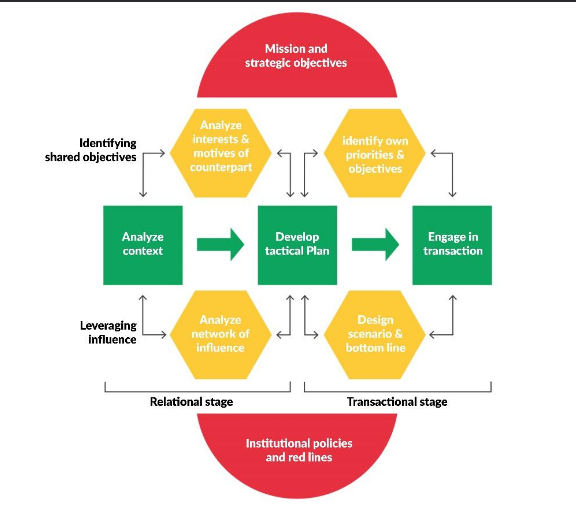 First we analyse the context and find shared objectives as well as a leverage of influence to get to our goals. If there are big disagreements such as not wanting to help communities problems can arise. A tactical plan has to be designed to help on the ground and then engage in a transaction→positive communication (breaking the ice using what your seller is fond of and offering a gain). Also be sure if you are a liability or an asset in a negotiation, e.g if you know the seller personally and he knows your family and etc… you might be more of a liability.
It is also important to talk to other stakeholders in the background that can positively influence your counterpart to then leverage this influence. We have to get below the surface, not only focus on the tip of the iceberg. See the interests and motives properly.
But we cannot forget about analysing ourselves, our interests and goals. And design different scenarios with alternative plans so as to not find ourselves in unexpected situations.
Finally, there are blocks to prevent us from making mistakes and being too crazy→the mission and strategic objectives. For our counterpart, its the institutional policies and red lines. However this red line of our counterpart is more of an orange one as they have a tendency of underreprensenting it, making themselves look more limited than in reality. We will do the same as well, ask for more than we need. Because we wanna make them feel trust and make them feel like they won, so we will concede a bit.
On the relational stage we break the ice and in the transactional stage we build a tactical plan.
Negotiation examples
Negotiating access to a detention facility
- Our organisation: IMC – International Monitoring Committee.
- Our mission: Monitor the treatment of detainees.
- Our counterpart: Governor of Province Z.
- Our objective: Access all prisoners in police stations to gather evidence of torture.
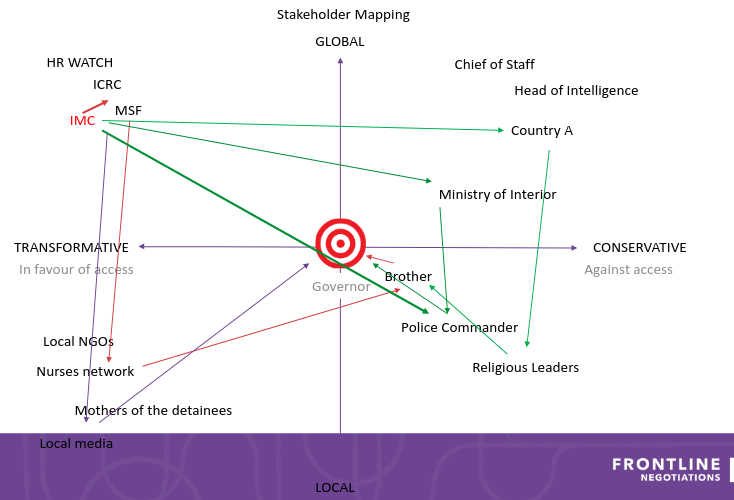 We map stakeholders based on whether they are transformative or conservative, local or global. This compared to the governor, which we negotiate with and is in the center. Dots then have to be connected to map a path of influence towards the governor through pressuring more conservative actors f.ex.
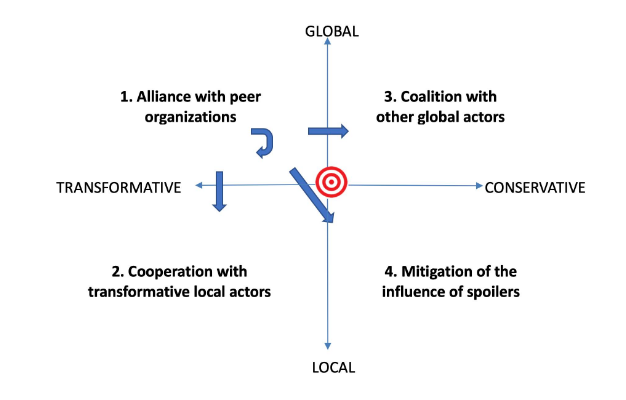 Different strategies for different actors.
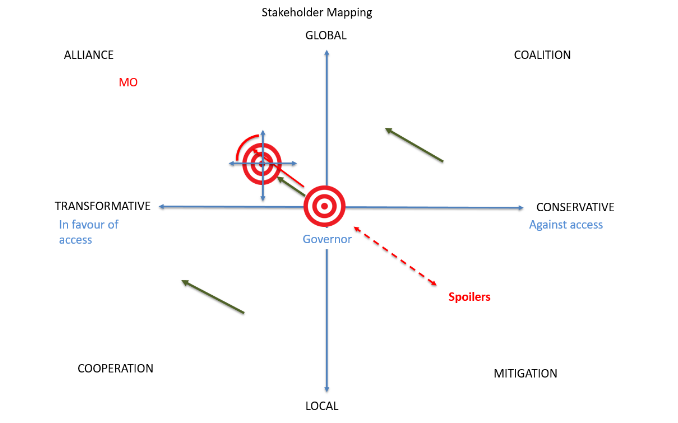 The goal.
Key lessons
- It is important to analyse the political environment and power relationships around your counterpart.
- Mapping influential stakeholders will help decide to whom you should talk and with which tactic.
- The four engagement tactics include:
- Creating alliances with actors in the same quadrant than you.
- Cooperating with local/transformative actors.
- Creating coalitions with global/conservative actors.
- Mitigating the influence of spoilers.
- The centre of the map is the sweet spot, the ideal point of equilibrium for your counterpart. To make him move towards you, you have to engage with all actors to allow him to move without losing this power and legitimacy.
- Create a spot of equilibrium where your counterpart can safely move at a low cost.
The negotiation iceberg
Objectives
- Analyse the interests and motives of the counterpart to better understand his position, reasoning and motives.
- Identify our own priorities and objectives to define our position.
- Explore potential areas of agreement to find acceptable options.
- Design a tactical plan.
Steps
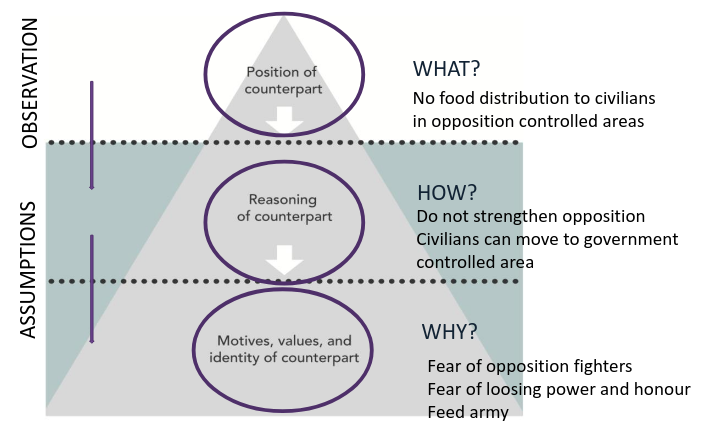 Maybe if we try to favour their why (e.g. trying to be recognised as an authority) we can influence them. It’s not about manipulating or having a hidden agenda, that can destroy negotiation. Going below the surface is important to uncover assumptions and values driving decisions.
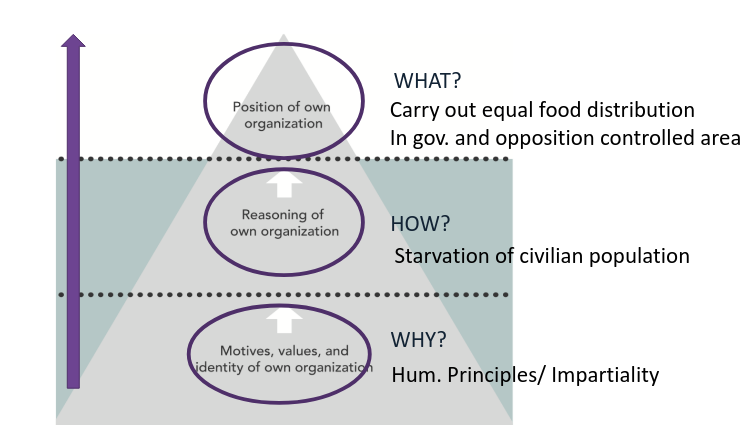
Common shared space
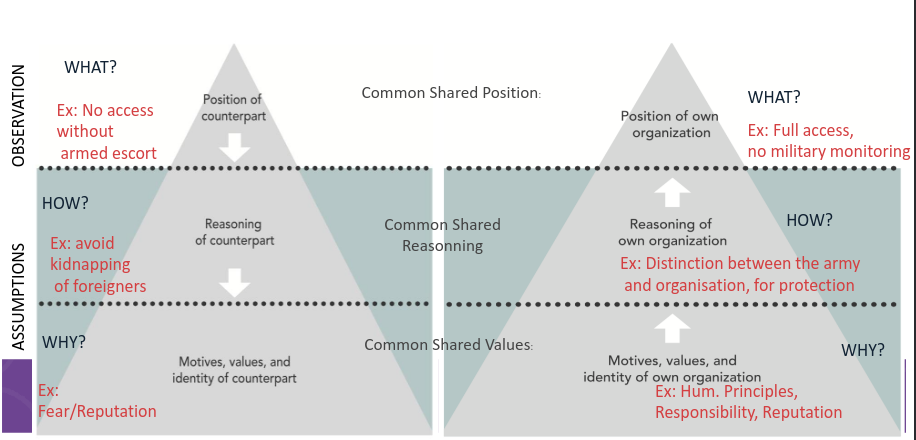 Here there are common spaces, basically the objective is to prevent actors from being assimilated to combatants (e.g. because they are accompanied by them) and harmed.
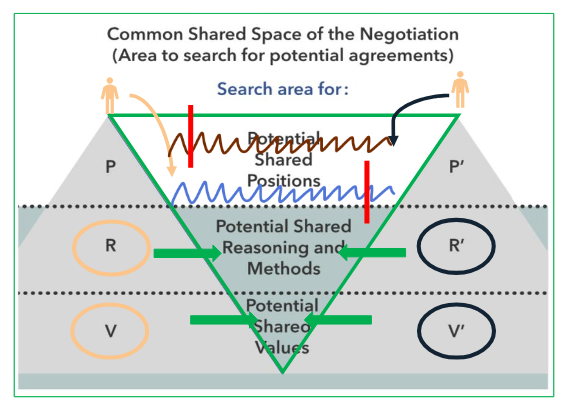 Basically there is a space between red lines of actors because there are also shared values and reasoning. As such there is a potential for shared solutions like escorts dressed as civilians so as to not alter perception of humanitarian actors and have them harmed. If there is no solution there will be no access, we will stay stuck so it’s important to find a proper solution. You can also openly denounce on the media the lack of flexibility if you are desperate if you can’t find any type of agreement even trough influence networks. You’ll probably fully lose access then.