A Swiss perspective
The Multilateral Trading System
From GATT to WTO: why the multilateral system was built
GATT creates basic trade rules after WWII (1947)
Some countries come together to lower tariffs without implementing a third institution for trade. Negotiating rounds brought tariffs down (General Agreements on Tariffs and Trade). This was to create a win-win situation and not provoke neighbours.
Uruguay Round expands scope (services, IP) (1986-94)
Lasted almost 8 years, this round created protection of intellectual and international property.
WTO founded : global institution for trade governance (1995)
98% of world trade is under WTO observation.
Reform efforts to adapt to new realities (digital, climate, security) (2025+?)
Disputes between USA and China, CH launched joint statements with other countries in favour of WTO reforms. New tech has to be implemented (AI, etc…) as well as online purchases control and many more.
Who’s in this trade ecosystem?
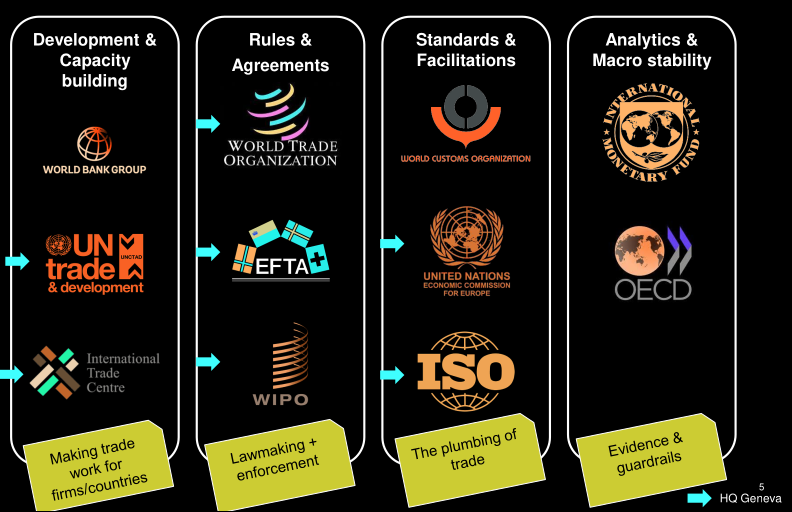 The WB and UNCTAD are here to help countries develop and build capacity, a certain part of the WB helped underdeveloped countries access global trade between 2006-22. 100 Bill $ allocated for this mandate. UNCTAD made a 170 member conference chaired by CH to help countries digitalise their custom systems.
WTO does hard law, EFTA is a free-trade agreement to complement WTO rules and WIPO is limited to intellectual property in some areas.
Standards are the plumbing of trade, WCO defines standards for tariffs. E.g. ISO, ECE…
Analytics such as those of IMF and OECD give evidence and guardrails that avoid friction and serve as analytical macro tools.
What the WTO actually does
Coverage (until recently…)
→ 166 Members accounting for 98% of world trade (Doubled since creation, to join you need some time to prove you are a market economy, etc…). → Over 70% of merchandise trade still under MFN!
Basic principles
- Law as a basis for regulating commercial relations.
- Most favoured nation clause (MFN).
- Proportionality, National Treatment (NT).
- Transparency.
- In-depth analysis of members trade policies by other countries, which creates trust (they ask questions f.ex.).
- Binding dispute settlement.
- Member driven / 1 Member = 1 voice / Decisions by consensus
- Organisation isn’t autonomous.
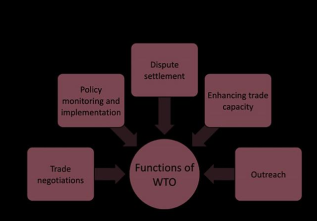
- Organisation isn’t autonomous.
Switzerland in the Global Economy (Why the MTS matters)
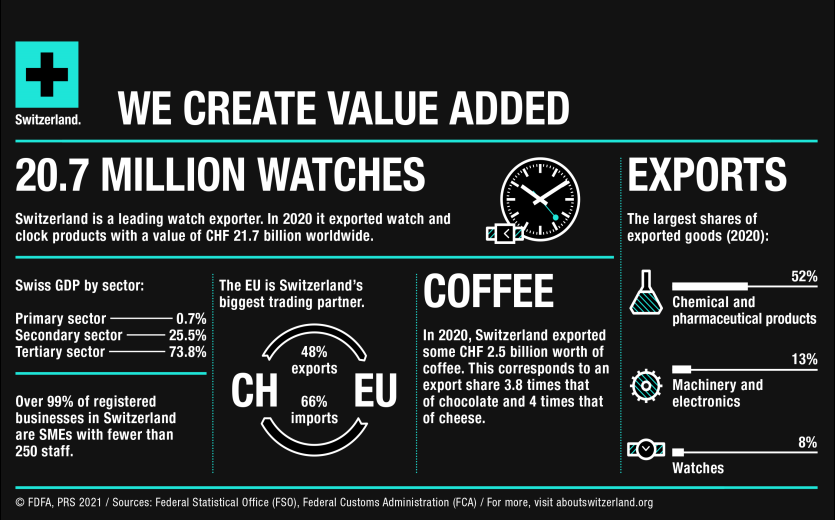
- Watch exports.
- Coffee.
- Trade with EU (important despite trade balance).
- But we are very different.
- We have good contacts though, almost as if we were a member.
- Being in a group can help overcome certain challenges.
- Important tertiary sectors.
- Small businesses.
- Switzerland is a brand, adds value. It offsets the high priced economy that augments our prices relative to foreign goods.
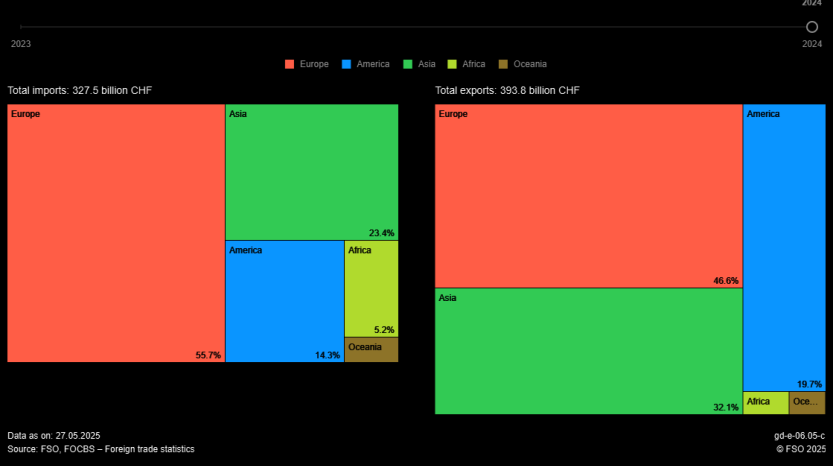 Main market is Europe, we always have a trade surplus we are an exporting economy (~70% of GDP). Trading worldwide isn’t as easy as with Europe, specially right now.
Swiss Foreign Economic Policy
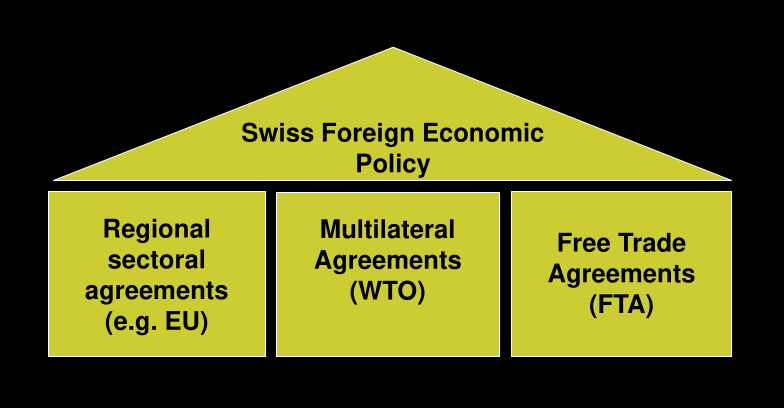 Our policy rests on the EU (food for example, these programmes are updatable a system exists), WTO (cornerstone of economic basis and of norms) and FTA (recently Mercosur and India) mainly.
Switzerland and the WTO
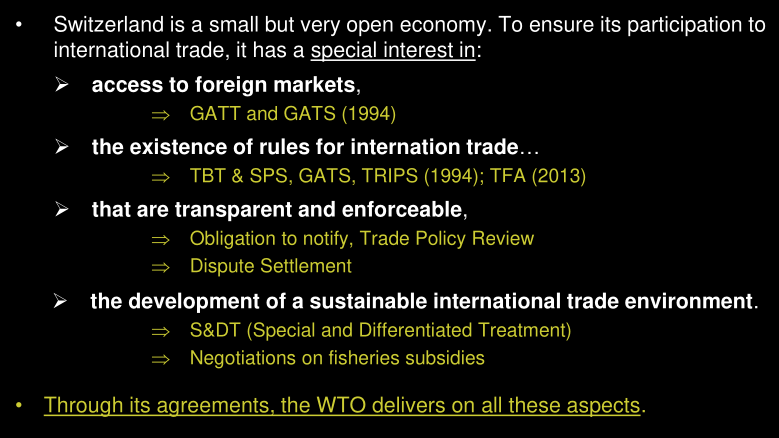
Inside the Swiss Mission
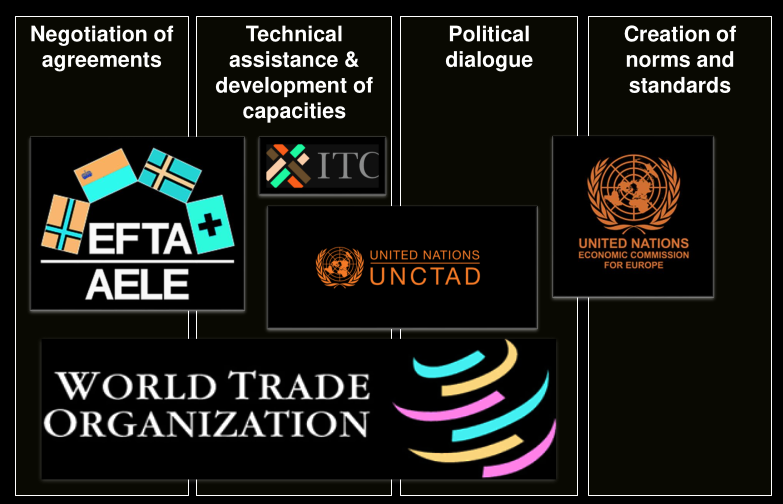
Organisations covered by the Missions
Principles of foreign economic policy
The foreign economic policy pursues Switzerland’s interests, prioritises multilateralism and organises free trade in an open and regulated manner.
- Focusing on Switzerland’s interests.
- Remaining sovereign, which nowadays doesn’t only entail keeping borders closed but constantly negotiating.
- Actively shaping multilateralism.
- Opening up and regulating foreign trade.
Free trade partners of Switzerland
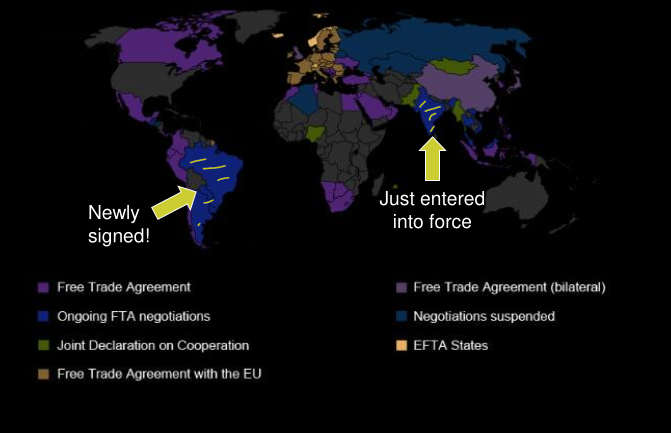 New agreements as with India, an immense investment in India and an FTA which even the EU hasn’t concluded. If numbers on investment aren’t reached, retaliation against CH→challenge.
Also agreements with Mercosur.
The WTO at a crossroads
A fragmented global economy.
Current Challenges in the Multilateral Trading System
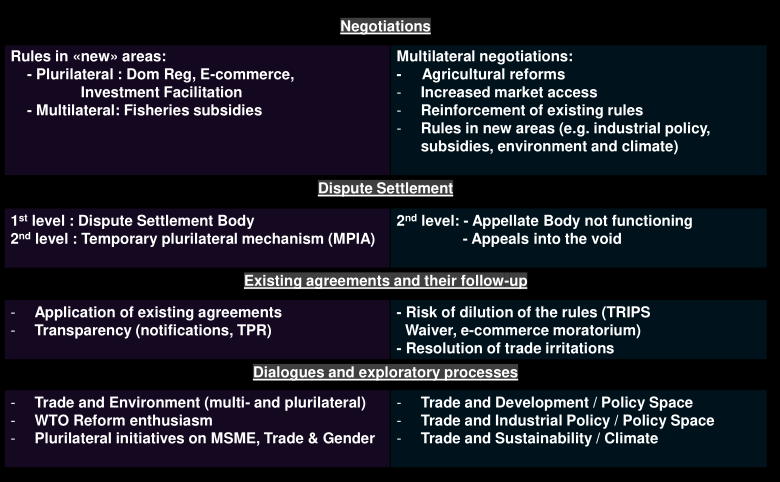
- Dispute settlement: Appellate Body still inactive → legal uncertainty; Plan B: MPIA (Multi-Party Interim Appeal Arbitration Arrangement).
- Acceptance of a second arbitration body for those that want to use it.
- MFN under strain due to sweeping U.S. tariffs and their countermeasures by other Members.
- Plurilateral fragmentation: separate deals risk sidelining full membership.
- If we deal on the sideline of WTO we take risks. Deals would need to be approved by everyone though…
- Climate & industrial policy spill-over: CBAM, subsidies, “green” trade wars.
- High obstacle to the enter the market, ecological reasoning.
- Digital trade & e-commerce: moratorium expiring → talks heating up.
- Need to extend the conference, if not mandate expires in 2026.
- Trade & security nexus: export controls, dual-use goods, supply chain decoupling.
- A connection, like with China.
- Development: SDT, policy space, capacity building, graduation.
What works/doesn’t
How does Switzerland engage in the WTO
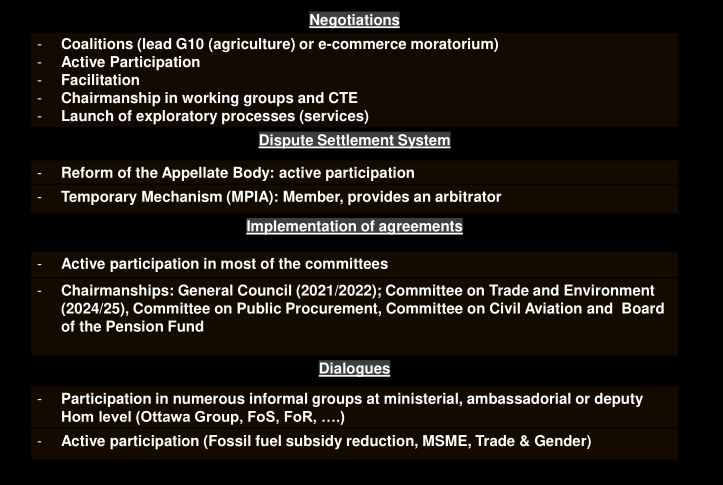 In a coalition of agriculture importing members. Participates in informal groups such as ambassador breakfasts to exchange opinion on issues (a big part of WTO is informal). Exchanges can often be non-interactive, just reading statements.
Case study: The FIT Partnership
Switzerland reacts and mitigates. An example of negotiation outside of the WTO.
Future of Investment and Trade (FIT) Partnership
- Launched on 16 September 2025 by 14 small and medium-sized economies (including Switzerland, Singapore, New Zealand, UAE, Chile, Costa Rica, Rwanda, etc.).
- They didn’t like where the WTO was moving.
- Informal, non-binding platform, not a free trade agreement and not a WTO coalition.
- Objective: give smaller open economies more voice and influence on trade and investment issues, and prototype solutions to current challenges (supply-chain resilience, digital trade, investment facilitation, non-tariff barriers).
- Come up with best practices and maybe apply them in the WTO in the wider community likes them.
- Present papers f.ex.
What does the FIT Partnership do
- Give greater weight to the trade policy concerns of small and medium-sized countries with an international focus;
- Launch thematic initiatives to find joint solutions to challenges in international trade;
- Create a platform for exchange between open economies to discuss trade and investment issues informally, in a solution-oriented manner and outside existing structures;
- Build new alliances to jointly address trade policy uncertainty;
- Promote exchange with private stakeholders and involve them more closely in finding solutions.