Interest Groups
What is the most important factor for explaining political outcomes?
- Last weeks: elections → parties, electoral rules, government systems.
- An alternative view: it does not matter who governs.
- Comes in two flavours:
- It does not make a difference anymore, because of external constraints (globalisation, European integration) → There is no alternative (M. Thatcher / A. Merkel).
- It never really made a difference → Hacker/Pierson.
Hacker/Pierson
Starting point: increases in inequality are concentrated at the very top.
- This needs to be explained politically since other countries do not follow the same trend.
- Yet, it cannot be explained by a median voter model.
- Even if we take into account unequal turnout etc., this cannot be a vote winner: large majority of voters should oppose this.
- Also, it cannot be explained by government partisanship: it happened under both parties.
Politics as organised combat
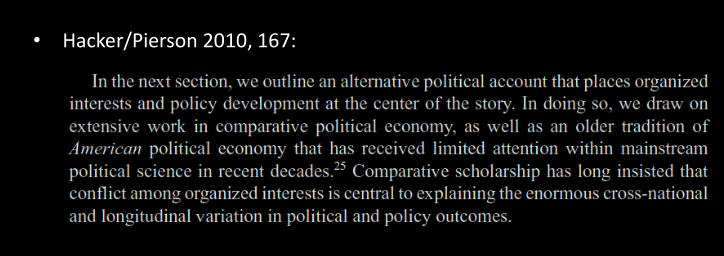
Electoral spectacle vs organised combat
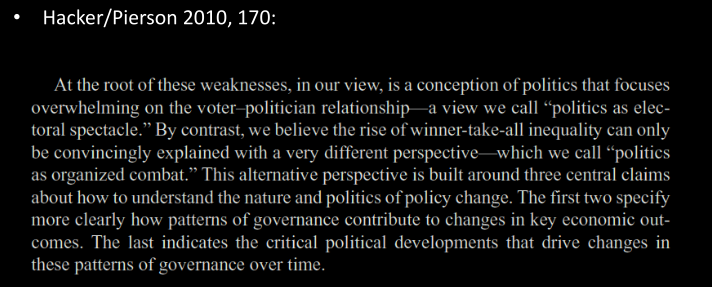
Policymaking requires organisation
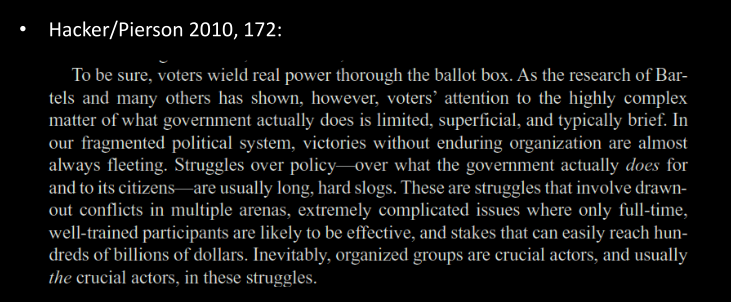
Skillful politicians balance the two views
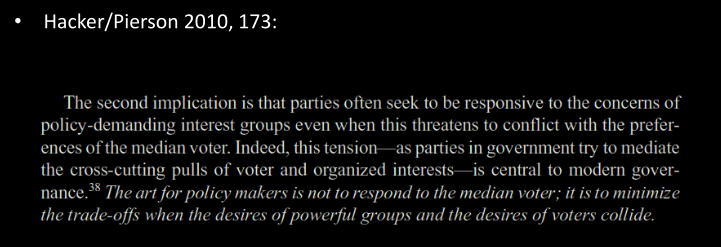
A related distinction
Culpepper distinguishes between noisy and quiet politics:
- Noisy: voters involved, high media attention, salient, mass politics.
- Quiet: voters not involved, little media attention, realm of experts, interest group politics.
Defining interest groups
Membership organisations that appeal to government but do not participate in elections (Erne, p. 253).
- This is a relatively narrow definition: Social movements often do not have formal membership. What makes you a “member of Fridays for Future?
- Members don’t have to be individuals: e.g. business associations.
Examples of interest groups
- Advocacy groups (the National Rifle Association, Pro Velo Suisse) Churches
- NGOs (Amnesty International)
- Sports federations (FIFA)
- … If Nestlé has a lobbying office in Brussels, that is technically not an interest group (not membership organisation). Yet, since firms don’t vote, their political activities are typically included here.
The most important actors in organised combat
Business associations
- Employer organisations: collective bargaining with employees
- Interest representation/lobbying organisations (Pierson/Hacker mention: The Chamber of Commerce, National Federation of Independent Business, Business Roundtable, National Association of Manufacturers (p. 176).
Trade unions
- Typically organised by industry (e.g. Syndicat du personnel des transports, Association du personnel de la Confédération, etc.).
- Sometimes other divisions, e.g.: Christian unions, communist unions…
Effects of interest groups
To explain differences between countries, it is necessary to think about differences in interest group strength. Example: Why do some countries redistribute more than others?
- Party argument: because they more often had left wing governments (e.g. because of proportional representation).
- Interest group argument: because of stronger trade unions, because of weaker business interests, because of the way government interacts with interest groups…
Two models of interest group relationships
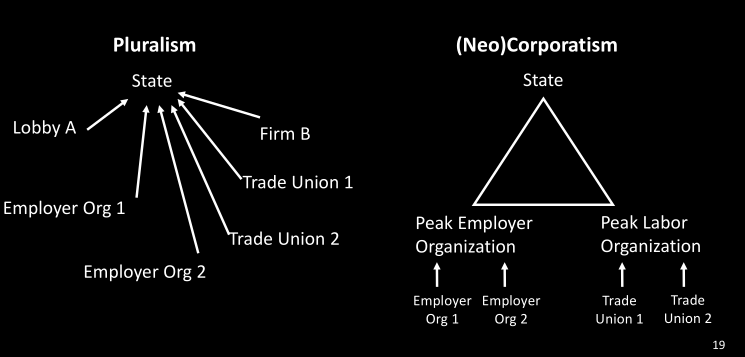
Corporatism in practice
Social pacts: An agreement between the government, trade unions and employer organisations that coordinates the government’s economic policy with the outcome of collective bargaining.
- E.g.: To fight inflation, trade unions agree to slower wage growth, employers promise new investment and the government reduces value-added taxes.
Without institutionalisation of communications this is not possible, e.g. USA. In CH we can though.
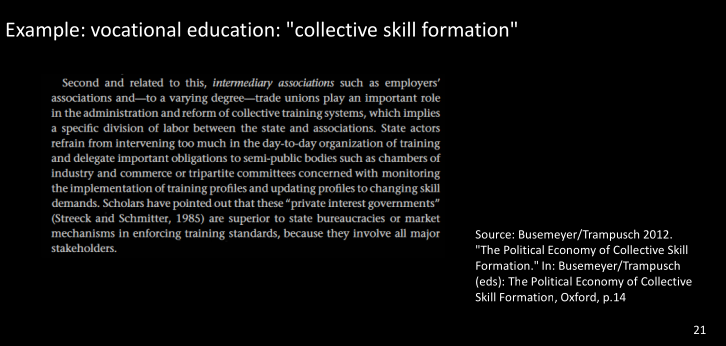
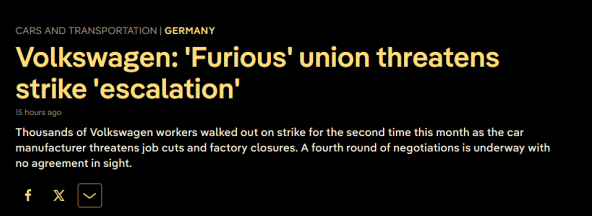
Doesn’t mean there is no conflict
Where interest groups and electoral politics meet
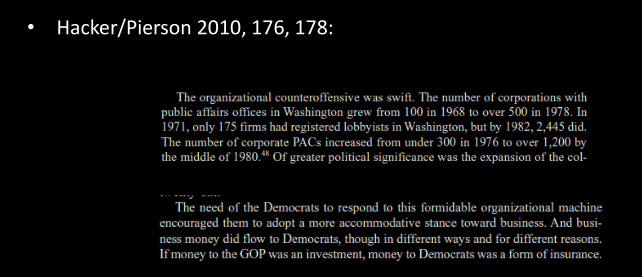
- Interest groups also seek to affect electoral politics, e.g. with campaign contributions, by endorsing candidates etc. (Pierson and Hacker acknowledge this.)
- More importantly, mass membership organisations (unions) mobilise their members and affect their political preferences.
- Higher turnout of union members.
- Stronger welfare state support of union members.
- Union members vote left more often.
- Problem of endogeneity though, left-leaning people join unions, but research tries to get through this and proves it. Some do.
Two forms of business power : Instrumental power
- Not related to the specific activities of the firm: Every firm has in principle the same tools available.
- Lobbying.
- Instruments:
- Campaign contributions.
- Revolving door.
- Providing governments and parliaments with information.
- Public relations campaigns.
- …
Instrumental Power
Structural power
- Definition: power that is related to the core functions of the firm (Culpepper/Reinke. 2014. Structural Power and Bank Bailouts in the United Kingdom and the United States. Politics & Society 42/4)
- Examples:
- A bank or insurance company sells government bonds of a country.
- A car company cancels the plan to invest in a new factory.
- An airline stops serving the airport of a major city.
Effects of Structural Power
An empirical pattern that can be explained with reference to structural power is the comparative generosity of bank bailout packages after the Great Financial Crisis. Comparing the US and the UK, one can see that British banks received a “better” deal in two aspects. … British banks drove a better bargain because they are structurally more independent from the British market. This becomes clear by comparing two relatively “healthy” banks. HSBC is a British bank which generates only 1/5 of its revenue in the UK (ibid., 438). Wells Fargo on the other hand is a US bank that makes most of its profits in the US. Therefore, Wells Fargo was dependent on the US market, rendering them less powerful vis-à-vis the US government.
If a business if very central to the economy it also works that way (e.g. Credit Suisse rescue in CH).
Challenges of mobilisation
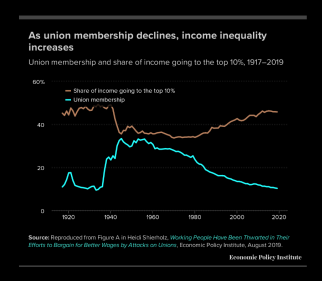
If trade unions are so effective, why has their membership declined so much?
Mancur Olson, 1965
- Rational choice argument: when is it individually rational to contribute to a public good?
- When the individual payoff from contributing is bigger than the individual cost.
- Public good provision permanently threatened by free-riding.
- Interest organisations provide public goods for their members (e.g., if a trade union bargains for a pay rise, it usually applies to all workers, also to non-union members.).
Olson’s prediction
It is much easier to organise few actors with an intense shared interest, than many actors with a marginal shared interest:
- Easier to organise firms than their workers.
- Easier to organise producers (e.g. farmers) than consumers.
- Easier to organise beneficiaries of protectionism than beneficiaries of free trade.
- Easier to organise polluters than those want a clean environment.
- But: This should explain levels, not necessary change in mobilisation. Why did it decline?
Mobilisation, old and new
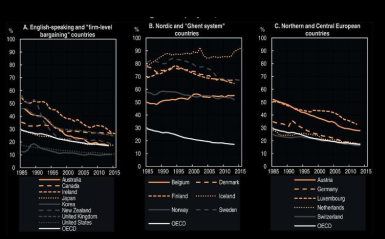
- Decline of union membership in most countries since 1980.
- Reasons:
- Legislation, court rulings.
- Structural changes in the economy.
- Exception:
- Ghent system: Unemployment insurance depends on union membership.
- Quintessential selective benefit.
- Why is it more difficult to mobilise the new working class?
- The ideal place to mobilise for unions is the factory.
- Service sector differs:
- Less stable working relationships.
- Work organisation: no stable groups.
- No stable milieus.
- Service sector differs: