Social Cleavages
Parties again
- In session 10, we talked about the role and the different types of parties, focusing on party organisations.
- Today, we will focus on parties’ ideologies. Which party families have developed in Europe and whom do they represent?
- To do so, we will develop a structuralist perspective on party systems. In this view, political conflict is structured by a limited set of dividing lines.
- This also means that we will not look at the role of candidates, campaigns, the media…
The formation of European party systems
- Starting observation: In the late 19th century, the parties that compete for votes in European countries become surprisingly similar and remain so for most of the 20th century.
- the period from 1850 to 1885 is one of fundamental homogenisation of electoral politics (Caramani, D. 2015. The Europeanisation of Politics. The Formation of a European Electorate and Party System in Historical Perspective. Cambridge).
- How can we explain that very similar parties emerge across very different countries?
- Why does that European party system then become frozen (Lipset/Rokkan)?
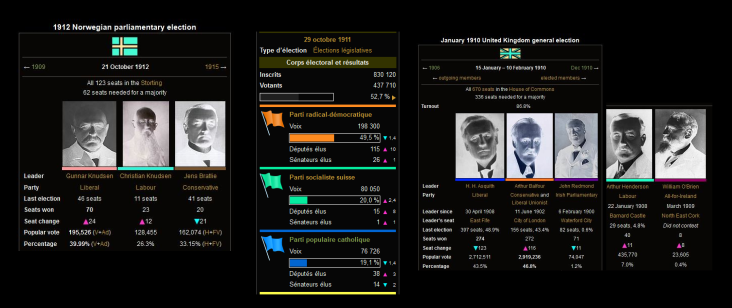 Same cleavages?
A definition of cleavages
The term cleavage identifies social and political divisions characterised by a close connection between individuals’ positioning in the social stratification system, their beliefs and normative orientations, and their behavioural patterns. This close connection contributes to the resilience and stability of cleavages over time.
Where do cleavages come from?
- According to Lipset/Rokkan, cleavages emerge in response to major societal transformations.
- In the 19th century, there were two such transformations: the national revolution and the industrial revolution.
The national revolution
- Unification: Italy (1861), Germany (1871).
- Creation of nation states: Switzerland, South-Eastern Europe.
- Homogenisation of existing states: France, United Kingdom, Russia. Massimo d’Azeglio: „We have made Italy, now lets make Italians“.
What does the national revolution entail?
Cultural homogenisation
- Language: Domination of a high national language, decline of dialects.
- Narratives of a national history; symbols: flags, anthems, monuments.
- National holidays also…
Economic homogenisation
- Erasure of tariff barriers, creation of national markets.
- Introduction of national tax systems, currency, etc.
Legal homogenisation
- Harmonisation of laws; constitutions.
The state-church cleavage
Matters of conflict
- Separation of church and state.
- Who controls education? Religious schools or public schools?
- The Church was the main educator before this revolution.
- Who controls family policies? E.g. is marriage a civil or a religious institution?.
- Now you don’t have to go to church to get married.
Where does it exist?
- Mainly in Catholic countries or countries with a strong Catholic minority.
- In Protestant countries, the church is controlled by the state (e.g., the British King is the head of the Church of England).
- Some people like dukes adopted Protestantism as it allowed the state to control the church.
Parties representing the state-church cleavage
- Historically: Catholic parties.
- Center party (Germany), Unione Elettorale Cattolica Italiana, Christian Social Party (Austria).
- After World War II: Christian Democracy.
- Christian Democratic Union (Germany), Austrian People’s Party (Austria), Christian Democratic Appeal (Netherlands), Democrazia Cristiana (Italy).
- Switzerland
- 1894-1912 : Parti populaire catholique.
- 1912-1957 : Parti conservateur populaire.
- 1957-1970 : Parti conservateur chrétien-social.
- 1970-2020 : Parti démocrate-chrétien.
- Since 2021: Le Centre.
The center-periphery cleavage
Matters of conflict:
- Centralisation of the state.
- Cultural homogeneisation.
- Minorities mobilised against the state majority.
Where does it exist?
- In countries with strong ethnic, linguistic or confessional minorities.
- In countries in which the national state emerged late (Germany, Italy, Austria-Hungary).
- Homogenous countries not really concerned.
Parties representing the center-periphery cleavage
- Historically: Regionalist or separatist parties.
- Polish and Bavarian parties in Germany.
- Irish parties in the UK.
- Today: Regionalist parties
- The Scottish Nationalist Party (SNP), Welsh and Northern Irish Parties.
- Catalan, Basque and other regionalist parties in Spain.
- The Bavarian Christian Socialists in Germany (CSU).
- (The Lega Nord).
- The Lega dei Ticinesi.
- Bloc Québécois.
The industrial revolution
- First period of sustained economic growth.
- Massive urbanisation.
- Dominance of wage labor.
- Inequality, poverty.
- Child labor, long working hours, bad working conditions.
The class cleavage
Matters of conflict:
- Economic redistribution: taxation, social policies.
- Ownership of the means of production.
- Regulation of working hours, working conditions etc.
- Before it wasn’t only welfare state policies that were important, but getting basic regulation.
- Democratisation (universal suffrage).
Where does it exist?
- Everywhere.
Parties representing the class cleavage
- Originally: socialist parties.
- The question of revolution or reform.
- Social Democracy (reformist).
- PS/SP, SPD, SPÖ, Labour, Parti socialiste, Sveriges socialdemokratiska arbetareparti.
- Communist Parties
- Parti Communiste Français, Partito Communista Italiano, Kommunistische Partei Deutschlands (before 1933).
Truly everywhere?
- Werner Sombart, 1906: Why is there no Socialism in the United States?
- Higher real wages, higher standard of living of American workers.
- Less workers.
- Better outside options (the frontier).
- The west like California.
- Electoral system prevents emergence of new party.
- Racism?
- Whites don’t want an alliance with black workers.
- Higher real wages, higher standard of living of American workers.
- But: The New Deal Coalition.
- Party competition after 1932 has a distinct capital-labor structure.
- Democrats as functional USA version of European social-democrat parties.
- Party competition after 1932 has a distinct capital-labor structure.
The urban-rural cleavage
Matters of conflict:
- The price of bread: cheap food for cities or higher incomes for farmers/rural elites.
- Free trade/tariffs: protection of rural interests or cheap imports, mainly from the US?
Institutional basis: majoritarian electoral systems.
- MPs representing urban or rural constituencies.
Where does it exist?
- In many countries, the relevant interests had been mobilised before by conservatives (rural) or liberal/socialists (urban).
- Often no new parties though.
- Still, affects trade policies everywhere (UK: corn laws, Germany: coalition of rye and iron).
Parties representing the urban-rural cleavage
- Historically: Farmers parties
- Farmers parties in the Nordic countries.
- Party of Farmers, Traders and Independents (SUI).
- Today: Green parties as urban parties? Radical right parties as rural parties?
- The SVP/UDC→used to be farmer’s party.
- BoerBurgerBeweging (NED).
Relationship between cleavages
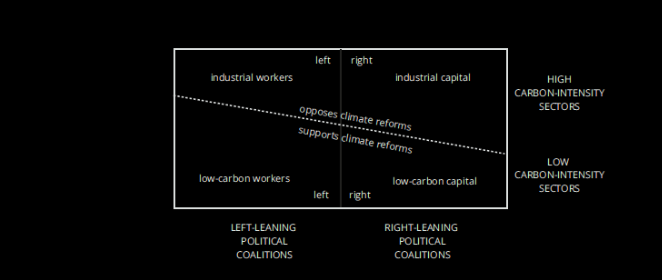
As seen in Séance 5-Les clivages. Cleavages can be reinforcing or cross-cutting.
Reinforcing
When positions one cleavage are parallel to positions on another cleavage:
- When the center is industrial and the periphery is rural.
- When the center is Protestant and the periphery is Catholic.
- When capitalists are from the center and the working class is from the periphery.
Cross-cutting
- When positions on one cleavage are distinct from positions on another cleavage. Examples:
- When parts of the working class are Catholic.
- When the periphery is economically more developed.
- A voter who is part of two cross-cutting cleavages (e.g. a Catholic worker) is cross-pressured.
Three dimensions of a cleavage
Recall the definition: … social and political divisions characterised by a close connection between individuals’ positioning in the social stratification system, their beliefs and normative orientations, and their behavioural patterns.
- A structural dimension.
- An identity dimension.
- An organisational dimension. On the height of the class cleavage, workers voted for working class parties (structural), voted as workers (identity), and were mobilised as workers (organisational).
The structural dimension
- An objective conflict of interest regarding a politically highly relevant question.
- Question: does an objective factor (income, place of residence, age, gender…) predict where someone stands on an issue?
- E.g.: Urban dwellers benefit from lower food prices, rural dwellers from higher food prices → each group shares a structural interest.
The identity dimension
- A perception of in-group membership and out-group demarcation as an important part of people’s social identity.
- Closed milieus, e.g. marriage only within one’s social group (class or confession).
- Example: class consciousness.
The organisational dimension
- Parties present themselves as representatives of social groups (the mass party). Election campaigns are more about mobilising existing supporters than about winning new ones.
- Civil society associations underpin political alignments (trade unions, churches, farmers’ cooperatives…).
- Encapsulation of voters.
- Strongest example: Pillarisation („Verzuiling“) in the Netherlands until 1970s.
- Protestant, Catholic, National-Liberal-Secular Pillar.
- Own schools, unions, radios, newspapers, sports clubs… (Lipset/Rokkan, p. 103).
New cleavages
- Why are we interested in all of this?
- What does this still have to tell us?
- Can we use cleavage analysis as a theoretical lens to analyse contemporary party formation and voting behaviour?
- On globalisation:
- Structurally the more educated you are the more of a winner you are (languages, college, etc…).
- Also some old cleavages repeat themselves here, e.g. if you old shares of a company they are winners.
- Cities.
- Identity wise they see the world differently.
- Cosmopolitan, internationalist, inclusive.
- Organisationally:
- The liberals.
- Structurally the more educated you are the more of a winner you are (languages, college, etc…).
The new cultural line of conflict
- Different labels
- Materialist-postmaterialist (Inglehart 1977).
- Libertarian-authoritarian (Kitschelt 1994, Flanagan/Lee 2003).
- Green/alternative/libertarian vs. traditionalist/authoritarian/nationalist (GAL-TAN, Hooghe, Marks, Wilson 2002).
- Integration-Demarcation (Bartolini 2005, Kriesi et al. 2008).
- Cosmopolitan-communitarian (de Wilde et al. 2019, Strijbis et al. 2018).
- Universalistic-particularistic (Häusermann/Kriesi 2015).
- But same basic idea: a cultural divide between embracing openness and preserving tradition.
New cleavages
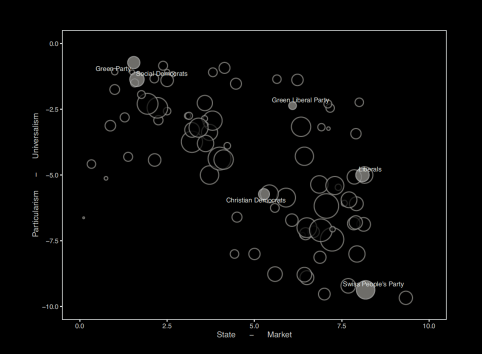 Cross-cutting cases addressed by parties such as the green liberals. Clearly positioned parties are challengers to those that haven’t positioned themselves as clearly. Structurally you can look at people and predict their vote to a certain extent (against median voter theorem). When a new divide emerges existing voter base gets confused.
Is this a cleavage?
We can use the earlier analysis as a checklist. Does it have:
- A structural dimension?
- An identity dimension?
- An organisational dimension?
- Most contested. No globalisation party.