Veto players
Definition veto players
- Formally, every actor whose agreement is required for moving forward with a political decision is a veto player.
- Politically, veto players only matter to the outcome of a political process if they are not absorbed by other veto players.
- If there are more than two veto players, those with the most extreme positions will be most relevant the outcome of political bargaining.
- Conceptually, the role of veto players is asymmetric: They can block political decisions, but they cannot make such decisions.
- In practice, second chambers or constitutional courts do also create laws or new constitutional rights. Even then, however, constitutional courts do not have a right of initiative.
- E.g.: US supreme court rules that banning abortion in the whole country is illegal and thereby legalises it.
- In practice, second chambers or constitutional courts do also create laws or new constitutional rights. Even then, however, constitutional courts do not have a right of initiative.
Main institutional sources of veto points
Federalism
Definition
- A division of power and authority between two different political decision-making units—a central one exercising jurisdiction over the entire nation-state and a constituent or regional one having responsibility for a part of that nation-state. These two governmental units would be recognised as having equal status in law, so that neither one could abolish or subordinate the other.
Examples and counterexamples
- Federalist countries:
- Switzerland, Germany, Austria, USA, Canada, Brazil, Australia, Mexiko, India.
- Often, it is in the official country name: Bundesrepublik Deutschland, United States of America, República Federativa do Brasil, Confoederatio Helvetica But: Canada, Republik Österreich.
- Unitary countries: France, UK, Nordic countries, Eastern European Countries, Spain.
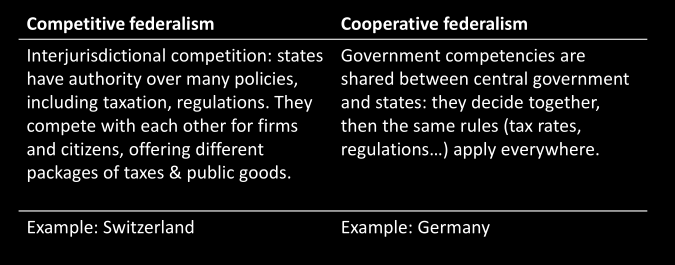
Different types of federalism
Consequences of federalism
- Strengths:
- Better representation of different interests.
- Decisions are made closer to the citizens, shorter lines of accountability.
- May lead to greater trust.
- Policy innovation: states as laboratories of democracies.
- Problems:
- Slow?
- Lack of accountability: who is responsible?
- Patchwork of rules.
- Race to the bottom?
Bicameralism
Related to, but not identical with federalism:
- Italy has a directly elected second chamber, but no federalism.
- In some federalist countries (US, Switzerland), the second chamber is directly elected.
- In others the second chamber represents state governments (Germany), state parliaments (Austria), or is appointed, not elected (Canada).
Definition
- The term ‘bicameralism’ refers to legislative institutions with two chambers sharing legislative powers. In bicameral assemblies, both first and second (or lower and upper) chambers play a role in consenting to proposed laws, although not necessarily equally.
- It results in veto players if those rooms are different, not if f.e they are elected by the people the same day.
Disproportionality of second chambers
- Second chambers often overrepresent small, rural states
- USA: 2 senators per state.
- Switzerland: 2 councilors per canton (1 for half cantons).
- Germany: biggest states have 6 votes, smallest states have 3 votes.
- This may happen when second chambers are directly elected (USA, Switzerland) or when their members are appointed by/represent, e.g., state governments (Germany).
Consequences of bicameralism
Depends on two factors:
- (roughly) symmetric political powers: the second chamber needs to have real competencies.
- Incongruent principle of representation: If elected very similarly to the first chamber, second chamber tends to be absorbed (see above).
If symmetric but incongruent, it often gives veto power to specific, geographically clustered (rural/ethnic/religious) interests.
Referenda
- Regular referenda on nationwide level are a uniquely Swiss institution, although some countries require referenda for (rare) constitutional changes.
- Other countries mainly practice direct democracy on a municipal or state-level (very prominent in the USA).
- This veto player can introduce and also block.
Effects of referenda
- For our purposes, the most relevant effect is that it induces policymakers to build broad (oversized) coalitions.
- It is possible to run a parliamentary government on a single-seat minority, but such a government would be likely to lose many referenda…
- There is a discussion about turnout:
- Do referenda depress turnout in parliamentary elections?
- Is turnout more socially unequal in referenda?
- Our multilevel analysis of the 26 Swiss cantons challenges recent studies conducted for the U.S. states: In the Swiss context, where direct democracy is more important in the political process than the less salient parliamentary elections, greater use of direct democratic procedures is associated with a lower individual probability to participate in elections.
Supranational organisations
Today, many countries are included in a dense network of supranational organisations and treaties that impose obligations on them.
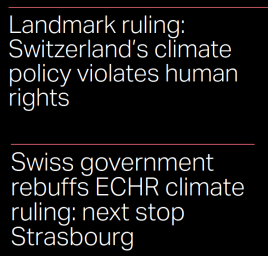
- European Convention on Human Rights.
- World Trade Organisation.
- Most importantly: the EU.
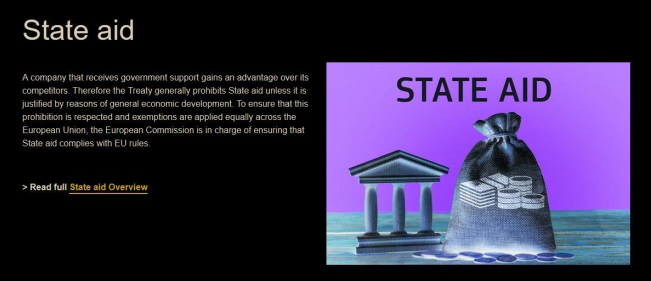
Example in te EU: State Aid
Veto players in the European Union
EU: extremely high density of veto players, typically not absorbed:
- Commission, parliament, council.
- Court of Justice.
- Council requires double majorities or even unanimity.
Courts
- At the center of many recent disputes:
- Poland and Hungary.
- USA.
- Israel.
- A general tendency towards a judicialisation of politics.
- Abortion in the US.
- Climate policies in Europe.
- Privacy and data protection.
- The Court of Justice of the EU.
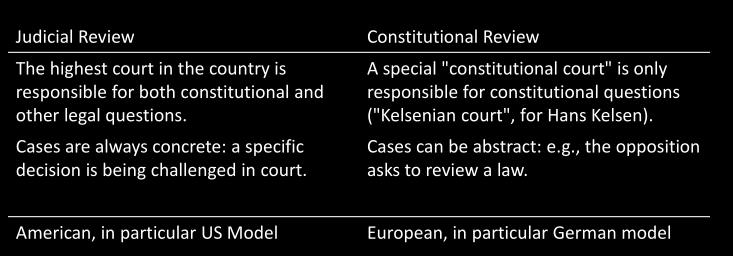
Judicial review
- Definition: The term judicial review refers to the practice of judges deciding whether or not to declare void a statute or an executive order on the grounds of conflict with a higher law.
- In other words, laws that pass parliament with a majority are declared unconstitutional.
Types of Judicial Review
The debate about the US supreme court and the need to understand veto players in context
I would submit that a very powerful Supreme Court with the power to nullify laws for unconstitutionality combined with a nearly impossible-to-amend constitution produces impossible pressures on the Court, pressures that push the institution to the breaking point with increases in political polarization. If the Supreme Court makes high-stakes decisions because that is its job and if political supermajorities (…) have nowhere to turn within the democratic system to alter Court decisions…, their only recourse is to put pressure the Court itself so that it will reverse its own rulings.
- Not sufficient to look at competencies of court, need also to consider competencies of other actors.
Scheppele’s advice
- To depoliticise the Supreme Court, think about changing other aspects of the political system as well!
- Compare the Swiss case: The initiative makes it very easy to change the constitution.
- By emphasizing the role of the Supreme Court in a constitutional system in Part I, I have argued that some of the most important changes you could consider might come from outside the direct constitutional and statutory regulation of the judiciary. … Such release valves would lower the stakes in the judicial nomination and confirmation process because the Supreme Court’s interpretation of the Constitution would not any longer be the primary roadblock in the way of modernizing it.
Doerfler and Moyn’s advice
Scheppele’s text is an expert report for a Presidential commission. Doerfler and Moyn’s is a political essay.
- Very different type of text.
- Two different strategies to control the power of the court:
- Judicial self-restraint: Accept wide leeway for elected policymakers. Problem Not institutionally stable, depends on will of judges.
- Weaken the institutional veto position of the court.
- Doerfler and Moyn, p. 9: An all-too-plausible pessimistic one involves the justices disregarding any inclination to “depoliticize” the court, with the spiral of partisan retribution continuing apace.
- The broader aim of advancing substantive reform within the country at large makes a much more pressing case for not merely capturing, but marginalising, the court.
- All the court can do, constitutionally speaking, is get out of the way (p. 10).
- But their argument is much less constitutional, much more overtly political.
Comparing the texts
Both arrive at similar conclusions about the need to weaken the position of the Supreme Court. However, the texts reveal a different democratic ideal:
- Scheppele wants to preserve strong checks and balances but sees the strong position of the Supreme Court as counterproductive because it politicises the court.
- Doerfler and Moyn see strong checks and balances fundamentally more critically and emphasise the majoritarian element of democracy.
Consequences of veto players
- Why are we lumping all these different types of actors together?
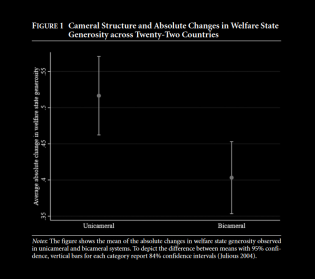
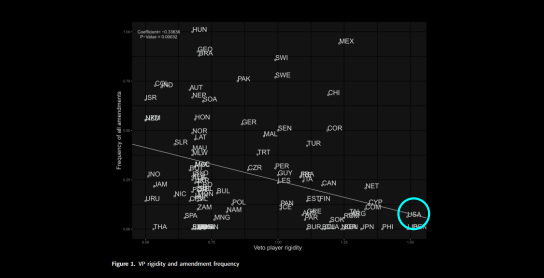
- They all have one fundamentally similar effect: making policy change more difficult.
- Veto players are said to increase policy stability.
Policy stability: examples
Prototypical case of unrestrained executives
United Kingdom:
- No Federalism.
- Weak, unelected second chamber.
- No/weak judicial review.
- Not a member of the European Union anymore.
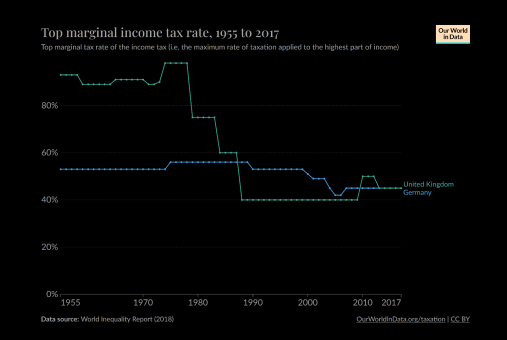
- “Elected dictatorship”, potential for strong policy reversals (e.g. Thatcher).
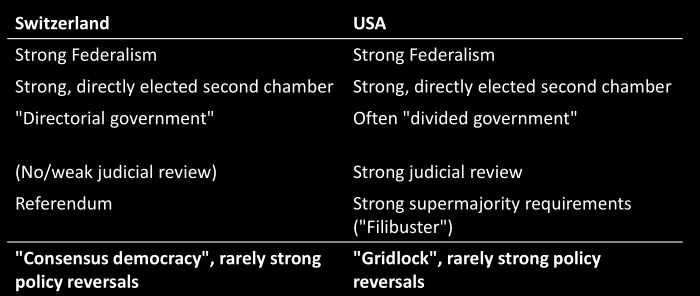
Prototypical cases of a restrained executive
Policy reversals: example