The Case of the Radical Right
In Western Europe
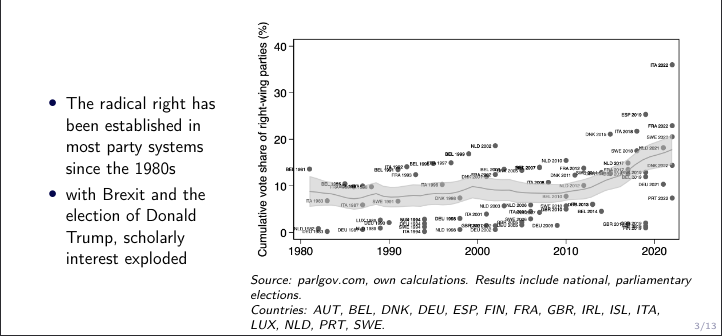
What are we talking about?
- Populism is a thin-centered ideology that considers society to be ultimately separated into two homogeneous and antagonistic groups, “the pure people” versus “the corrupt elite,” and which argues that politics should be an expression of the volonté générale (general will) of the people (Mudde 2007: 23).
- Jan-Werner Müller adds anti-pluralism: We – and only we – are the real people (Müller 2017).
- The “Populist Radical Right” (PRR) are primarily Radical Right (Mudde 2007: 26). They “fill” populism with nativism, defined as “an ideology, which holds that states should be inhabited exclusively by members of the native group (“the nation”) and that nonnative elements (persons and ideas) are fundamentally threatening to the homogenous nation-state. (ibid., 19).
How did we get here?
Cultural explanation
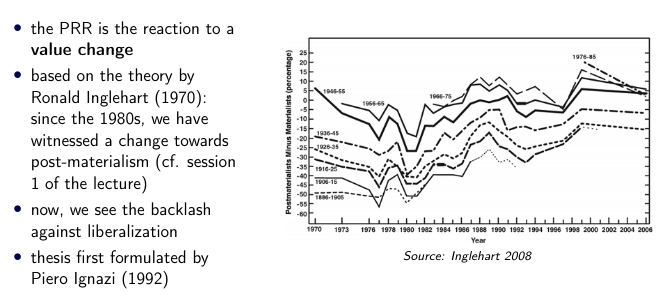
The argument by Norris & Inglehart
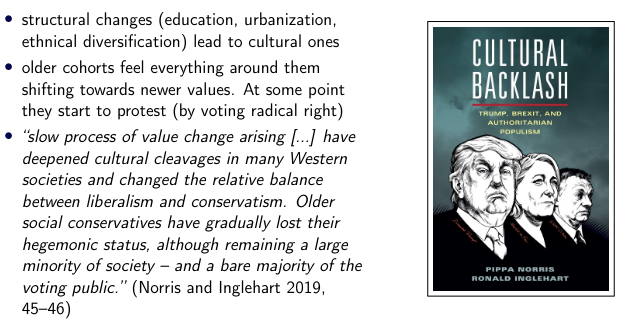
Schäfer 2023
What is the relationship between theoretical and empirical work for Norris and Inglehart?
Their theory says long-run liberalisation pushes older, more conservative cohorts toward authoritarian-populist parties once a “tipping point” is reached; empirically they try to show cohort gaps in values → “populist attitudes” → voting, using ESS/BES for people and CHES for parties.
How do they operationalise and measure their central concepts?
Generation (cohorts)
Four birth cohorts: Interwar (1900–45), Boomers (1946–64), Gen X (1965–79), Millennials (1980–96); used as categorical dummies in models. Schäfer notes the cut-offs aren’t well-justified cross-nationally.
Values and attitudes of people
- Values (authoritarian ↔ libertarian): From ESS Human Values (10 Schwartz items, 1–6). Factor analysis → two factors labelled “authoritarian” and “libertarian”; then z-transform (mean 0, sd 1) and sometimes rescale 0–100 for plots/regressions.
- “Populist attitudes” in ESS (proxy): Reverse the political trust items (trust in parliament, parties, politicians), sum, rescale to 0–100. Schäfer’s point: mistrust ≠ populism.
Position of parties
- CHES 2014 expert survey: 13 items → 7 for libertarian/authoritarian, 2 for populism (anti-elite rhetoric salience; importance of reducing corruption), 4 for economic left–right. Sum within each block and standardize to 0–100 (higher = more authoritarian / more populist / more economically right).
Schäfers critique
The z-scaling overstates polarisation; mistrust ≠ populism; cohort gaps are small; and when measured cleanly, older cohorts aren’t more populist and younger cohorts can be more likely to vote A-P, while anti-immigration attitudes—not generic “authoritarian values”—best predict A-P voting. Plus:
- Generations (ESS): cohorts from pooled rounds via birth-year bins. Cohort cut-offs are weakly justified cross-nationally.
- Values (ESS): Schwartz items → factors → z/0–100. Z-standardising can exaggerate “polarisation” vs raw scales.
- “Populist attitudes” (ESS): reversed political trust used as proxy. Mistrust ≠ populism; proxy is noisy vs direct BES populism scale.
- Parties (CHES): expert scores for authoritarianism & populism. Populism is thinly measured; mixing libertarian-populist with authoritarian-populist muddies tests.
- Vote outcome: N&I model A and P separately. Should test the combined A+P; when you do, cohort gaps are tiny and sometimes younger lean more A+P.
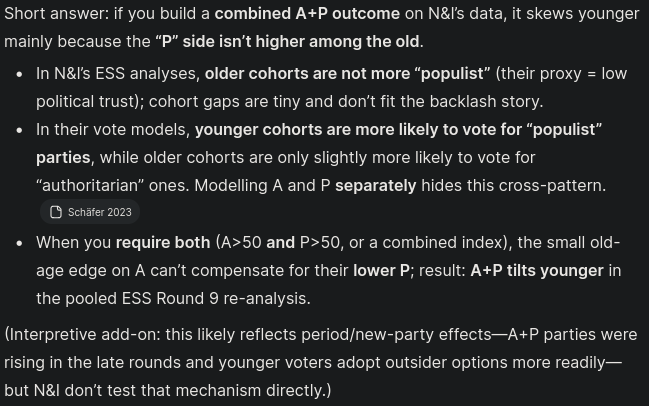
- Mechanism claim: values → populism → vote. The chain isn’t shown directly; opposition to immigration predicts A+P better than “generation.”
Economic explanation
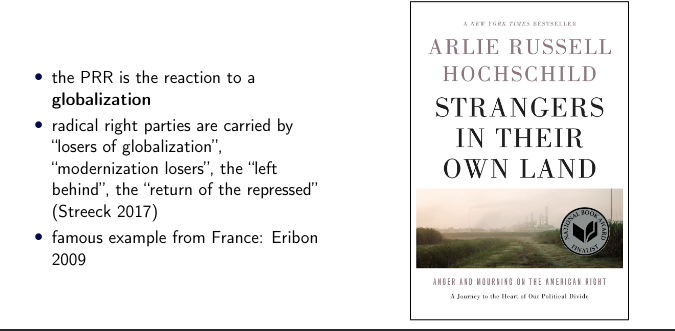
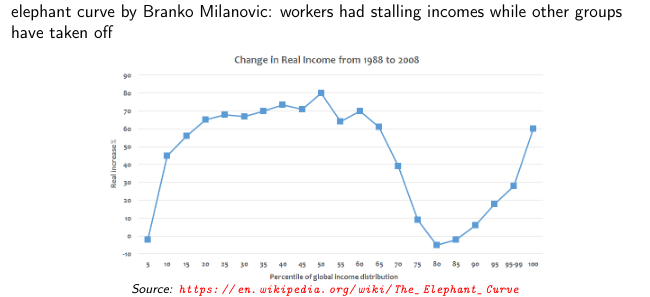
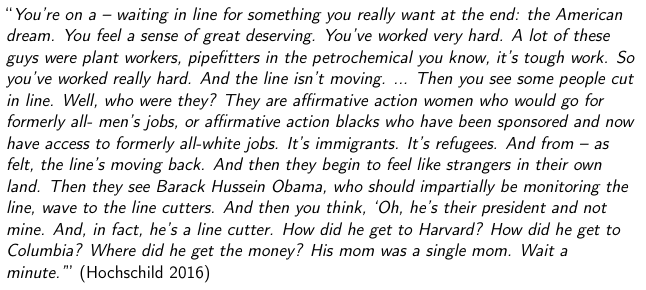
The Deep Story
Bhambra 2020
How does Hochschild develop her theory?
Inductively→from the empirics to the theory through an ethnographic research. Immersive ethnography in Louisiana (“super-South”), interviewing mostly white conservative/Tea-Party residents over several years. She builds an interpretive “deep story” to summarise how they feel politics works.
What is the evidence she uses to support her theory? How is her approach different from the one in Norris & Inglehart?
Interview narratives + observations from Louisiana (incl. “Cancer Alley”), organised through the deep story; it’s qualitative, place-based, and emotion-centred.
What does Bhambra criticize about Hochschild’s theory and evidence? What does she mean by “ethnographic charity”
- Talks to well-off people and not working class ones, using them to legitimise these political attitudes and votes (journalists often do it not her but this has to be noted).
- It’s not a loss of income but of privileges and makes it seem like they don’t have the right to equalise privileges. She doesn’t make this claim but puts forward others claims. The broader context isn’t mentioned.
- By only interviewing white people and putting their claims forward she legitimises them and creates a charitable attitude towards them.
Best approach is Hochschild with Bhambra blabla