Climate Change and Comparative Politics
Free-riding or distributional conflict
IR scholars explain that there is a lack of collective action and a free-riding problem→climate as a public good as seen in Environmental Economics.
Others put more emphasis on climate as a distributional conflict→who pays? People which jobs in dirty industries f.ex. could be more impacted.
Should states focus their efforts on international cooperation like the Paris accords or on domestic distributional struggles then?
Group work I: Finnegan 2023
What does it mean to view climate change mitigation as a policy investment? Alternative view?
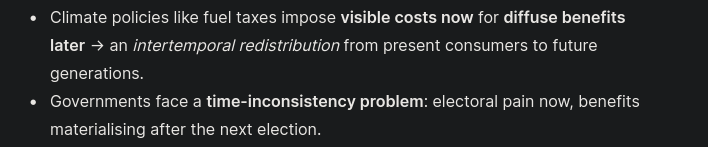 Alternative view in Mildenberg lecture.
Which dimension of the party system can explain climate change policy and how?
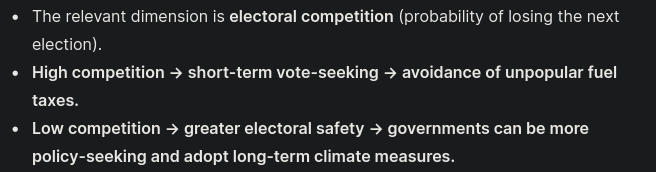 They can also decide based on what happened in the past (other policies and elections, but also the margin by which they won).
Can we identify institutional factors that contribute to this feature of the party system?
 Also, clearer distinction between opposition and government. So what about non-democratic regimes and their party? And centrist parties? And the HC where many parties know they are safe? The electoral system isn’t the only important part.
Also he assumes parties are environmentally friendly, not always the case.
He also measures fuel taxes which even if easy to operationalise and everyone perceives their effects is a very unidimensional view of climate policy.
What does policy-seeking mean in regards to high electoral safety and long term engagements? Do you think a conservative government would also be affected?
They might work for the environment, but using these taxes is unlikely for conservative governments.
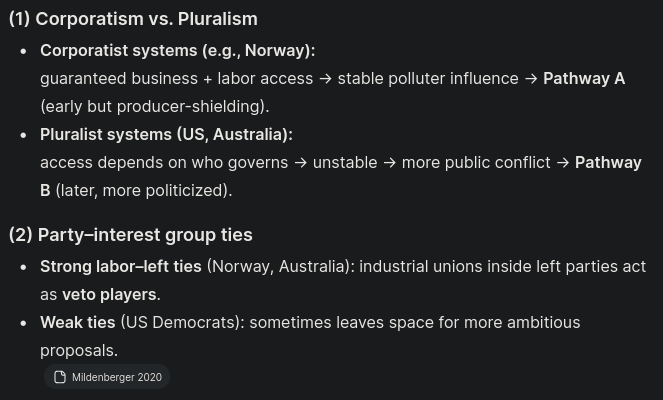
Group Work II : Mildenberger 2020
This text is better, less superficial and more explicative.
What does Mildenberger mean by “double representation” and why does it benefit polluters?
It’s not left vs. right, winners and losers are scattered between parties. There is cross-cutted. This doesn’t mean its 50/50 though. Since you need only one veto to not enact change the status quo is benefited by this. Probability of status-quo-keeping is increased as it’s more likely that someone against has power.
How does Mildenberger conceptualize the policy process?
Either you influence at first, the proposal, or later by creating social conflict. In the HC we have both. Basically when laws are influenced at first they pass more often.
What are the two institutional factors that he puts most weight on and how do these affect the outcome?