How to value the costs of climate change among others?
How to go about valuing nature? The beauty of a landscape, quality of water, etc… Pricing them would help us make decisions and find solutions when different parts of society want different things (preserve or use? f.ex.), so as to make everyone as happy as possible.
- How property rights and incentives—can help manage natural assets efficiently.
- Yet markets only function properly when the prices they reveal correspond to the value of what is being traded.
- Valuation provides that foundation: it estimates society’s willingness to pay for environmental goods and services when no explicit market exists.
- Like for the services trees provide, for which no market exists→therefore bad pricing for trees.
- Once these values are known, they guide the design of market instruments such as PES schemes or carbon credits.
How do we quantify nature’s contribution
- We know that ecosystems sustain life, productivity, and resilience — but how can we express this contribution in economic terms?
- Natural capital provides services that support welfare — clean air, water, soil fertility, climate regulation, recreation, biodiversity.
- Yet many of these benefits are non-market — they don’t appear in GDP or prices.
- Valuation translates these services into monetary terms that reflect their contribution to human well-being.
- Valuation connects ecology and economics — it tells us how much nature contributes to welfare and why it matters for policy.
- When markets begin to operate, the prices they generate become revealed valuations—real-world signals of scarcity and benefit.
- Valuation therefore closes the loop between theory and policy.
- it is how economists translate environmental change into measurable welfare change.
- We can make statements about the demand for environmental goods by either:
- construing a hypothetical market or
- using information from consumer behaviour on existing markets.
- The methods used for the former are called ‘stated preference’ methods.
- The methods used for the latter are called ‘revealed preference’ methods.
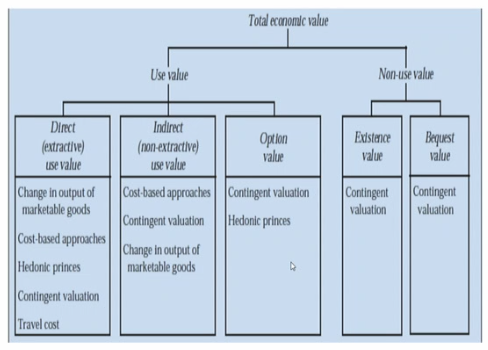
Global services global analysis?
- Costanza et al. 1997. The value of the world’s ecosystem services and natural capital. Nature 387: 253-260
- Estimated value of global ecosystem services of 18 trillion).
- Global GDP was approx $18 trillion at the time of the study… not consistent with the WTP idea.
- It seems like a budget constraint has been violated.
- Major problems:
- Confusion of marginal values and total values.
- Not a policy relevant or meaningful question.
Steps in valuation and decision making
- Identification of the alternatives.
- There has to be one at least. In the valuation of Costanza there isn’t.
- All Impact to be identified.
- Consequences of maintaining status quo Vs alternative(s). Public policy decisions involve making incremental, not revolutionary, changes to the status quo.
- Calculating the total value of ecosystem services, by contrast, is not very helpful.
Hedonic - the basic idea
- Revealed preference method.
- Observe behaviour in some other (closely related) market.
- Use that information to make inferences about market for environmental good.
- Typical example.
- Market for real estate: local environmental quality is a decision variable for consumers.
- Prices paid for real estate should incorporate information about the demand for environmental quality.
- Use real estate prices to make inferences about valuation of environmental quality.
- Observe prices of a uniform good for varying levels of the environmental good that is jointly consumed with the good.
- Examine link between variation in price of good with variation in environmental good.
Examples
- House prices at different levels of air pollution – Wages at different levels of risk.
- Establish marginal value (in money terms) of a change in the quantity of the environmental good.
The practice
- Deriving the demand for air quality from observations of price differentials.
- Challenge: Decomposing goods into different value components (Lancaster).
- Example: A house ‘is’ a bundle of
- number of rooms.
- Size of garden.
- Neighbourhood characteristics.
- Local environmental quality.
- Look at case study.
Air quality in Boston
- Seminal 1978 study of hedonic pricing by Harrison and Rubinfeld.
- What are the benefits of tightening NOx emission standards for car traffic?
- Benefit side of CBA.
- Estimate household MWTP for NOx reductions.
- Forecast distribution of NOx reductions across neighborhoods in the Boston area.
- Aggregate over neighbourhoods.
- Compute average WTP per household.
- Step 1: Decompose house prices
- 13 components
- Structural variables (number of rooms, garage,…).
- Neighbourhood variables (schools, crime rate,…).
- Location (access cost)
- Air quality.
- Explains the value of a house to consumers pretty well.
- 13 components
- Step 2: Determine marginal price of air quality
- Consider the air quality coefficient of the house valuation estimation.
- This gives for each level of NOx pollution the marginal EQL price for additional NOx.
- Denote this price with w.
- Note: This is the EQL price of NOx pollution.
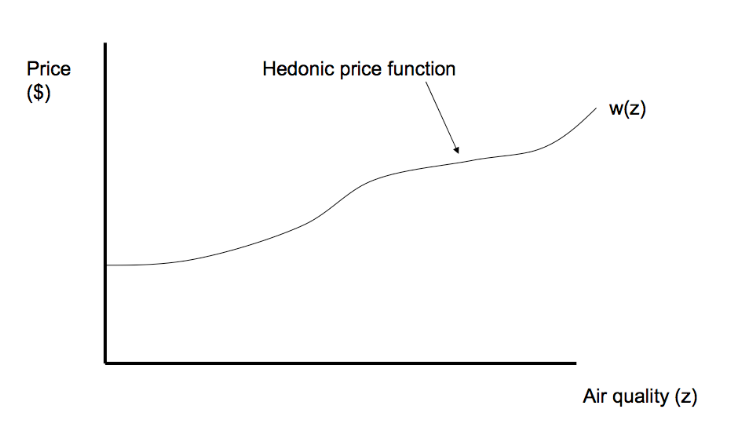
- Step 3: Estimate demand for NOx pollution
- Recovering demand curve from price is difficult
- So-called identification problem.
- Endogeneity of demand and supply.
- Solution:
- Extract a demand curve out of EQL prices.
- Explain marginal price of NOx as a function of income and pollution levels log(w)=α0 +αP log(P)+αY log(Y) with pollution level P and income Y.
Other applications
- Plant biomass is an increasing function of diversity (Tilman and Downing, 1994; Naem et al., 1995; Lehman and Tilman, 2000; Tilman et al., 1996).
- Higher diversity contributing to increases in the productivity of ecosystems (Tilman et al., 2005).
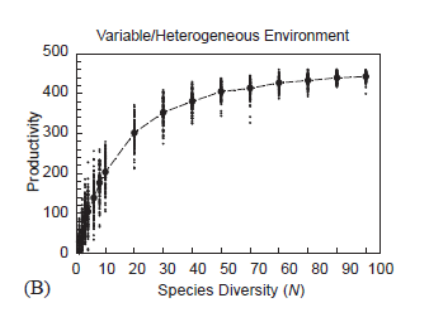
Explanation
- Multiple species coexistence occurs if there is an interspecific tradeoff such that each species is a superior competitor for a limited range of values of the physical factor, and if the physical factor is heterogeneous.
- More species→minimises risk of losing access to resources provided by them if conditions change.
Biodiversity value - when data is available
- The value is captured hedonically.
- Crops that have a market price.
- Use a productivity framework with prices.
- Production approach can deliver hedonic.
Productivity framework
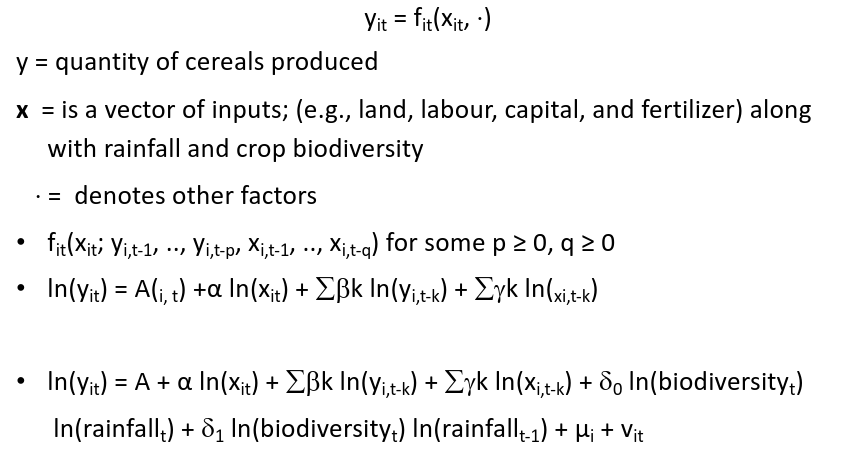
What is the impact of biodiversity, rainfall shocks and their interaction on production
- The estimated model is used to simulate production under alternative scenarios.
- Start with a base scenario where the agroecosystem production is simulated forward in time.
- The comparison of these paths across scenarios provides useful insights into resilience and agroecosystem dynamics.
- IPCC estimated rainfall reduction is 5% to 15%.
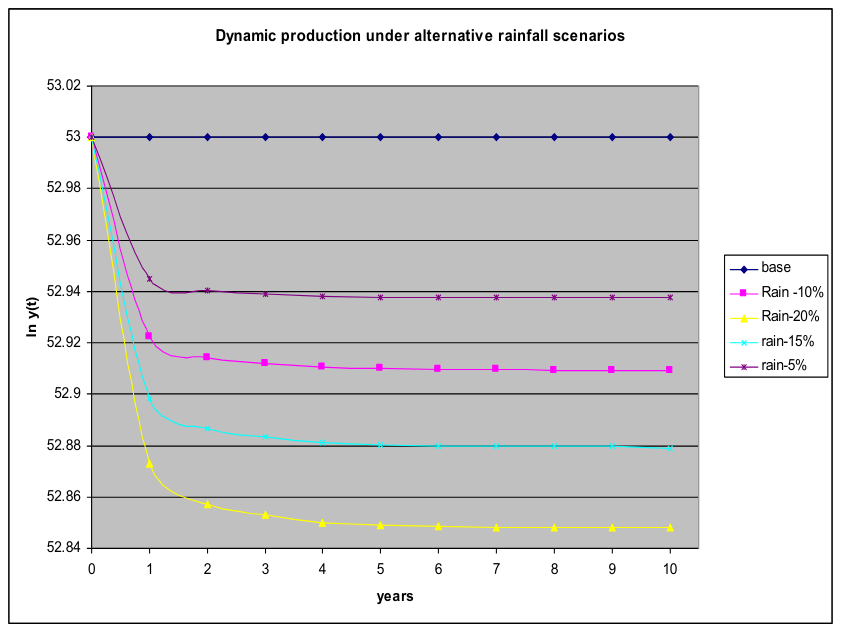
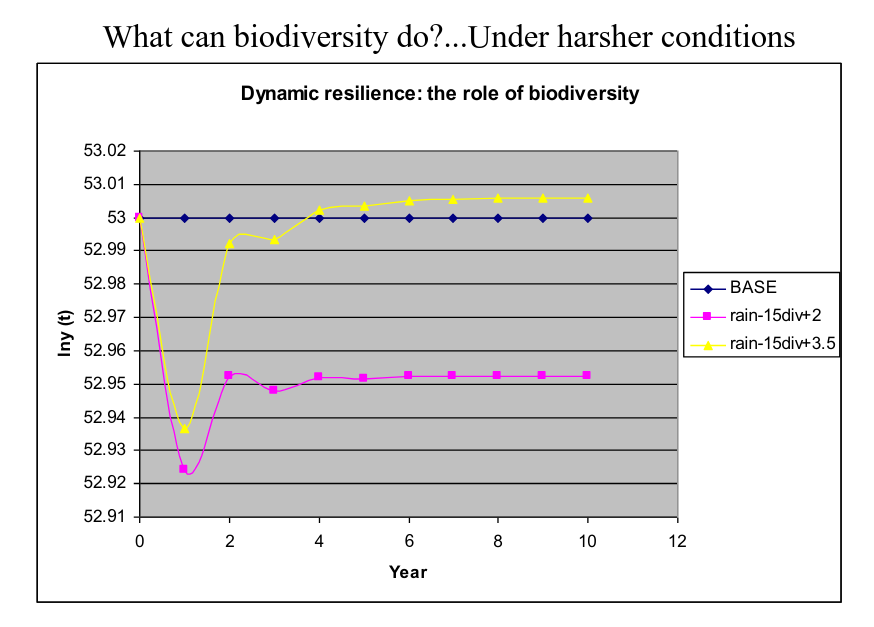 We can assign a price to biodiversity from here.
Contingent Valuation
- It is to elicit people’s willingness-to-pay (WTP) in a hypothetical market.
- Originally, for public goods, parks, fisheries, endangered species etc.
- One person consumption does not affect another person consumption.
- To date also for privately provided goods (i.e. water).
- Direct questioning individuals to determine how would they react to some specific situations?
- When we cannot use other valuation methods or cannot capture alternatives.
- Ricardian model→people don’t do the same always, e.g. hotter climate=switch to other crops.
- Hedonic is always better when we can use it though (contingent valuation as last resort).
- Each individual is asked to evaluate a hypothetical situation and express their WTP.
- By asking consumers directly about their willingness-to-pay (WTP) to obtain an environmental good.
- A detailed description of the good involved is provided, along with details about how it will be provided.
- The actual valuation can be obtained in a number of ways, such as asking respondents to name a figure, having them chose from a number of options, or asking them whether they would pay a specific amount.
How to do it?
- WTP or WTAccept.
- An interviewer after describing a good (preservation of an endangered species, or water quality) asks the max price WTP or WTA.
- Socio economic data.
- Awareness of the issue (i.e. water pollution).
- WTP for improvement.
- Boatable to fishable, from fishable to swimmable quality.
In contrast to other techniques
- Often only provide a partial estimate of environmental costs and benefits.
- They need to describe in detail the good being valued, interviews in CV surveys are often quite time-consuming.
- It is also very important that the questionnaire be extensively pre-tested to avoid various sources of bias.
Major concerns
- Strategic bias.
- Maybe try to benefit yourself, or say what others wanna hear (why is this person asking this?), etc…
- Information bias.
- Some people could naturally know more, or specific stuff.
- Starting-point bias.
- It matters if you lose or gain f.ex.
- Hypothetical bias and discrepancy between WTP and willingness-to-accept (WTA)
- Higher WTP than other methods.
- How to assure the understanding from the respondents.
- Are the respondents responding to the specific question?
Delphi Technique
Same thing but interviewing relevant stakeholders in round so as to perfect their answers relative to each other and compare against regular contingent valuation possibly. It can also be used to complete knowledge when data about a certain thing isn’t possessed in a sufficient amount.
Can a Charismatic Species Be an Instrument for Nature Conservation Kontoleon and Swanson 2003
- Contingent valuation (CV) that elicited willingness to pay (WTP) of OECD citizens, for the conservation of the Giant Panda.
- The focus on a handful of species might translate into funding for their natural habitat, and thus provide much broader conservation.
- it might be the case that society is willing to support the preservation of the species alone, in preference to other life forms or forms of nature.
The Willingness to Pay for Property Rights for the Giant Panda
- Is the flagship species approach an important instrument for biodiversity conservation, or a mere distraction?
- The primary cause of this endangerment is habitat disruption.
- It has been estimated that the rate of habitat disruption in the panda reserves has proceeded at a pace of 5% per annum, over the past two decades.
- Current conservation efforts for the panda are not focused on habitat conservation but increasingly rely on captive breeding programs in ex situ facilities.
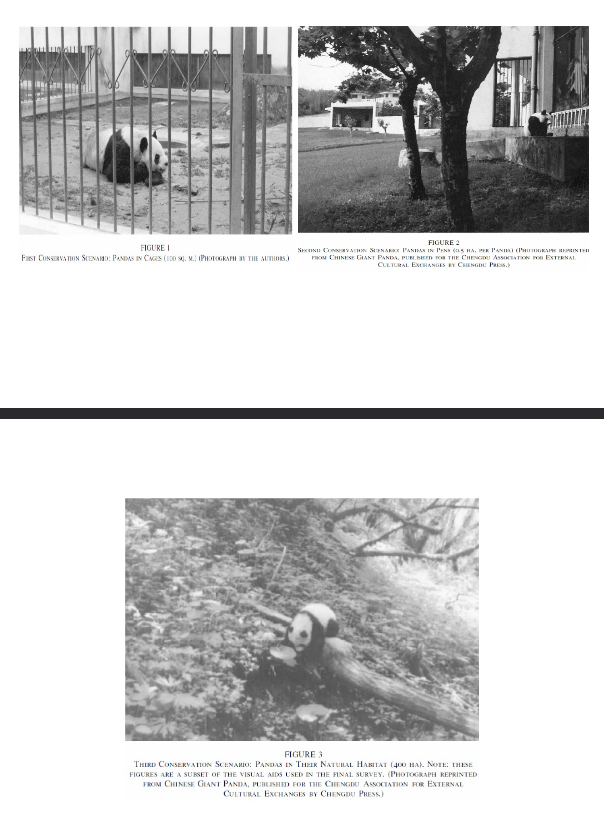 Ask people WTP to conserve the panda in each habitat.
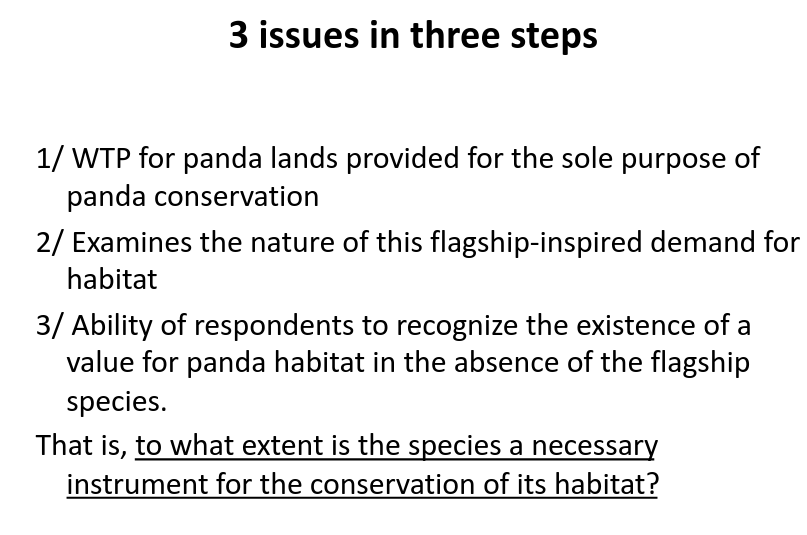
- There is some evidence to support the proposition that the WTP for the panda habitat would not exist, if the panda did not exist.
- The fate of nature conservation is now inextricably interlinked with the fate of particular charismatic species.
- Can we trust the flagship then?
- Contentious…Prendergast et al (1993), and Williams, Burgess, and Rahbek (2000) show that the flagship approach has little positive effect on biodiversity conservation.
- This is so because biodiversity hot spots do not usually host flagship species.