IEL & Trade Law
Countries may adopt trade policies (e.g. subsidies) to protect the environment such as green industries subsidies. They however have to be made consistent with the rest of international policies. Some multilateral environmental agreements regulate trade even if they are not trade agreements.
E.g.
 We restrict trade in what pertains to hazardous chemicals, we distinguish in the regulation of trade between products that are or not hazardous to the environment.
But
However, international trade law (ITL) is based on the idea of never discriminating. So a tension exists.
GATT
 In 1947, very first time we get a multilateral agreement to regulate trade. Many countries put tariffs on imports with protectionist goals against cheaper goods. But post-WW2 we develop this idea where free trade leads to peace (as Montesquieu used to say) and as such (specially the USA and the UK where this was quite a strong train of though) some countries convince others to push for the GATT.
Hasn’t changed much, quite important for the regulation of trade even after the creation of the WTO (was integrated inside it kind of).
Principles
Only allowed to deviate from these rules in some specific exceptions.
Progressive reduction
Progressively reduce import tariffs and never go backwards.
Quantitative restrictions
Restricting the quantity of a product imported or exported are not allowed. Basically all measures that are not tariffs but limit the quantity such as quotas.
Non-discrimination
Not allowed to discriminate in trade policy (e.g. tariffs) between foreign products. This also applies to imported vs. domestic once they have been imported (like selling them only in specific stores). Of course here we talk about products that are alike, so they share a relationship even if they are not identical (e.g. apples).
From an environmental perspective this is bad, the environmental impact of the processes used to produce said product cannot be taken into account to discriminate. This environmental difficulty arises within the broader framework of the WTO’s general principle of non-discrimination.
Preamble
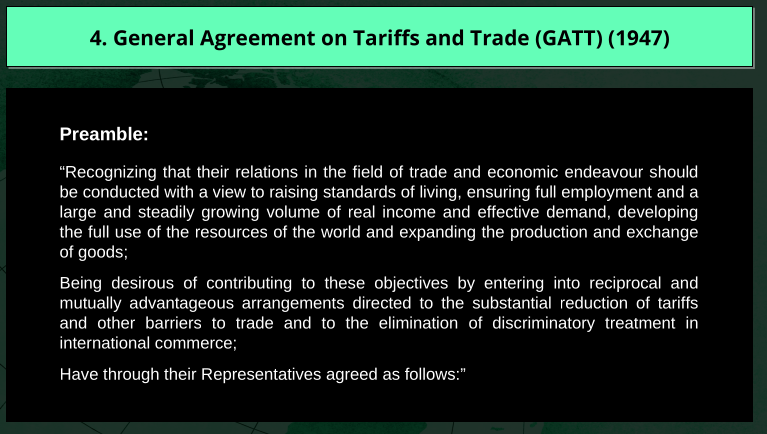 Preambles are not binding but as we saw show intentions, here we see nothing about protection of the environment as a goal. Only economic development (consistent with the contemporaneous approach).
With everything that happened in the 60s, as we saw, we get to 1972→Stockholm.
Stockholm declaration
Principle 11
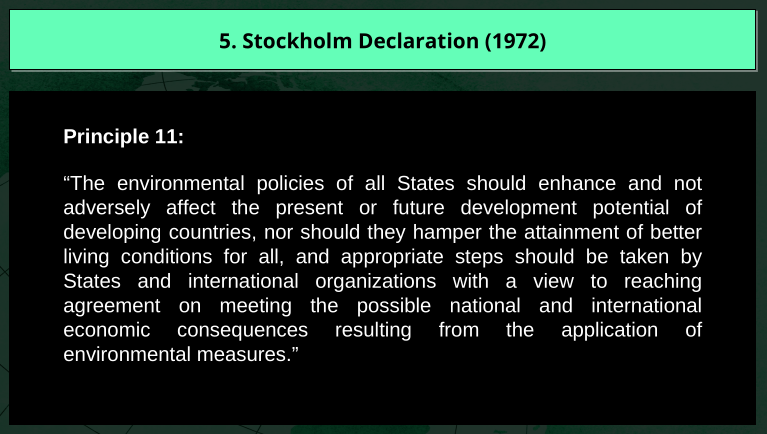 Shows that they did think about trade : countries adopt environmental measures that could have economic consequences and we need to deal with them. Even at the genesis of IEL we already see a hierarchy, economy first.
First environmental issue brought to GATT
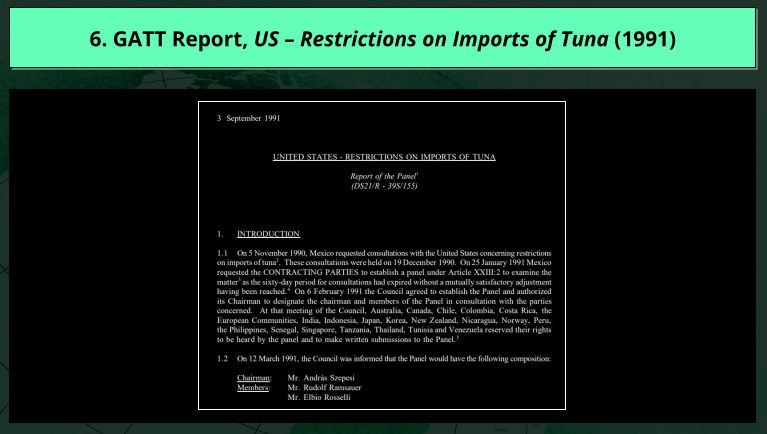 The two fields of IL clash. It was brought by Mexico against the USA, as the USA had imposed an embargo on imports of tuna from Mexico. A violation of the GATT, extreme quantitative restriction.
USA said this was because of the Purse Seine tuna fishing technique used by Mexico, which went against local legislation for the protection of marine mammals. Thus supposedly the violation was justified by the exceptions contemplated in the GATT.
Specifically
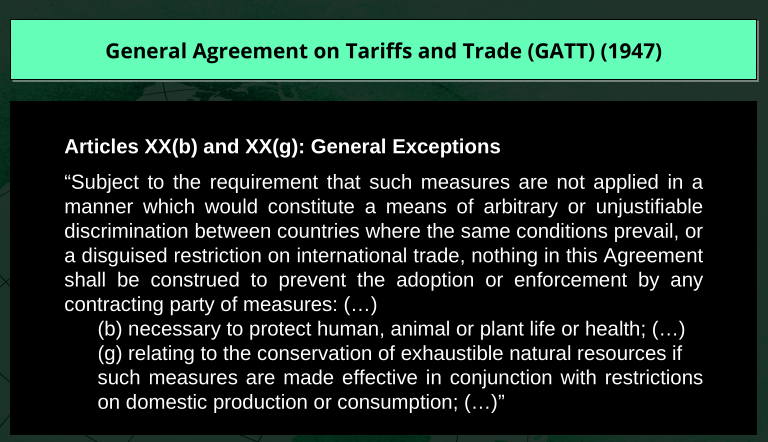 Basically contemplated violations to protect certain public interests. You need to fullfill many parameters but essentially here b and g are fulfilled. Judges couldn’t have given less of a fuck, the objective of the GATT is in its preamble and it’s to avoid trade restrictions→this is a violation of the GATT. Dolphins or environment, not even mentioned in the award.
In 1947 when drafting this we though more about pests and protecting resources such as minerals. This wasn’t written to apply here, USA lost.
Very bad reception of the award, the trade community appeared as against the environment. The GATT was seen as an obstacle to environmental protection. In 1987, with the release of the Brutland Report and the arrival of sustainable development the legal view on this tension changed.
Rio
Cristallises the principle of sustainable development.
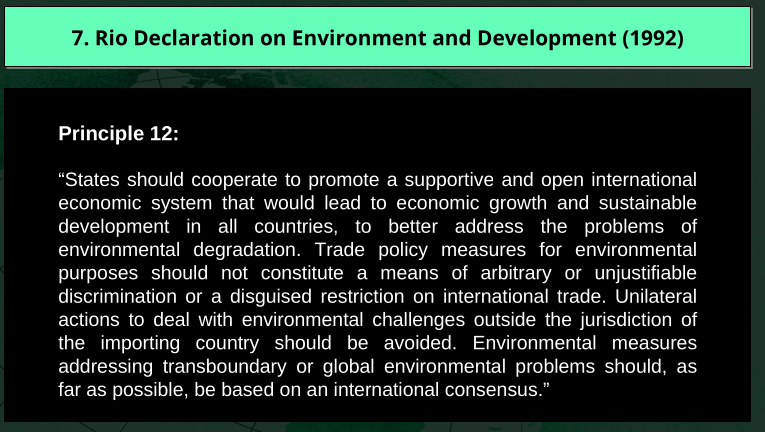 There is an element to free trade here, it’s not only an environmental declaration after all (starting from Rio IEL is not only environmental but about sustainable development). Here the idea is that IEL and ITL have to support each other.
Indeed the language here about trade restrictions wasn’t born with Rio but comes from the GATT. 3 pillars to this synergy:
- Complementary, both should be aimed at sustainable development as an overarching goal.
- No hierarchy, none is superior to the other.
- No subordination between them.
- A treaty in one doesn’t disqualify a treaty in the other.
Synergy examples
Rotterdam, Stockholm…
1995
Everything changes in ITL→GATT no more, it is kept as a very small piece of a much larger puzzle: the WTO, as established in the Marrakesh Agreement of 1994. As such, dispute settlement is improved: panel of experts in the GATT→institutionalised dispute settlement system, unique in international law because of its 2 levels like in domestic systems.
Dispute settlement
A member can bring a dispute against another member which forms a panel of 3 experts just like the GATT, then a report is issued. Either party if they are not happy with the report can appeal to the Appellate Body, unlike what happens in other international courts like the ICJ.
Because of the USA, the Appellate Body is crippled (lack of renewal of american judge). Since you can’t decide without consensus they can’t elect new judges and now we have none: appealing into the void. Way less disputes now as it is just possible to appeal and it just disappears. Can’t do much for violations.
Until 2020 it did exist.
Marrakesh agreement
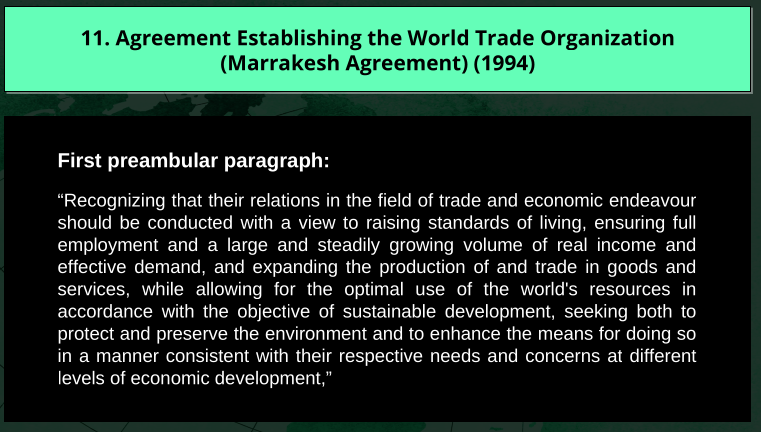 Mentions sustainable development unlike the GATT. It changes some stuff, like writing optimal use and with the objective of sustainable development. Underlining complementarity.
Shrimp case
 Brought by 4 Asian countries as a WTO complaint. The USA invent TED to catch shrimp without killing endangered sea turtles and impose domestic legislation to use TED and ban imports of shrimp for countries that can’t show they use it.
Same complaints as with Tuna-Dolphin and same defence by the USA.
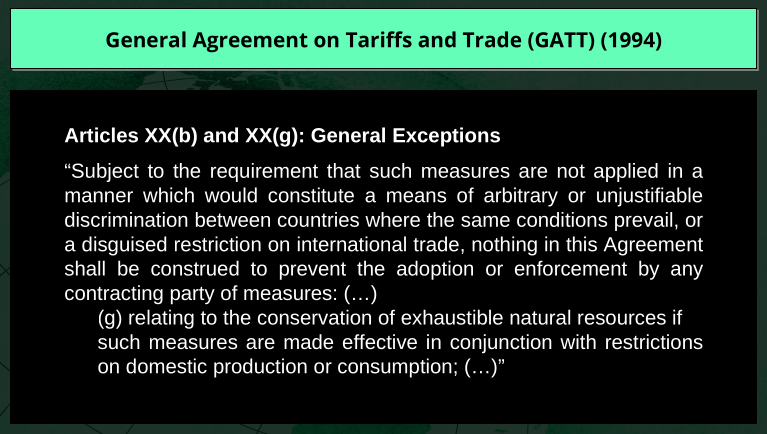 The decision was that:
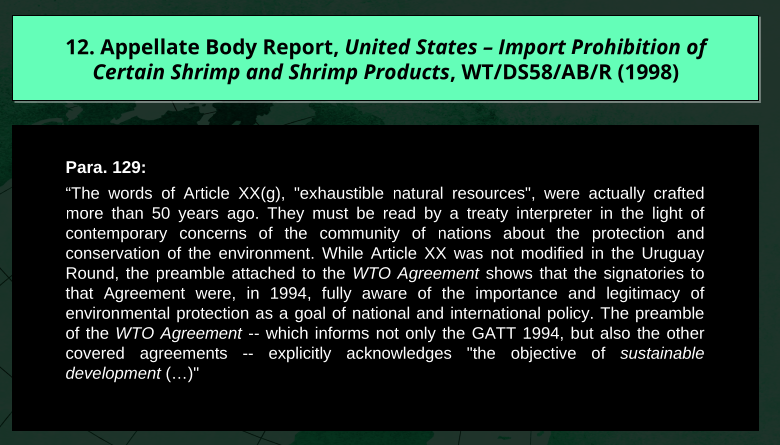 They interpret exhaustible in light of mutual supportiveness and sustainable development.
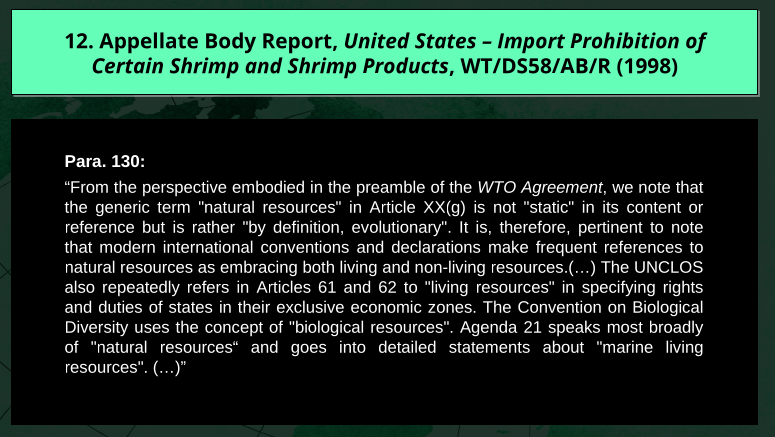 Natural resources as they say is a term that is not static and evolves according to needs and desires of the international community. And current IEL (they even look at soft law) like UNCLOS refers to living stuff as well as non-living.
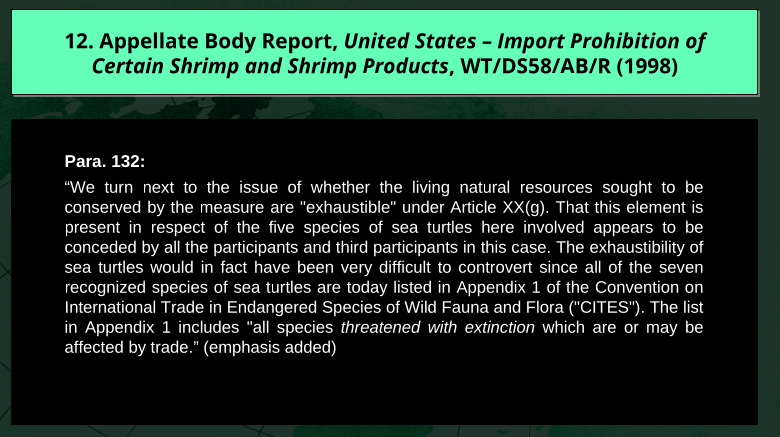 They prove that they get into the scope of g as they are exhaustible citing CITES which underlines their endangered status. They however said that this was unilateral and this problem requires cooperation quoting principle 12 of Rio. The appellate body relies on soft law to say whether or not the US violated the GATT.
The USA lost, they failed. Also an issue of proportionality here, doing all this alone through a nuclear approach. However this award shows that the future is in this synergy. The appellate body made it clear that this didn’t mean that the environment was not significant here or that members shouldn’t protect endangered species. They can do that, and specially by cooperating. Here we relied on IEL to decide.
It’s just that there is a desire to filter between environmental measures and protectionist ones that seem environmental.