Emergence of Environmental Issues at the International Level
1972 is considered the birthing point of IEL but this doesn’t mean that environmental concerns didn’t exist prior. How have they contributed to the formulation of IEL principles?
Critical dates
1893
First dispute
In 1893 we got the first environmental dispute ever, it occurred between the USA and the UK: the Bering’s fur seals case. It was submitted to international arbitration, it was one of the first cases along with the Alabama one (non-environmental, but important historically regardless).
Arbitration
In arbitration you can choose your arbitrators, with modern international courts this is not possible. This thus reduces the autonomy of states. At this time, there wasn’t a permanent court for international justice that was established.
Issue
But how did this dispute arise? Fur seals from the Bering sea would sometimes cross to US territorial waters, so the US government established they had a right of property and thus extraterritorial protection over these animals. Canadian vessels would often be seized and their crew imprisoned for hunting the fur seals. The UK didn’t like this being done to its dominion (they usually represented Canada at this time either way). They questioned the USA’s right to extraterritorial protection, ending up in international arbitration with the objective of solving this dispute.
Positions
IEL didn’t even exist, as IL was purely a law of coexistence. There was no regulation pertaining to the manner in which states could protect the environment. This legal vacuum, wasn’t perceived in the same way by the other parties. The USA was progressive and invited the tribunal to engage in judicial legislation (when an international tribunal acts as a legislator) so as to create IL. They said the tribunal had a mission to create law for the rights and benefits of future generations→intergenerational equity (even though it wasn’t a concept yet).
The UK said the contrary, the tribunal could only apply customary IL in the presence of such a vacuum (since there were no treaties regulating this type of issues between the USA and the UK). They said the only principle applicable at the time was the freedom of nations to kill wild animals.
Result
Neither the UK or the USA lost this arbitration or won it completely:
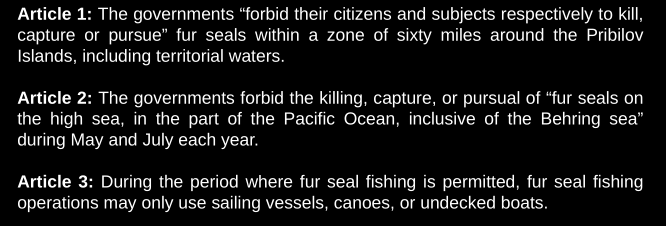
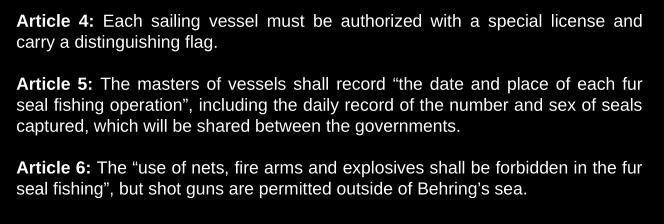
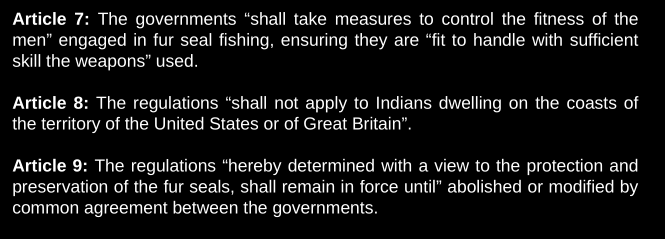 Arbitral tribunals give awards (decisions) as the final decision to a dispute. It contributed at 3 levels to IEL.
1rst
First international tribunal ever to dispute that states can freely dispose of shared natural resources. They cannot exerce an exclusive property over such a good. This goes against what the USA were claiming. The seals migrate, as such they are shared.
2nd
First international tribunal to formulate the principle of cooperation with respect to environmental protection. When it comes to transboundary environmental problems (beyond domestic jurisdiction), states should cooperate to solve them→ this idea was formulated for the first time in this award.
3rd
First ever international tribunal to have adopted a measure of environmental conservation (at the international level obviously). At this level it is true that the USA kind of won the dispute.
Why enact these reasons?
The tribunal decided to protect these seals, not because of their intrinsic intergenerational value as natural resources, but because of purely utilitarian reasons. This way it’d be guaranteed that they could always keep being exploited. No one cared about protecting the environment back then, it is only now that we are capable of being critical about the real purposes.
There was no opinio juris around this, it was later accorded more importance although at first it was purely utilitarian. The first generation of environmental treaties was composed of texts such as Convention designed to ensure the conservation of wild animals that are useful to men or inoffensive or Convention on the protection of birds useful to agriculture which are very obviously not written from an intergenerational equity perspective. This tribunal was merely a child of its time.
Old treaties today
When applying that first generation of environmental treaties today difficulties arise… E.g. the International Convention for the Regulation of Whaling
1946: International Convention for the Regulation of Whaling
It prohibits the hunting of whales except if you do it for scientific purposes. This poses problems… Japan has been doing scientific research on whales for decades (JARPA 1, 2, 3, 4 now… and it’ll continue). Australia considered that Japan was just hiding comercial whaling behind so-called scientific research. They had been studying the anatomy of whales through hunting for a long while but whale meat could be found domestically…
AUS-JP dispute
Australia sued Japan in front of the International Court of Justice and said that it was necessary to interpret the convention in light of conservation purposes but the ICJ said this wasn’t the purpose of the convention, but rather sustainable development of the whaling industry. Purpose has to be taken into account when interpreting, and the preamble is clear:
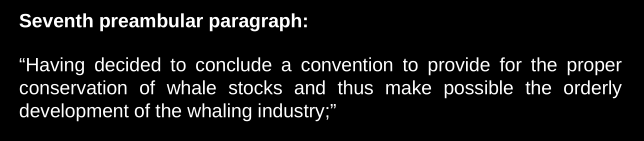 This poses problems because we have a different mindset today. The ICJ admitted there was a conservation purpose but Japan wasn’t really that wrong. If stocks are allowed to remain at a sustainable level, hunting could be in line with the convention. The ICJ recognised the Convention’s conservation purpose but ruled that Japan’s JARPA II program did not qualify as scientific research and therefore violated the Whaling Convention, ordering its termination.
1941
Melter at the USA-CANADA border
Washington city in the USA (not DC) shared (and still does) a border with the city of Trail in Canada. In this city, metal was melted in a melter just at the border. The latter produced sulphur oxyde as a result of its operation which damaged the crops and cattle on the USA’s side of the border. This externality in emissions resulted in a complaint from farmers to the US government so they would get diplomatic protection (help in claiming compensation from injuries caused by another government).
Disagreement
The Canadian government was asked for reparations and accepted its international responsibility. There was however a disagreement on the appropriate level of compensation, which was submitted to arbitration.
Consequences
This process could have been relatively simple but the tribunal made history. For the first time, the no harm principle was enunciated.
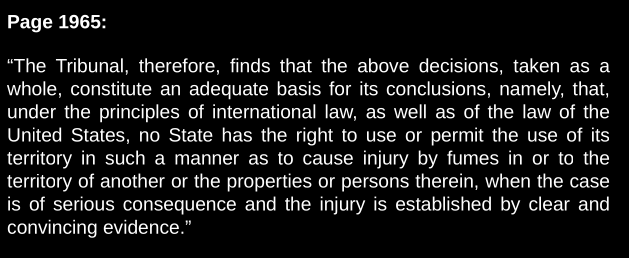 The tribunal said the under the principles of international law no state has the right to use or permit the use of its territory in such a way that it causes injury to the territory of another state. This was customary law apparently, where this was taken from… no idea. Indeed this had been contradicted before like with the case between Mexico and USA and the use of shared rivers like the Rio Grande (Harmon doctrine of absolute territorial sovereignty - pretty hypocritical to believe in it and fight for sulphur-affected farmers though - which many countries believe in to this day, like others believe no harm of any kind - so no threshold - can be committed→ absolute territorial integrity).
But in any case, this status meant it was opposable to any member of the international community. It is a principle of customary international law. It was however formulated with a threshold of severity (*…serious consequence and the injury is established by clear and convincing evidence.).
Importance
This principle is considered as the backbone of IEL, as it embodies it’s central purpose very well. This isn’t the birth of IEL as the word environment wasn’t even here… Again the purpose is not to protect the environment, neither is it about transborder pollution. It was more about economic considerations.
Later
8 years later with the ICJ and the Corfu channel case it was stated that it was an elementary consideration of humanity. Went even further.
1957
The Lake Lanoux Affair between Spain and France. Lake Lanoux is interdependent/interconnected with the Carol River in Spain. The Bayonne Treaty was concluded between ES & FR to declare the waters of Lake Lanoux and Carol River of common usage.
Conflict
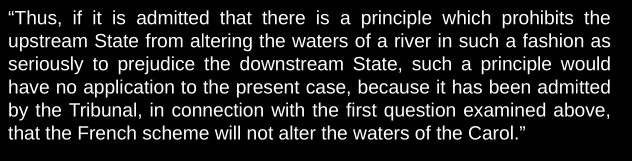
To produce energy they wanted to deviate the waters of LL and then get its course back to Spain. Spain said it had a veto power and said no, but France said there was no veto power. The case was submitted for arbitration, in which Spain defended itself on the basis of the no harm principle. Although the tribunal said even admitting the principle existed France hadn’t violated it:
Environmental consequences
Nowadays we would’ve said that it would harm the environment (fish f.ex.) in what pertains to the ecosystem among other things. This wasn’t done by Spain though. The tribunal also said there was no veto power based on the BT, so Spain lost based purely on technical considerations. In this era there was, again, no attention paid to the environment but to economic considerations. Spain would get the water for irrigation so no problem was identified.
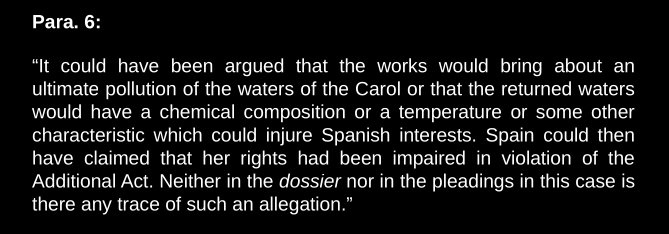 They even said had it been alleged that there could be environmental ramifications the outcome could’ve been different.
Shift
From the 60s there was a shift towards environmental awareness and more disasters also. This pushed parties to cooperate more. Despite this, there was resistance to this new order and the possible new international economic order pushed by developing countries→
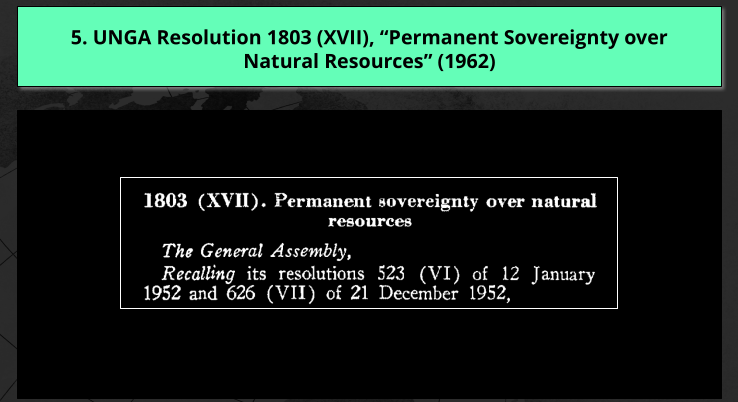 In fact many countries - such as Tanzania with their gas reserves - are trying to revive this nowadays, and even expropriate foreign extractors.
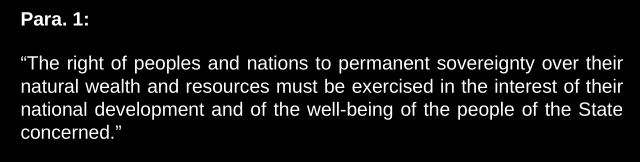 Here there is no mention of the environment or the no harm principle. This doesn’t mean however that there wasn’t any progress at the international community level. Awareness was arising because of factual (unfortunate events, the first big environmental disasters like the very famous 1967 Torrey Canyon oil tanker that sank in the British Channel and shocked the international community after leaving 100k tons of crude oil there) and philosophical factors (emergence of a wave of ecological thinking→silent spring of Carson as a defining moment that rang the alarm on issues such as pesticides like DDTs and their effect on the environment).