Human Rights & IEL
Big relation, strong in modern times. UNGA even recognises the human right to a clean, healthy and sustainable environment to live in.
IEL was born late relative to other parts of IL, like the UN Charter.
UN Charter
An institution supposed to ensure peace, security, human rights, etc; preventing another WW2 basically. There are lots of references to human rights in this text but not to the environment. IEL is also very different from HR, which are for individuals/groups and not states. The rights and duties that come with them have to be respected by everyone, including states. These have to be protective of the rights vis-à-vis of third parties.
The first convention on HR was the Universal Declaration, plus the two covenants (East-West). There are also regional conventions like the african (most/all african countries+mentions the environment cause being post-Stockholm), european or american (not USA though) one. These create courts to judge the violations, which contribute to interpret and apply the rights.
Despite the oldness of some of these texts these courts use them for environmental purposes sometimes, that’s why they are important. Switzerland was recently judged for this in a landmark award from the EUCHR. It’s normal though, human rights came before IEL even if not viceversa obviously, influence is possible.
Stockholm declaration
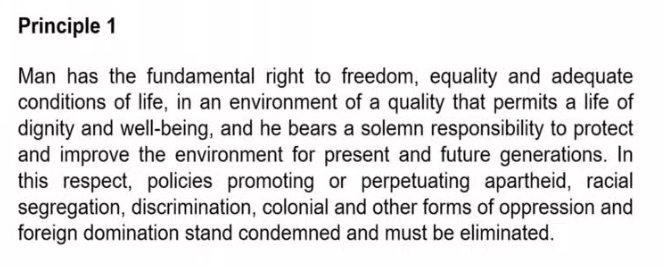
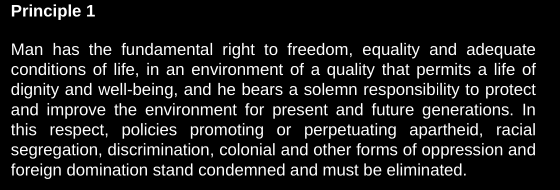 Already the idea that an environment of a certain quality is needed to enjoy our rights.
Rio
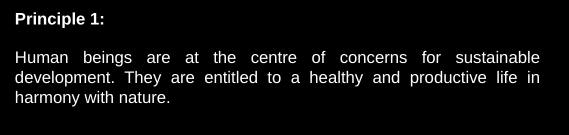 Because of using entitlement some though it was a step back, less strong then.
However, always this same synergy. IEL and HR both pursue human well-being after all.
Human Rights Courts and the Environment
No court for IEL so another court has to be used, but many issues arise→e.g. for a state or a person? But the EHRC is important as HR courts can allow civilians to do something if your rights have been violated.
But often these apply conventions not about the environment as it is not their task.
ECHN
 A right used consistently→Art. 8: the right to respect for private and family life. Has some exceptions though :
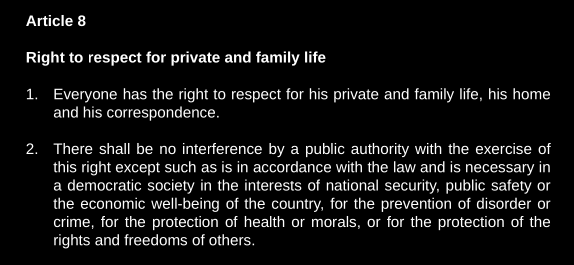 Basically if you can prove that a governmental activity has interfered with your enjoyment of this right you can claim a violation.
Lopez Ostra vs. Spain (1994)
Ostra lived 12 meters away from a water treatment plant that polluted in some capacity, the government removed some and only reduced the activities of others. Ostra had to leave her house because of this and her lawyers said to the EHRC that the decision of the Spanish government had violated her right to private and family life (a right created with no thought at all around the environment).
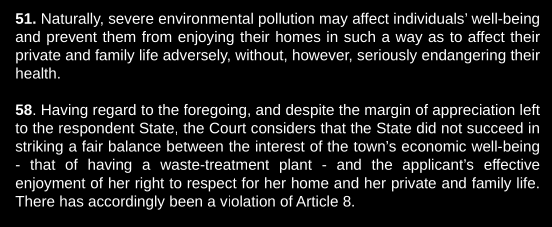 The court used the word naturally using this right, and in the first ever environmental ruling by this court. Stockholm and Rio had influence, as we can see. It is also obviously established that environmental harm can constitute a violation of human rights. A landmark.
They found that in the balance between the economic well-being of the town and Ostra’s wellbeing, the latter was being disfavoured. It is now difficult to find an award against this link nowadays, even if the balance can change.
American Convention of Human Rights (1969)
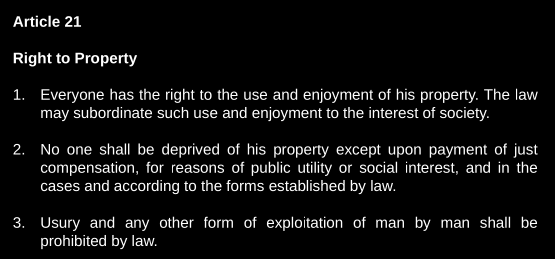 States have to respect and protect this right unless a certain interest of society is present. Indigenous communities have many rights, but this is one of those that relate to them. They have lived somewhere for a long time and cannot be deprived of their property.
Awas Tingni Community vs. Nicaragua (2001)
Indigenous people versus Nicaragua. They had been asking to have a delimitation of their land officially, which was very rich in natural resources such as timber. The government never responded, but signed a logging contract with a Korean investor so they could cut down the forests, in which the indigenous people lived.
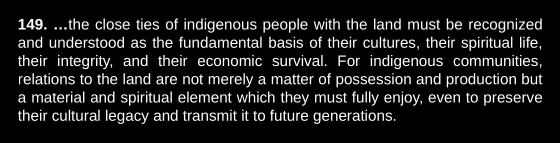 Indigenous people won on the basis of their close tie with their land (spiritual life, integrity, economic survival), etc. It’s not just about possession.
So any activity that harms that land harms their rights. Meant that Nicaragua had to delimit the land and while doing so not sign contracts with foreign investors so as to harm/exploit that land. Many modern cases go way beyond, but build on this one.
According to the jurisprudence of the court, indigenous people have to be consulted and EIAs have to be conducted. Lack of this might mean a violation of HRs. And also, benefits should also be shared with indigenous people. Compared to the EHRC many more things are done than just not harming, it’s a step forward without devoiding the Ostras case of its value.
African Charter of Human and Peoples’ Rights (1981)
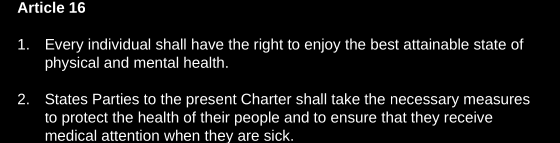
 First hard law instrument to recognise the right to a healthy environment. Gives way more material to work with.
Ogoni case
Foreign investors, some Dutch, had been exploiting oil in the land occupied by the Ogoni people. Negligence led to oil spills in said land. The case was brought against Nigeria, as corpos don’t have duties under IL. Nigeria was the one that had failed to protect or respect these rights, and the nigerian national oil corporation was part of the exploiting consortium.
The ogoni should have been protected from third-parties. Also violation of rights to physical integrity and to protest because of violence during uprisings against the oil spills by the military.
This is why it’s to important to have the right to a healthy environment recognised, as it can allow for important awards.
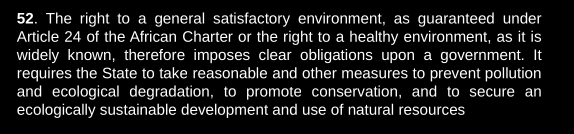 The comission said that this right imposes the respect of many other principles outside of HRs (complying with IEL to show the respect of a human right), here we see even sustainable development and environmental democracy. The european court has done much more now but in Ostra just said you can’t harm the environment.
The African HRs system was the most progressive in this domain, right to a healthy environment and environmental rights, but since 2017 it could rather be the American context.
Inter-American Court of Human Rights, Advisory Opinion OC-23/17, Requested by the Republic of Colombia (2017)
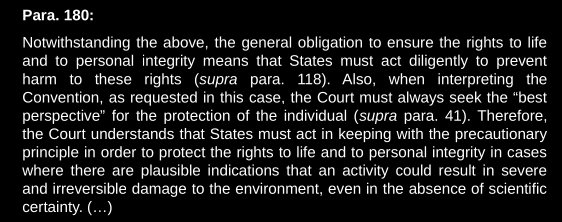 To protect certain human rights, prevention has to be done. It’s also precaution, even a more ambitious effort.
Climate Change
Rather than local environmental harm we wanna look at more, not only transboundary harm but rather, global climate change. Can we rely on HR and its courts to complain about governmental action that causes it?
Things have improved a lot. E.g.: Inuit people were very affected by climate change, they said the USA was responsible for this phenomena. Courts in the american context said it was hard, had to prove causation (in/action→damage→harm to you/environment whatever). How to prove that the US’s emissions affect the inuits in Canada? Some suffer more than others, contribute more than others… it’s global.
Now, it took a lot of cases though, we consider that if you contribute to climate change you contribute to harm and thus it doesn’t matter if it’s specifically your emissions.
Urgenda case
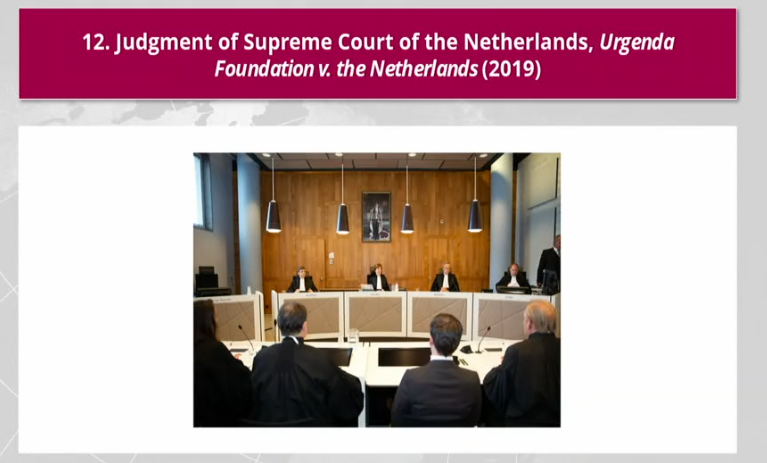 Under the Paris Agreement countries have to submit NDCs (Netherlands had said 18%) and paris said minimum 25%. Urgenda said this violated HRs. The equivalent of the Dutch Supreme Court agreed and demanded more ambition.
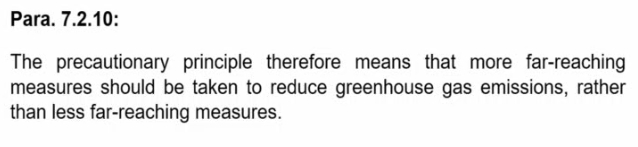
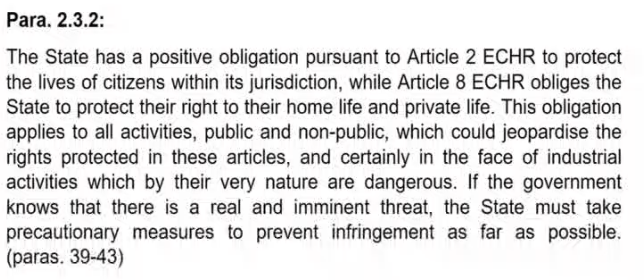 ECHR (Art. 2→protect lives of citizens + Art. 8→protect right to home and private life)… not doing enough to protect them (precaution, not prevention!=more far-reaching measures should be taken).
KlimaSeniorinnen Schweiz case
 Swiss courts did nothing so they went European. After Urgenda opened the door of applying HR to CC this become more possible. They said there wasn’t causation, that emissions were a drop in an ocean (can’t fix things alone) and that why shouldn’t the others also do something? The court dismissed everything.
Since you contribute it’s enough to identify the obligations you have as a state.
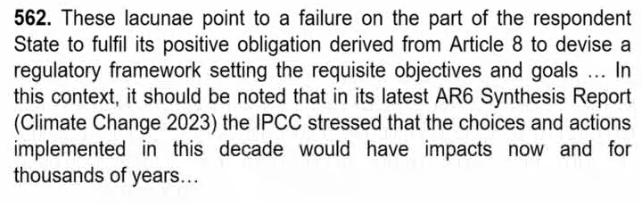 Said that in Art. 8 there are positive obligations that need to be taken into account.
The Right to a healthy environment
Starts with Stockholm, as we saw.
 Kind of disappearance in Rio, isn’t that strong.
African Charter
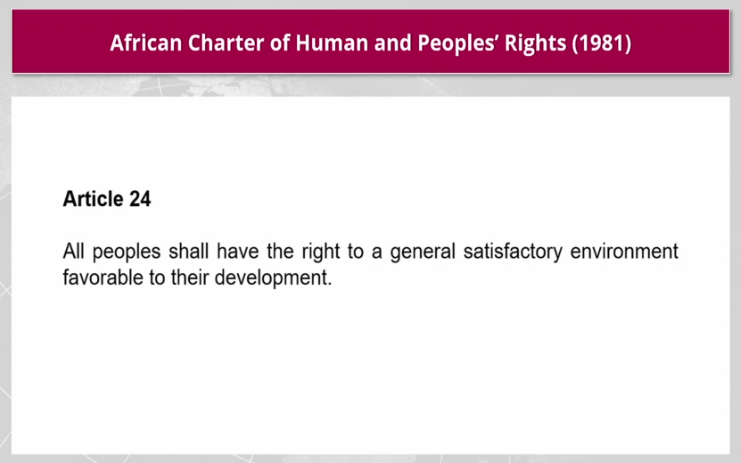 First instance in a regional instrument. And then in national constitutions (first is Portugal) around 1972-3, now more than a hundred!
Protocol of San Salvador
To the american convention.
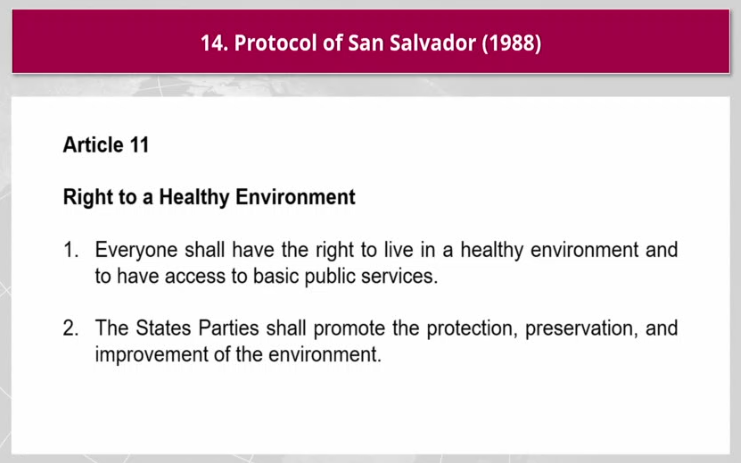
Obscure meaning?
Some say that the meaning is a bit obscure but no, Ogoni was very clear→ we now know what this right is. The Inter-American Court also did, saying that it was collective.
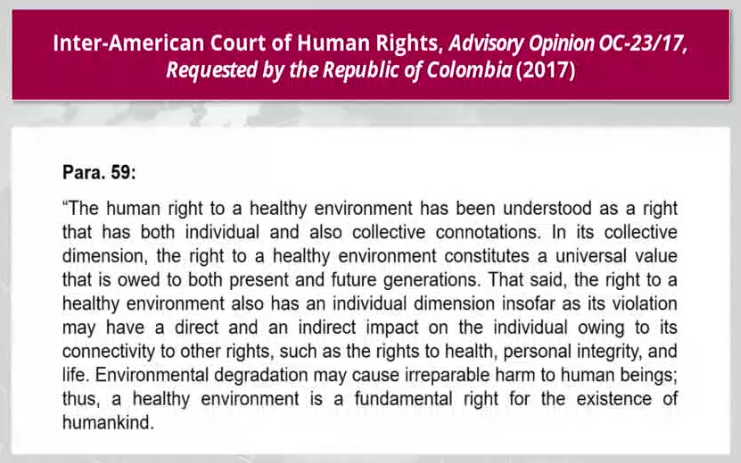 You don’t have to prove that your individual right has been violated, the whole collectivity is owed a healthy environment.
UNGA Resolution 76/300
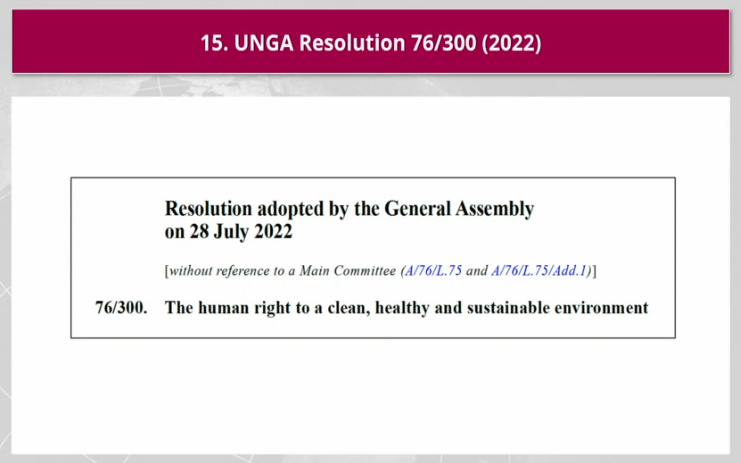 Also incorporates it.
Advisory opinion of the inter-american court AO-32/25
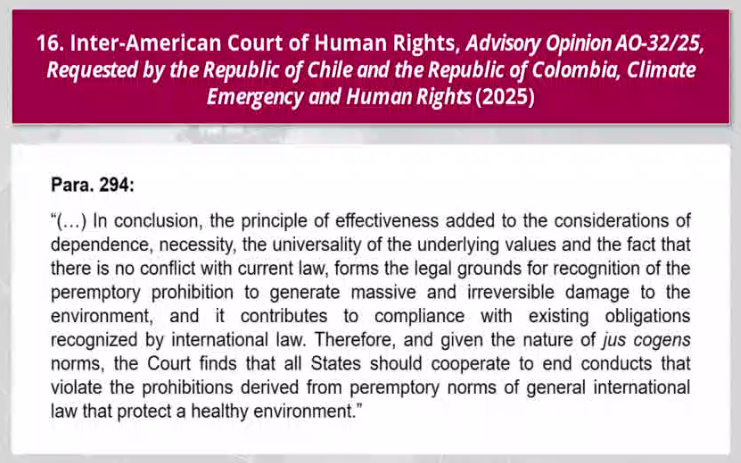 Builds on the 2017 one. Quite progressive, considers the degradation of the environment as unlawful and a violation of jus cogens.
Procedural Environmental Rights
Rio
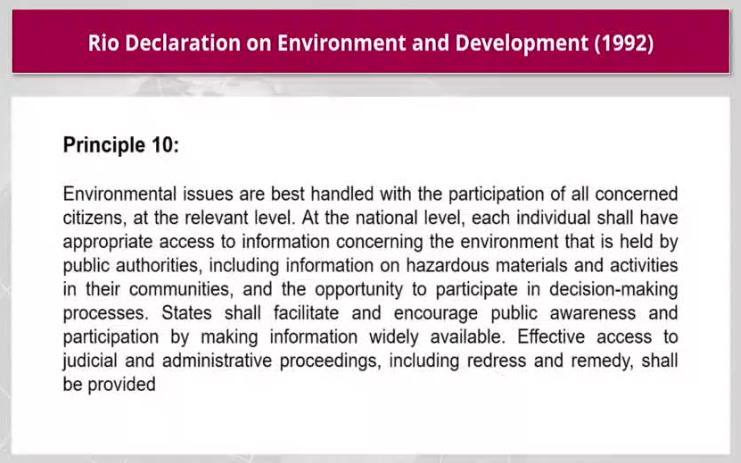 Rights to environmental democracy that we already saw. A principle of soft law can become hard if it becomes customary or you implement it in a treaty. In this case only regional instruments, which we have seen (e.g. Aarhus Convention).