Regionalism and PTAs
Table of Contents
New Regionalism
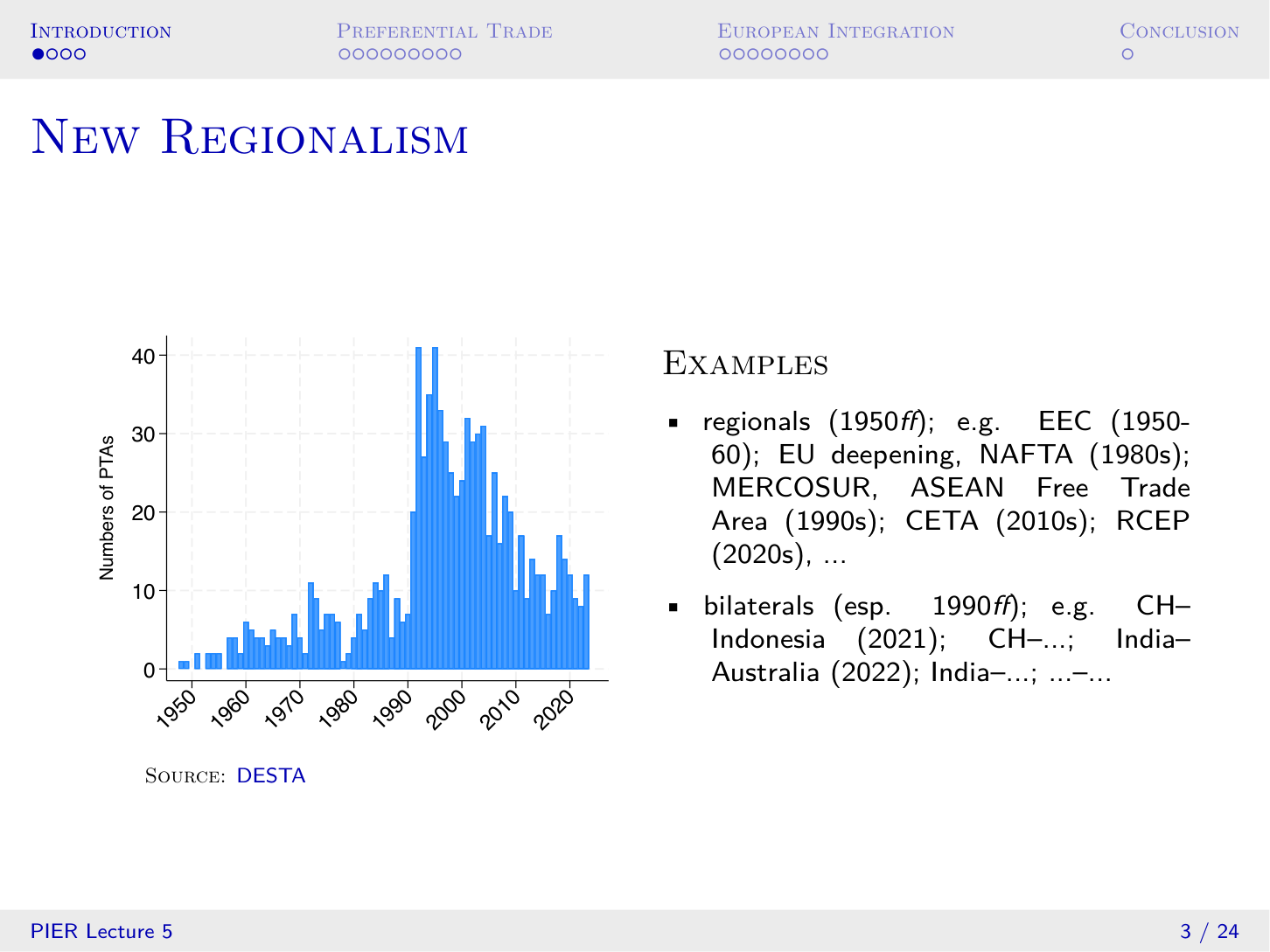
Graph = agreements signed each year. The later decline partly reflects saturation: many possible agreements already exist.
GATT Provisions
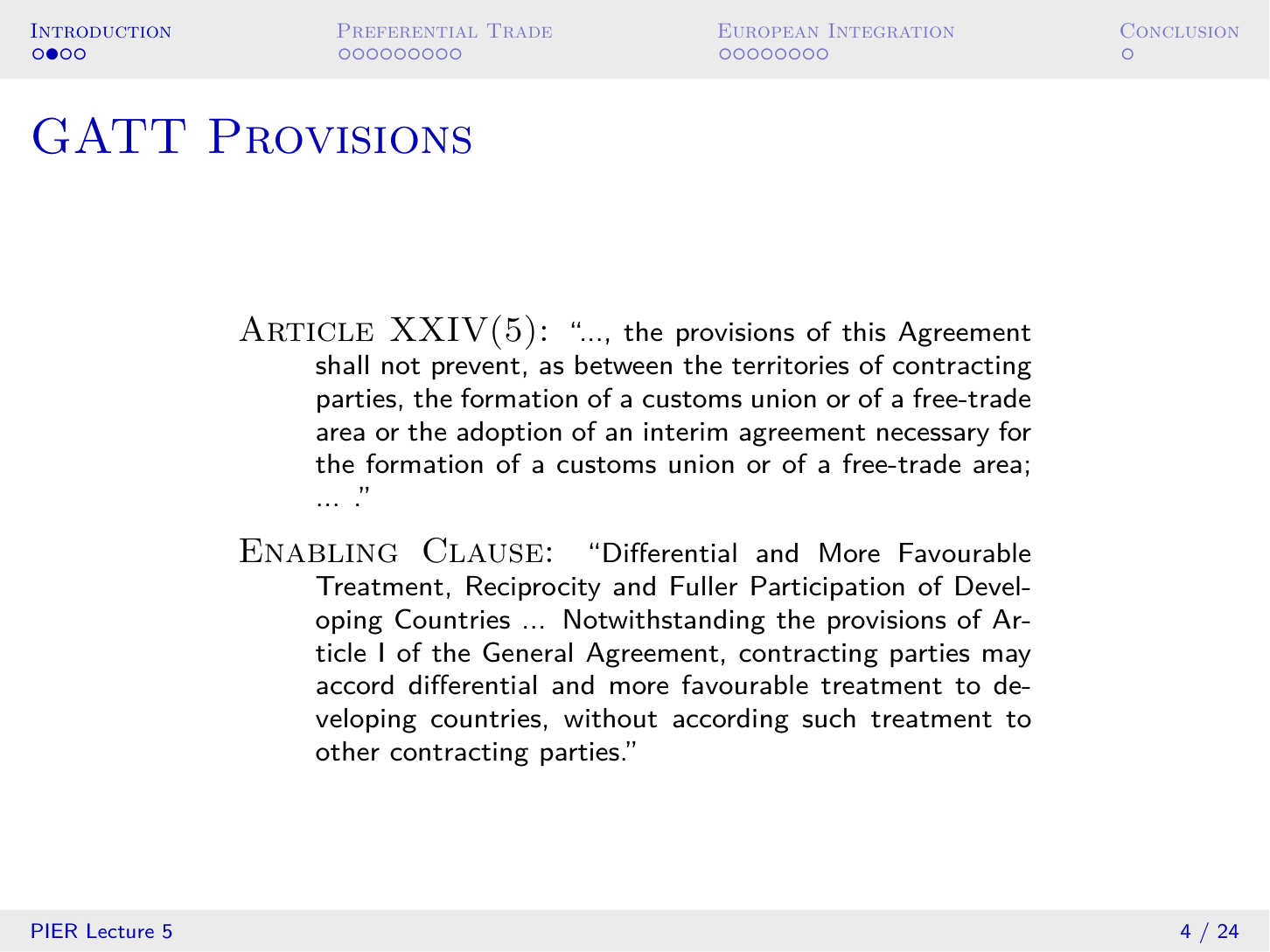
MFN: a tariff concession to one member must normally be extended to all members. PTAs give selected countries preferential access. Article XXIV and the Enabling Clause permit these exceptions.
Multilateral Stagnation
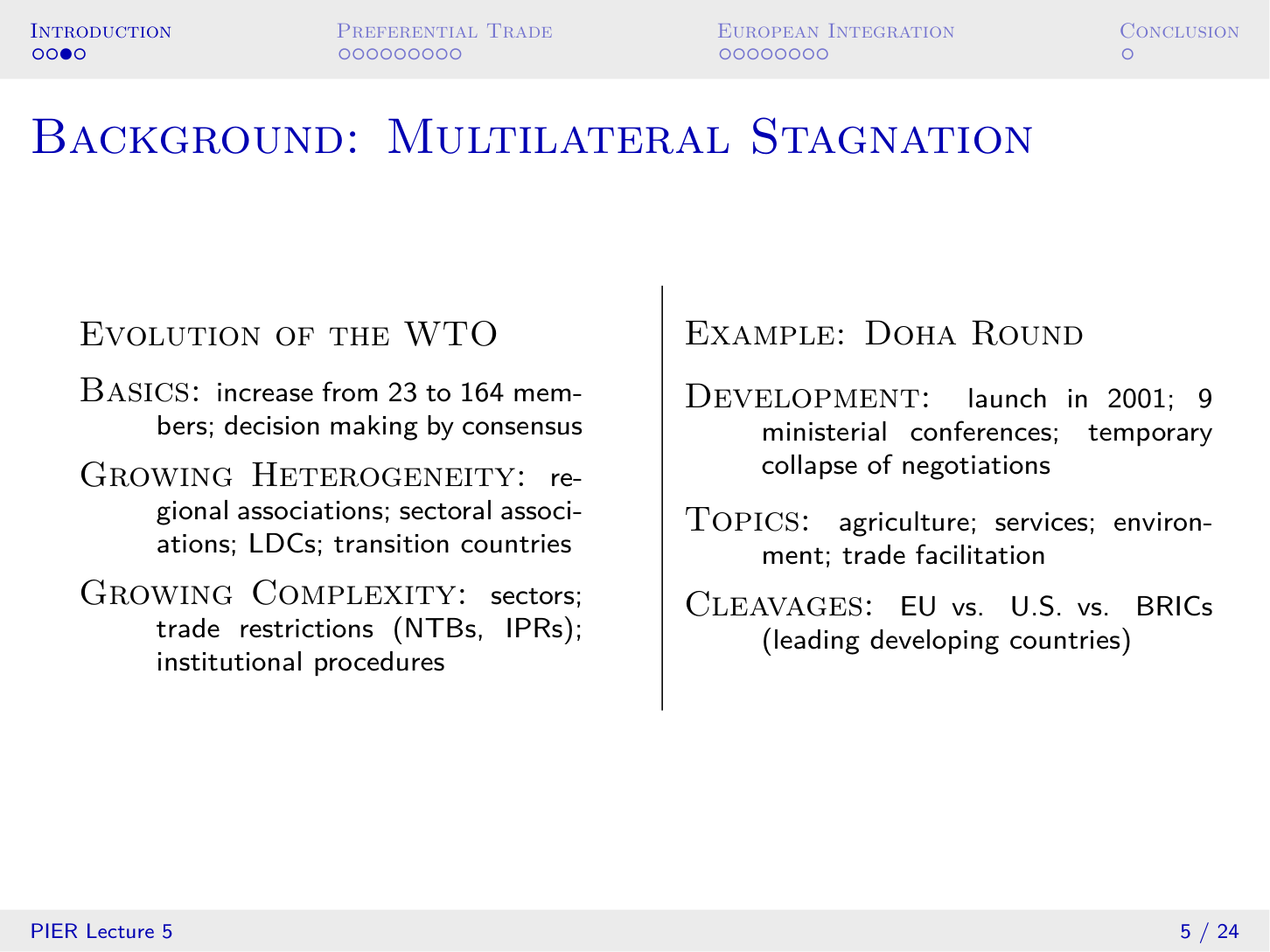
More members → more heterogeneous interests → harder to reach consensus.
With tariffs already low, negotiations increasingly concern domestic regulations and other non-tariff barriers, affecting national policy autonomy.
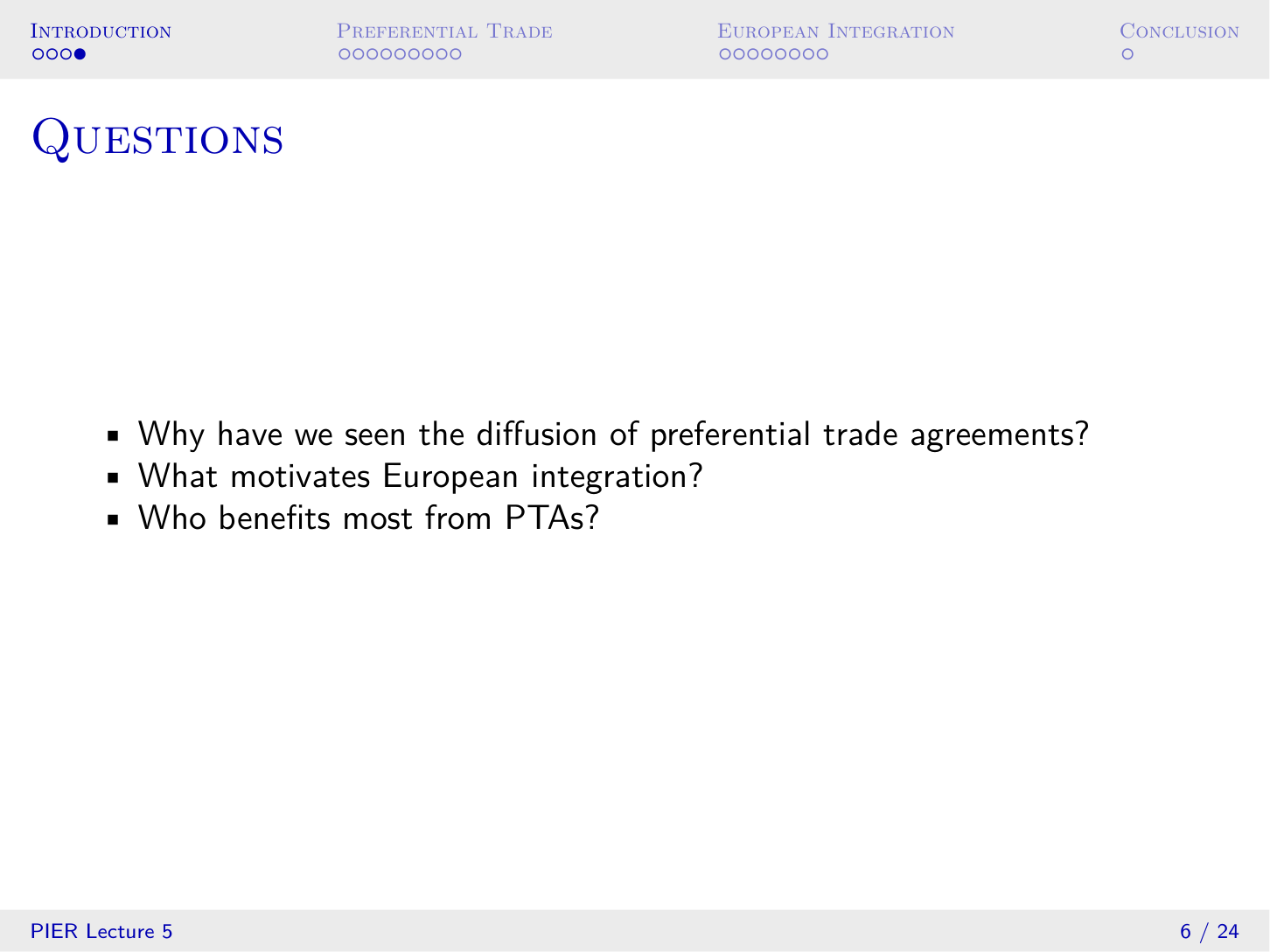
Questions
Characteristics of PTAs
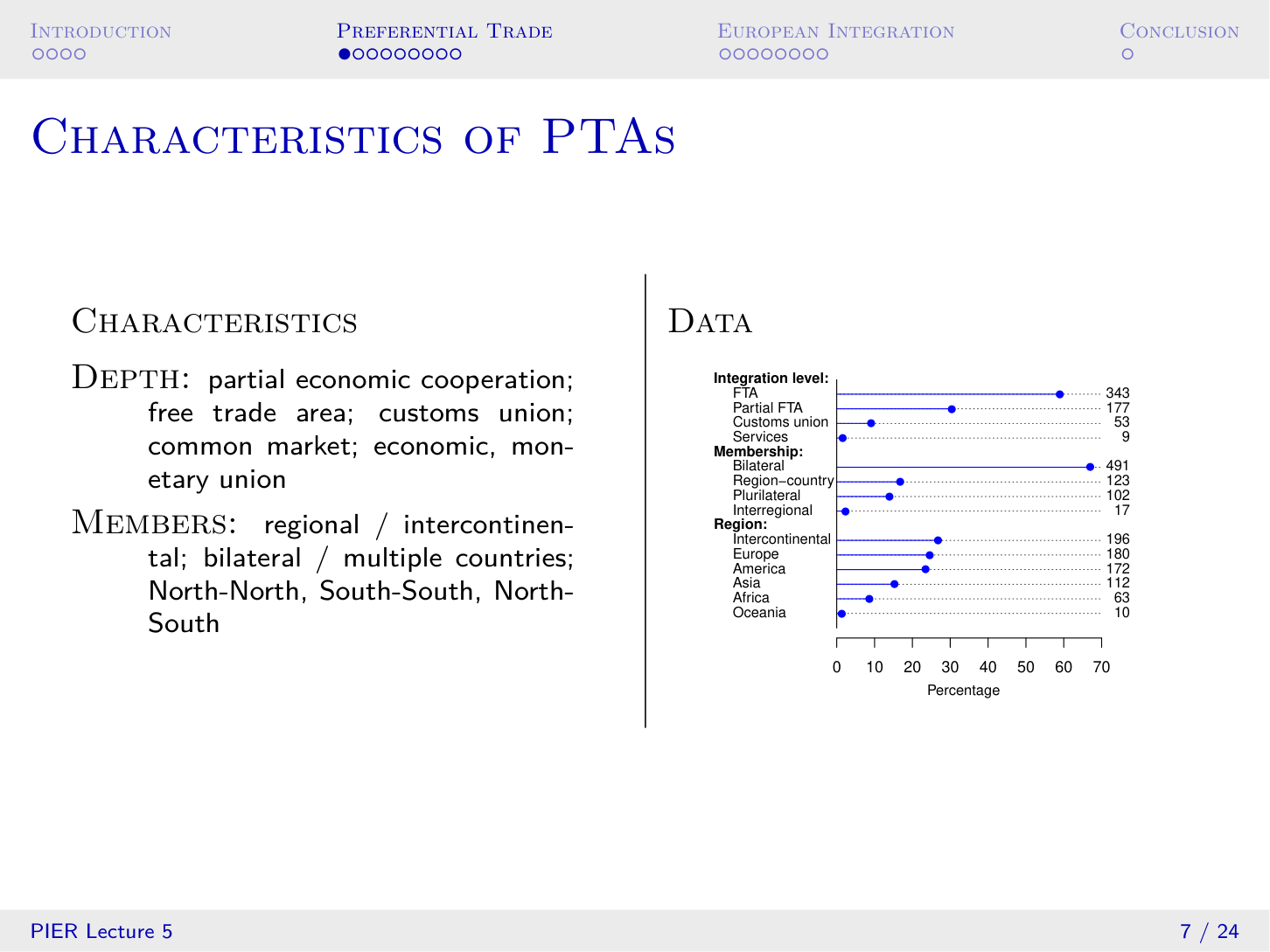
- FTA: members retain separate external tariffs. Imports could enter through the lowest-tariff member → need rules of origin, specifying sufficient local value added.
- Customs union: common external tariff removes this routing incentive.
- Common market: adds free movement of labour and capital.
- Currency union: adds a shared currency.
Switzerland–EU: separate external tariffs + free movement = a mixture of FTA and common-market features.
Coverage
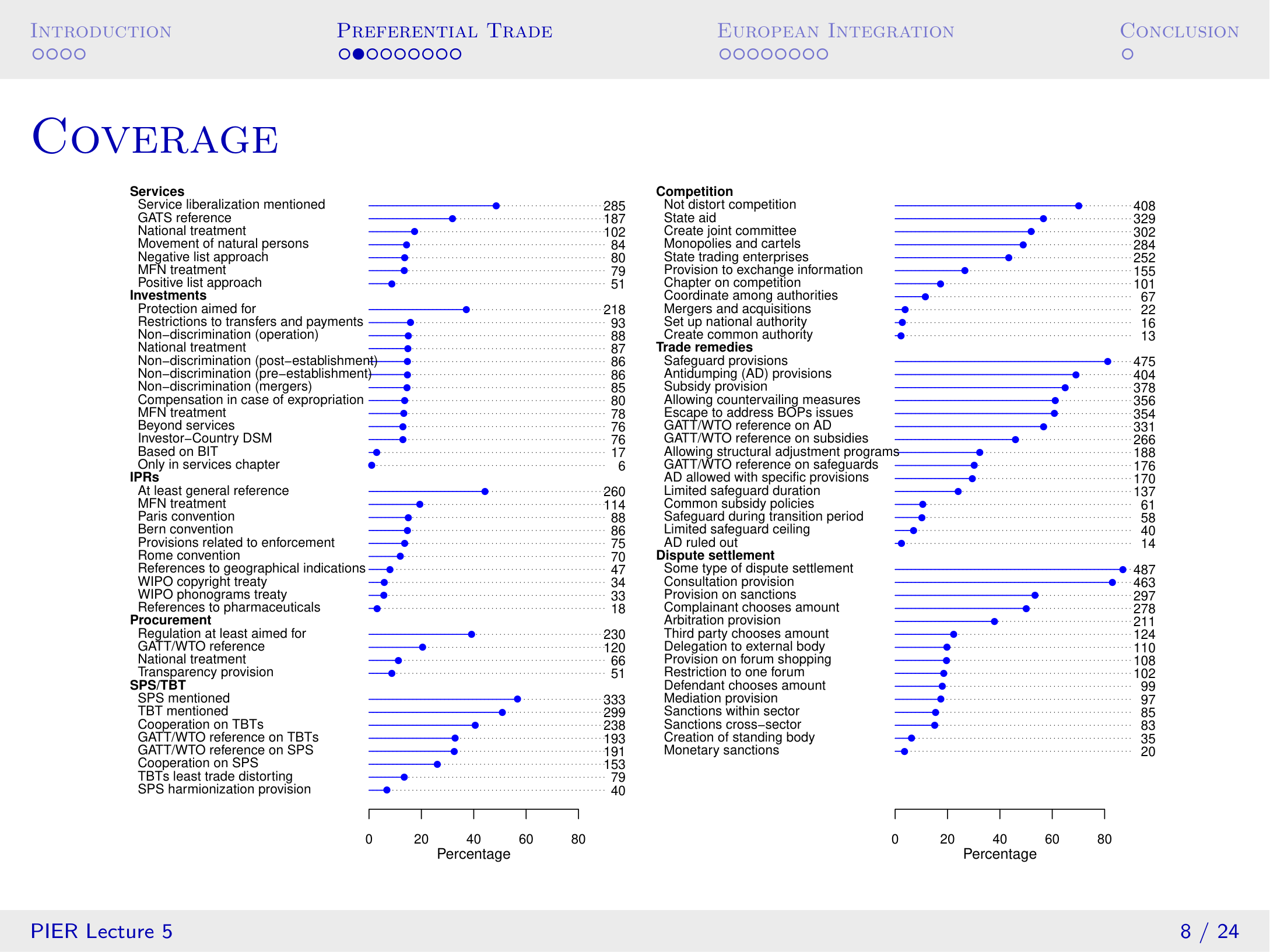
PTAs extend into domestic rules governing firms.
- Procurement: access to government tenders.
- SPS: sanitary and phytosanitary measures. TBT: technical barriers, e.g. production/packaging requirements. Protective standards can also restrict trade.
Example: CH–Mercosur
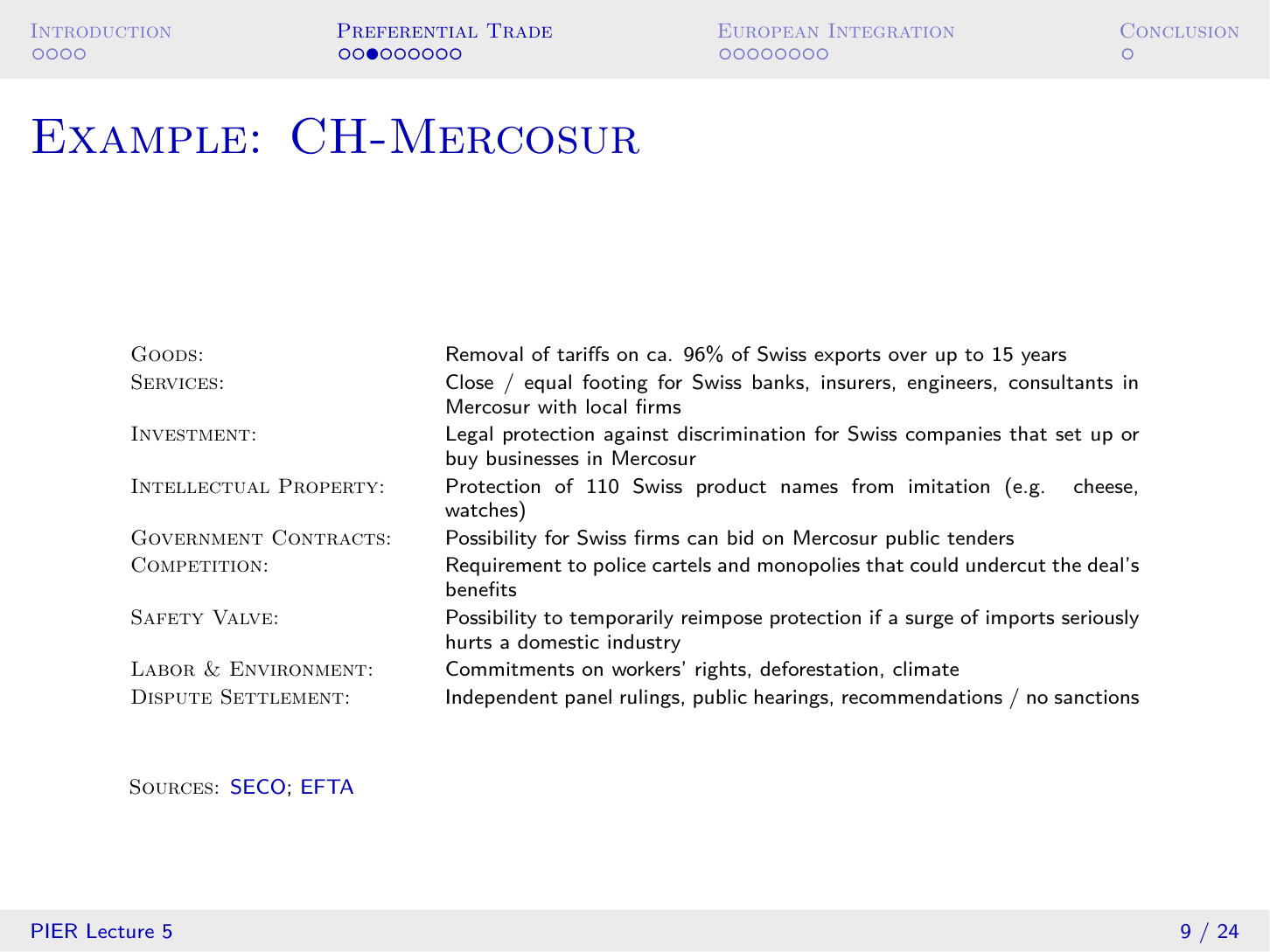
Agreement between EFTA and Mercosur. Market access can coexist with domestic approval requirements, e.g. opening a bank subsidiary.
Labour/environmental commitments lack binding sanctions and are excluded from the main dispute-settlement mechanism. Distinguish commitments from enforceability.
Domino Theory
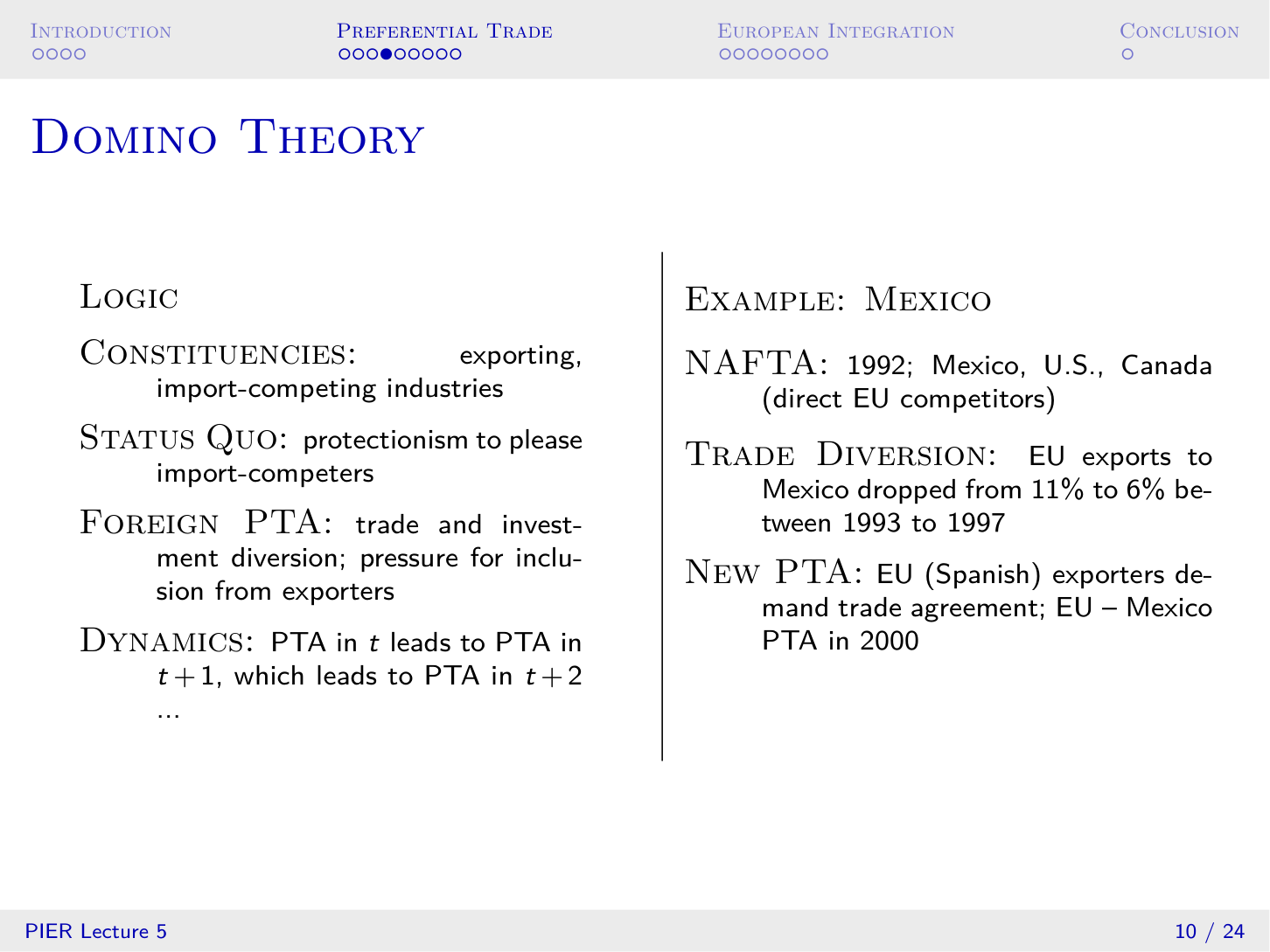
A and B sign a PTA → firms in excluded country C lose competitiveness/market share → C’s exporters lobby for their own agreement → further excluded countries react.
Diffusion through competition: foreign agreements change domestic lobbying incentives.
Mexico example: 11% → 6% refers to the EU share of Mexican imports. European exporters then pushed for EU–Mexico liberalisation.
PTA Winners: MNCs
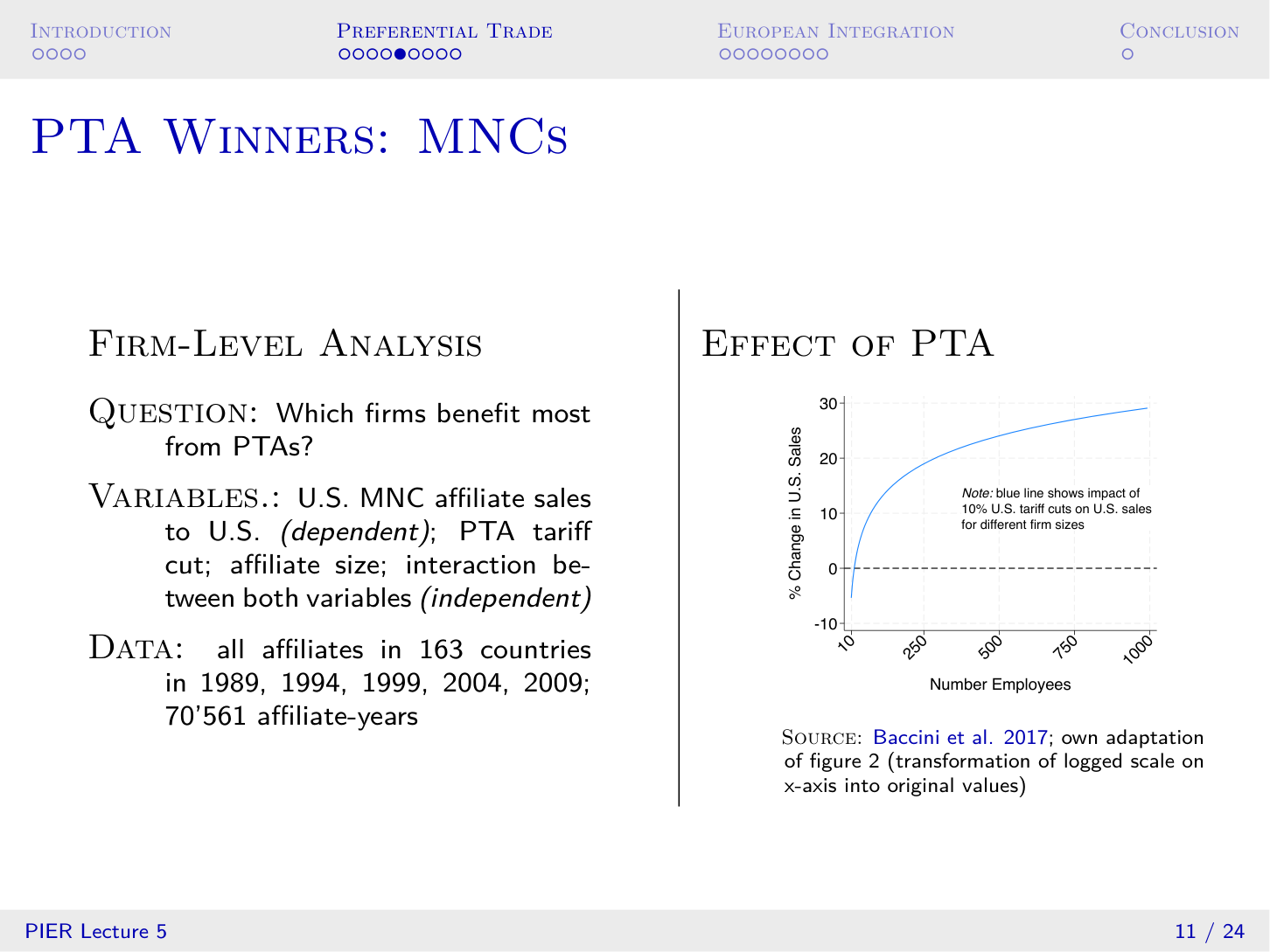
Much trade takes place within multinational production networks: intermediate goods cross borders before final assembly.
- Outcome: U.S. affiliates’ sales back to the U.S., e.g. GM Mexico → U.S.
- Interaction effect: the gain from a tariff cut increases with affiliate size.
- For the same 10% tariff cut, small affiliates gain little; larger affiliates gain substantially more. Large MNCs therefore have strong incentives to lobby for PTAs.
Development Strategy
Time-consistency problem: government promises favourable conditions → firm builds an immobile factory → government can then change taxes/rules. Investors anticipate this risk.
PTAs lock in reforms and make investment promises more credible → help developing countries compete for FDI.
FDI Risks and Solutions
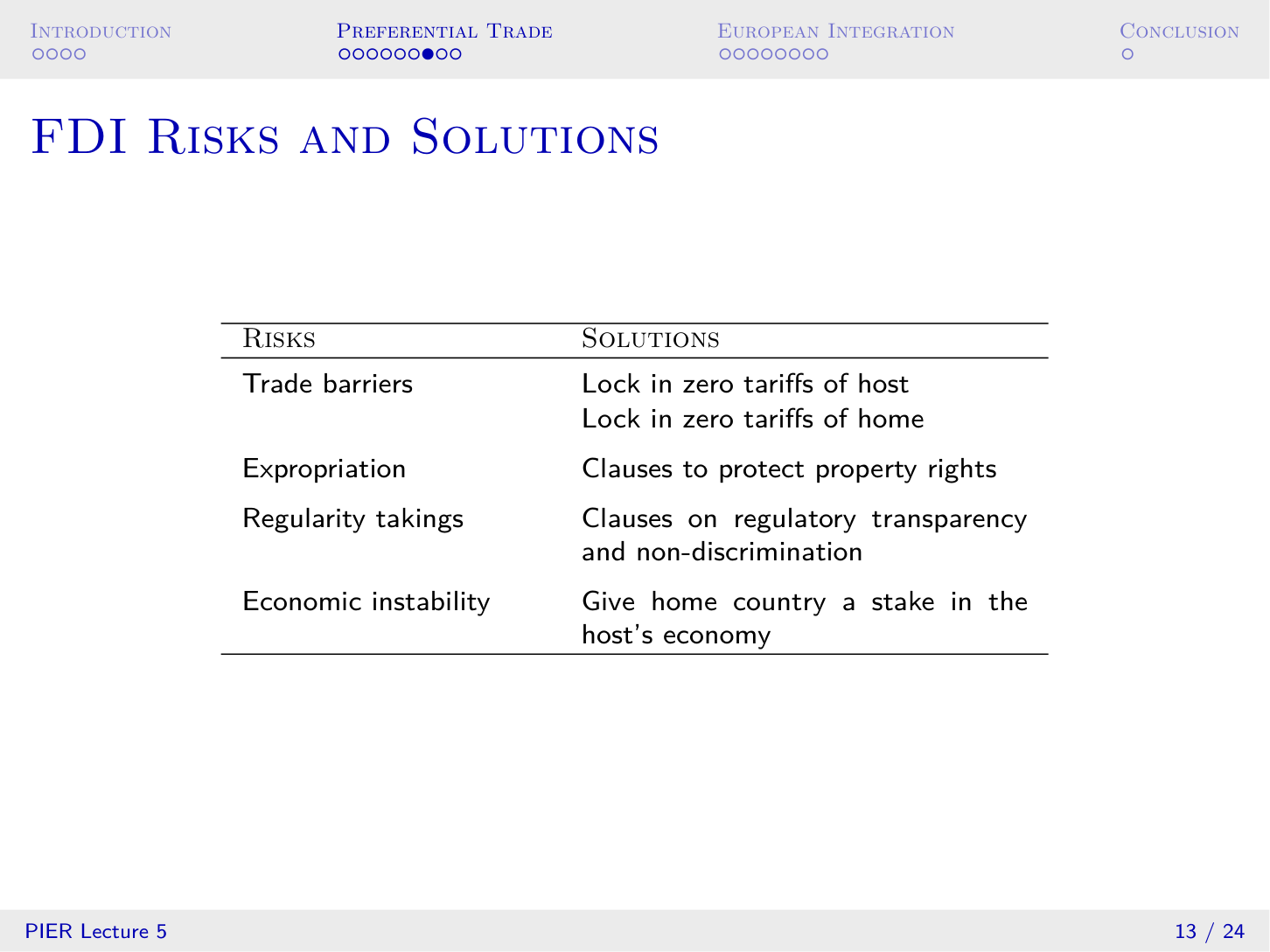
- Need low host-country tariffs to import inputs and low home-country tariffs to sell the output.
- Regulatory takings: ownership remains, but new regulations restrict how the investment can be used.
Economic Reform
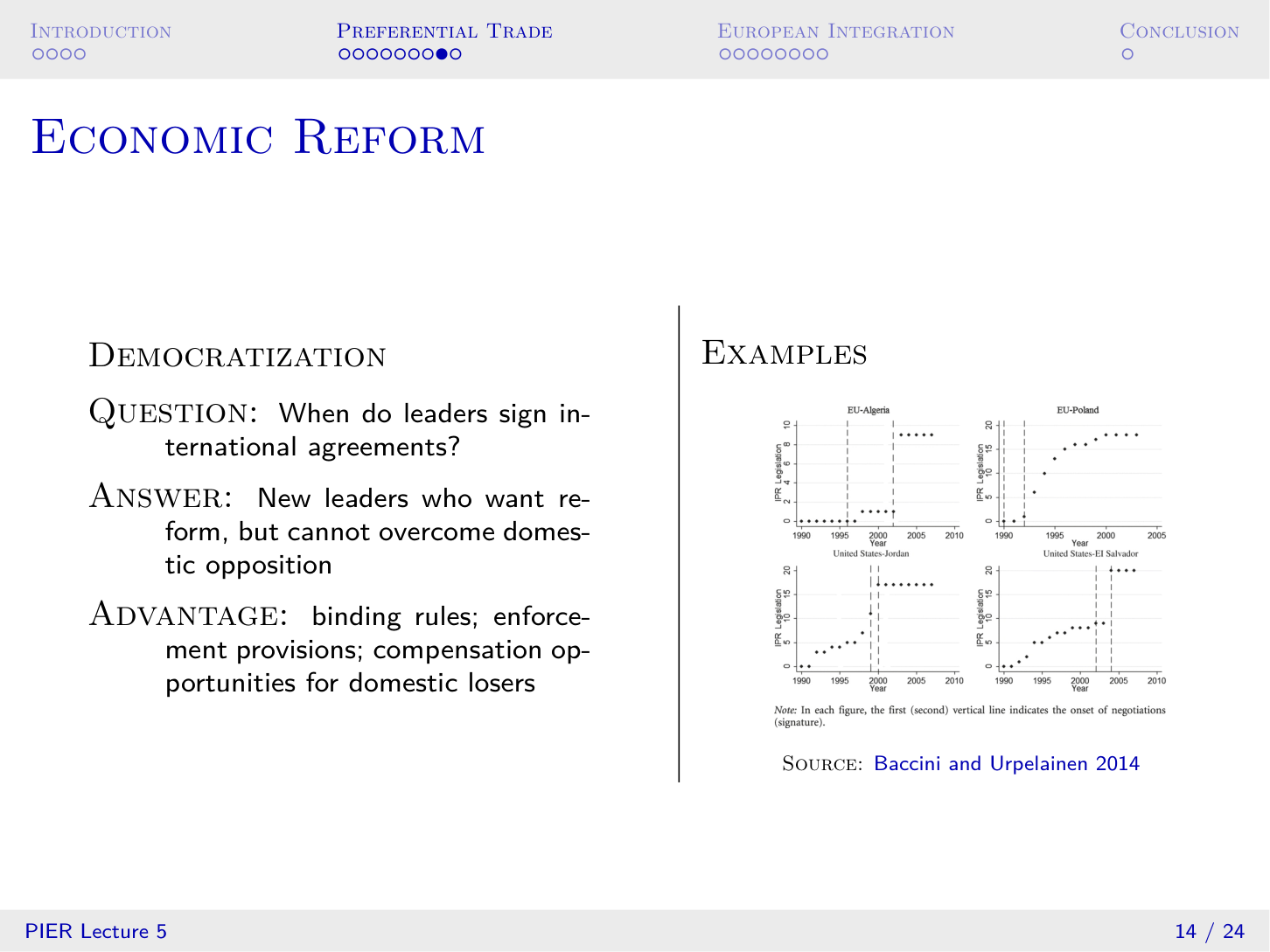
New reforming governments face resistance from established economic elites. A PTA offers those elites access to foreign markets, making reform more acceptable, and locks reforms in against reversal.
Graphs: first dashed line = negotiations begin; second = signature. IPR reforms increase around the agreements.
Political Risk
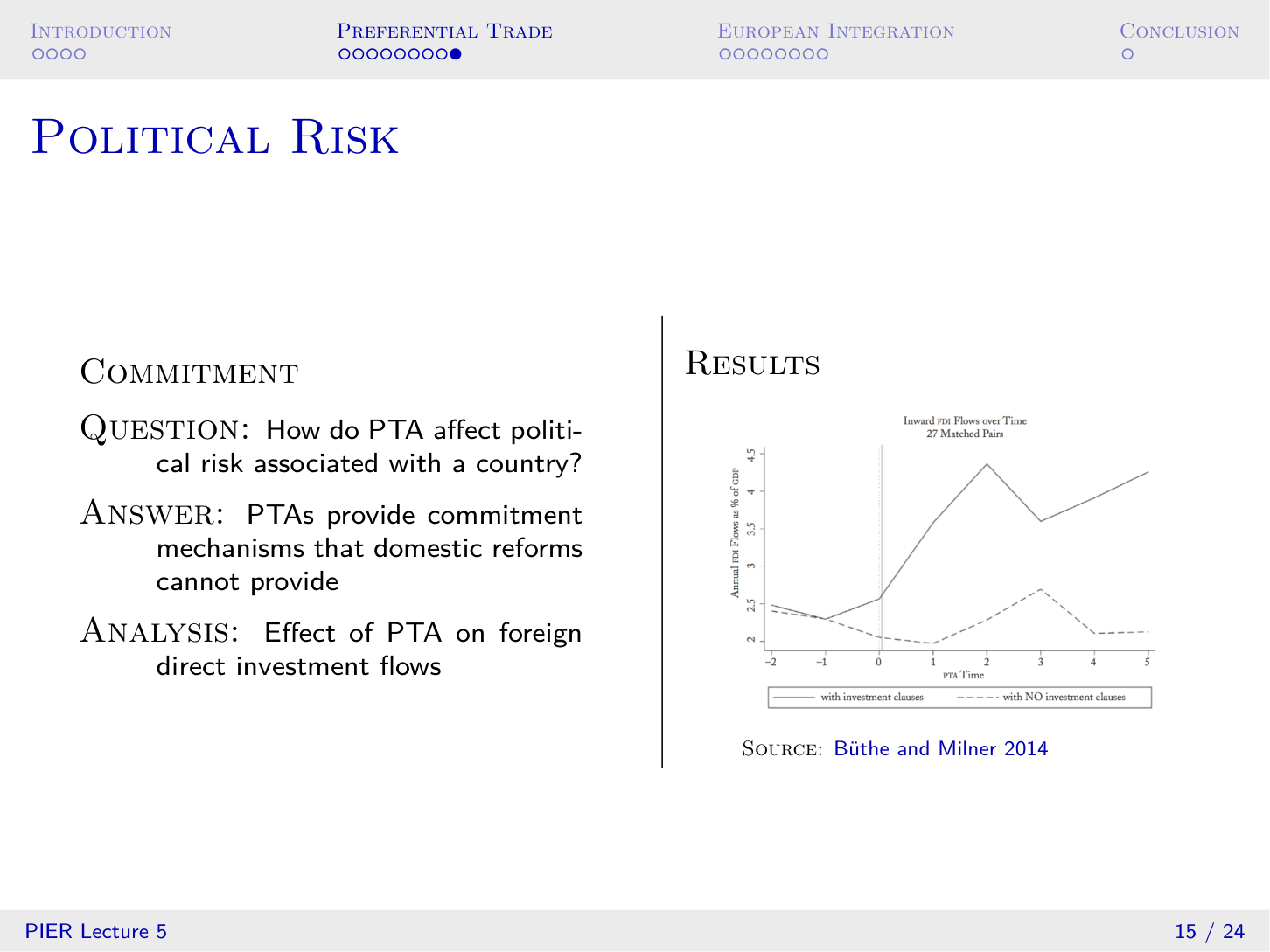
Matched pairs: compare countries with similar observable characteristics but different PTA investment provisions.
After signature, FDI rises more with investment clauses → evidence supporting the commitment mechanism.
European Integration
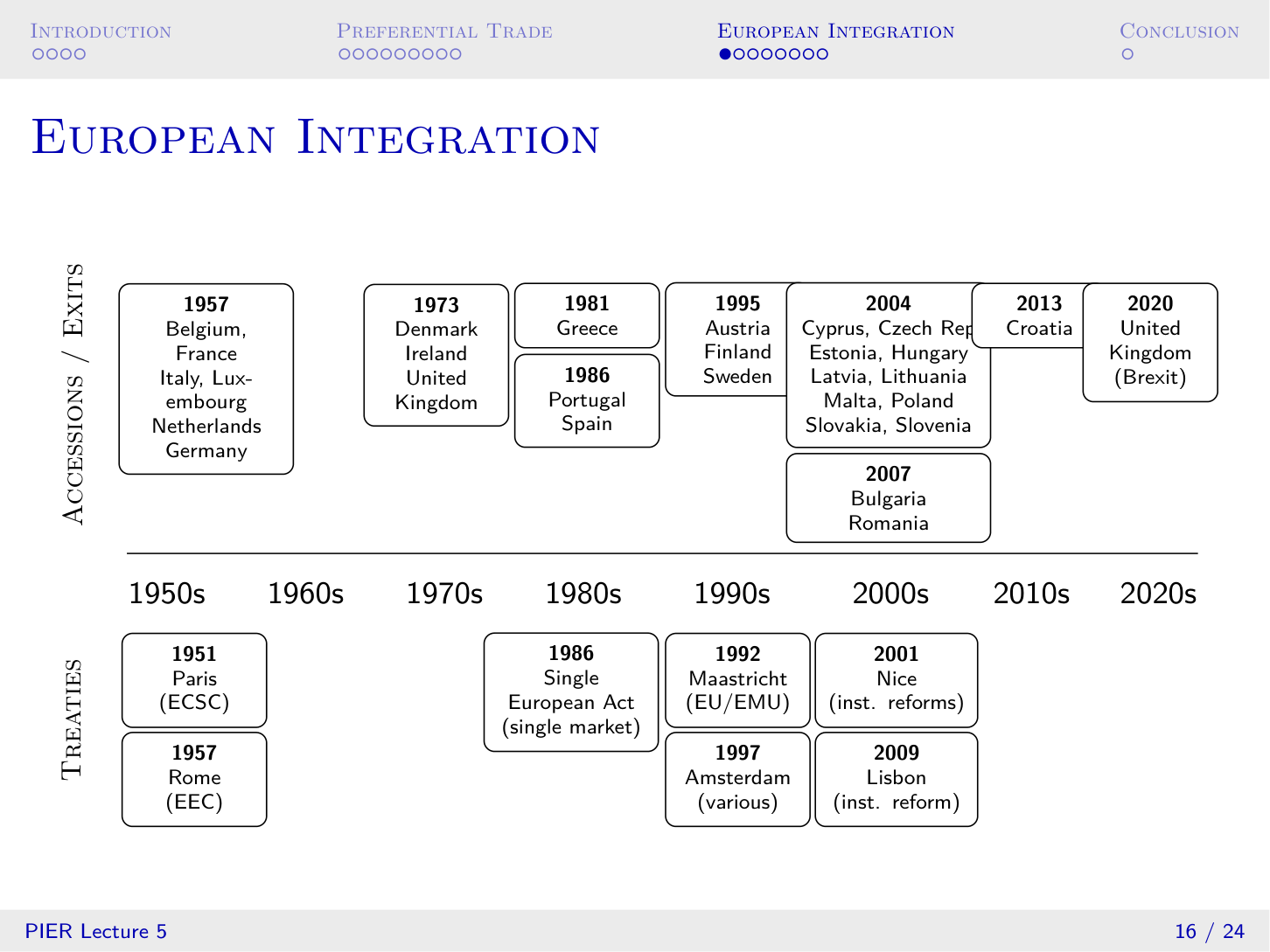
ECSC = sectoral integration → EEC = broader integration → single market = factor mobility → monetary union = shared currency.
Widening: more members. Deepening: greater integration.
Intra- / Extra-EU Trade / Investment
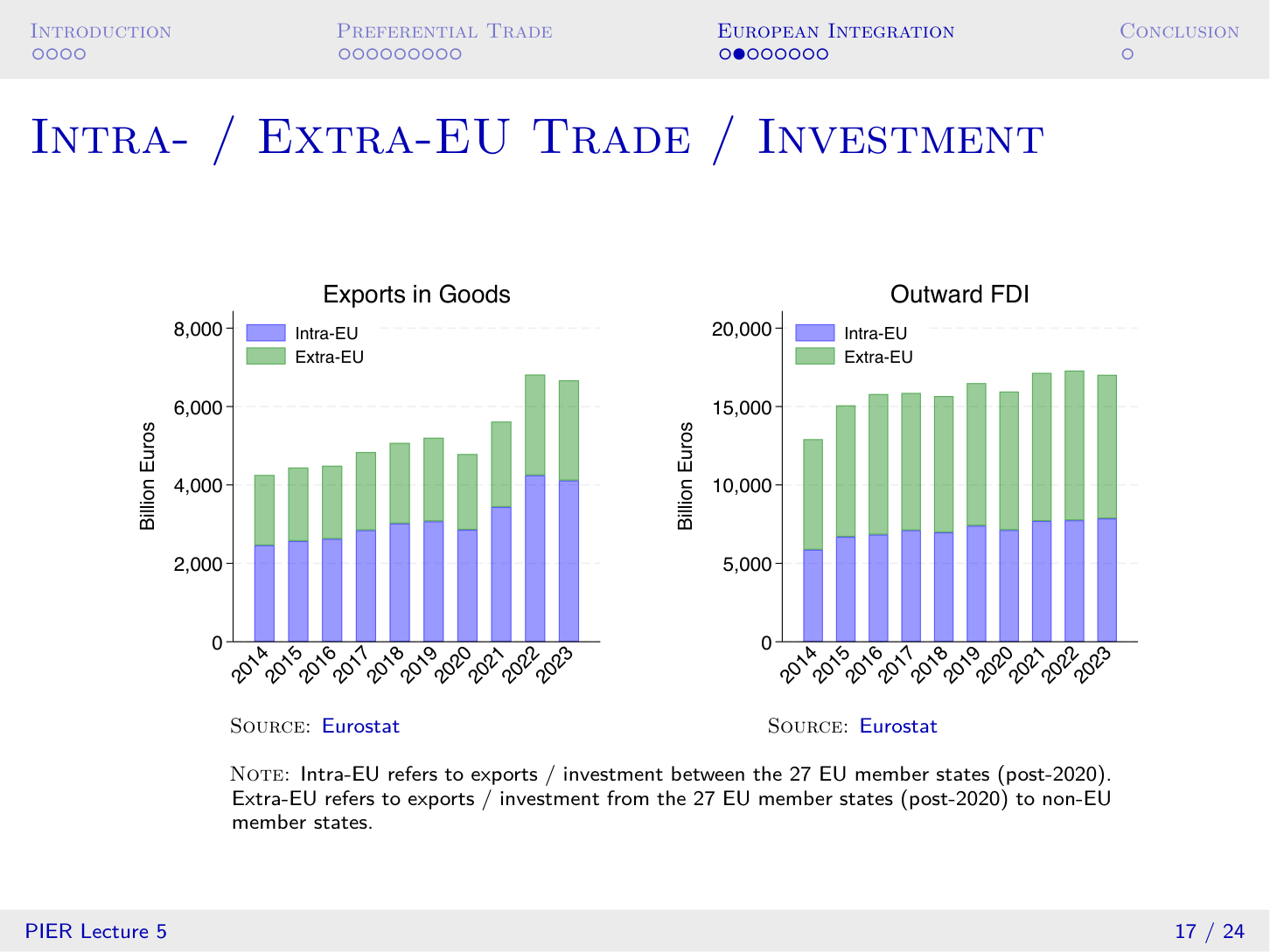
- Roughly two-thirds of goods exports shown are intra-EU.
- More outward FDI goes outside the EU: global production exploits differences in wages and factor endowments.
- Constant EU-27 definition: UK treated as non-EU throughout the graphs.
European Monetary Integration
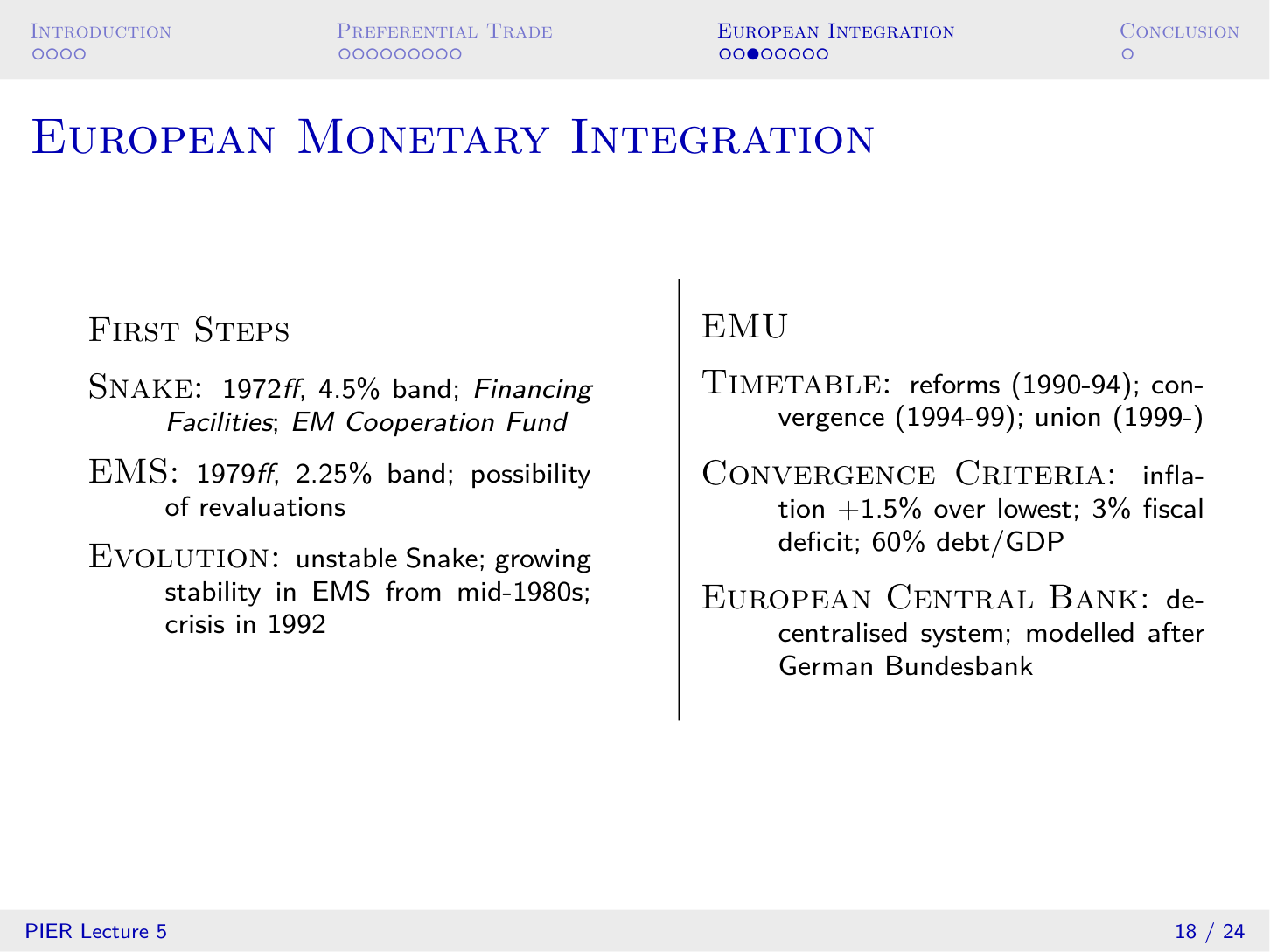
Breakdown of Bretton Woods → attempt to preserve exchange-rate stability regionally.
Snake unstable; EMS became more stable as French policy converged toward Germany’s restrictive approach. ECB modelled on the independent Bundesbank.
Optimum Currency Areas
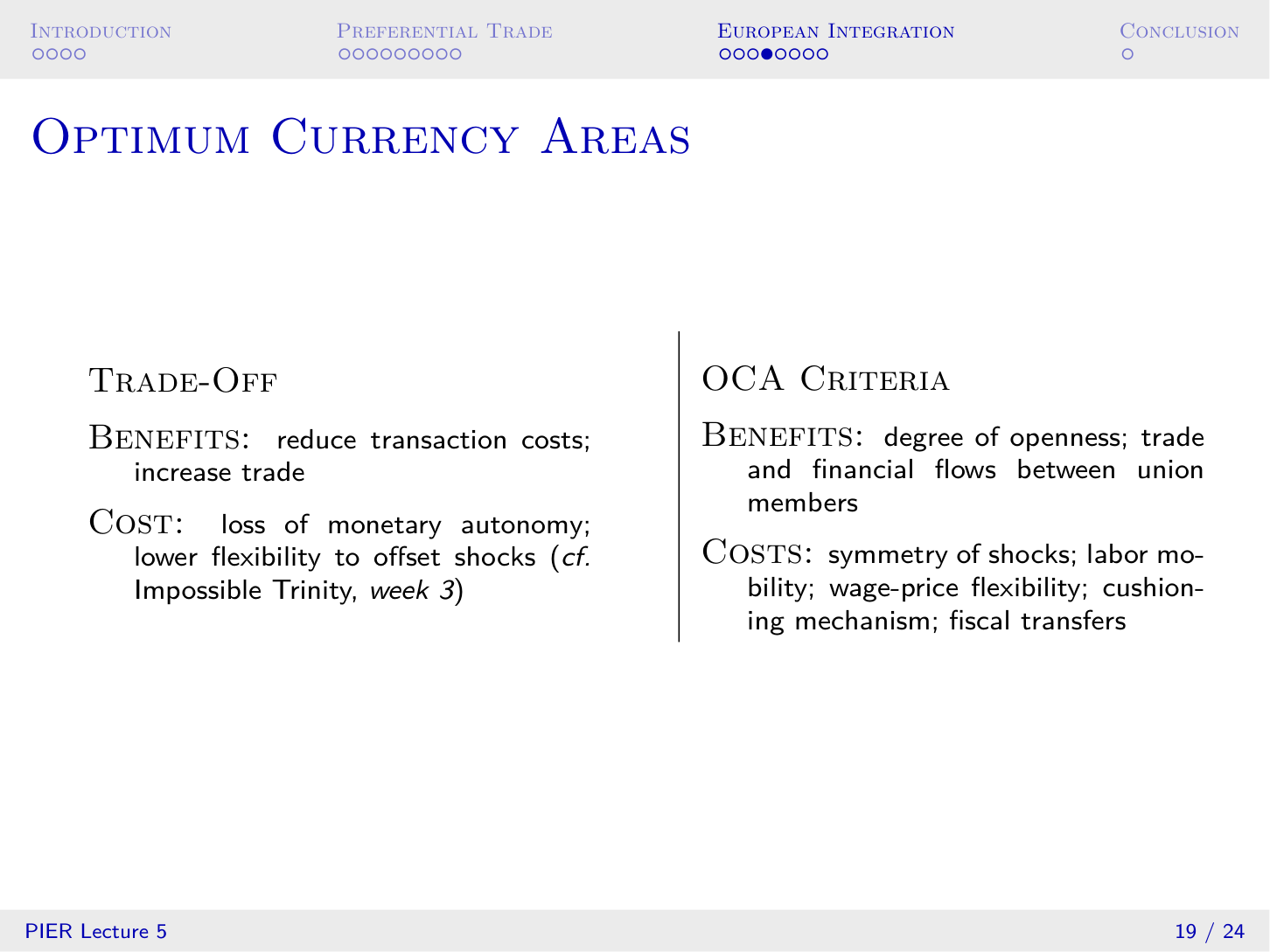
Trilemma: capital mobility + fixed exchange rates → loss of national monetary autonomy.
- Symmetric shocks: a common monetary response can suit members.
- Asymmetric shocks: members need different responses but cannot adjust monetary policy separately.
- Labour mobility, wage flexibility and fiscal transfers help absorb these differences.
Is EMU an OCA?
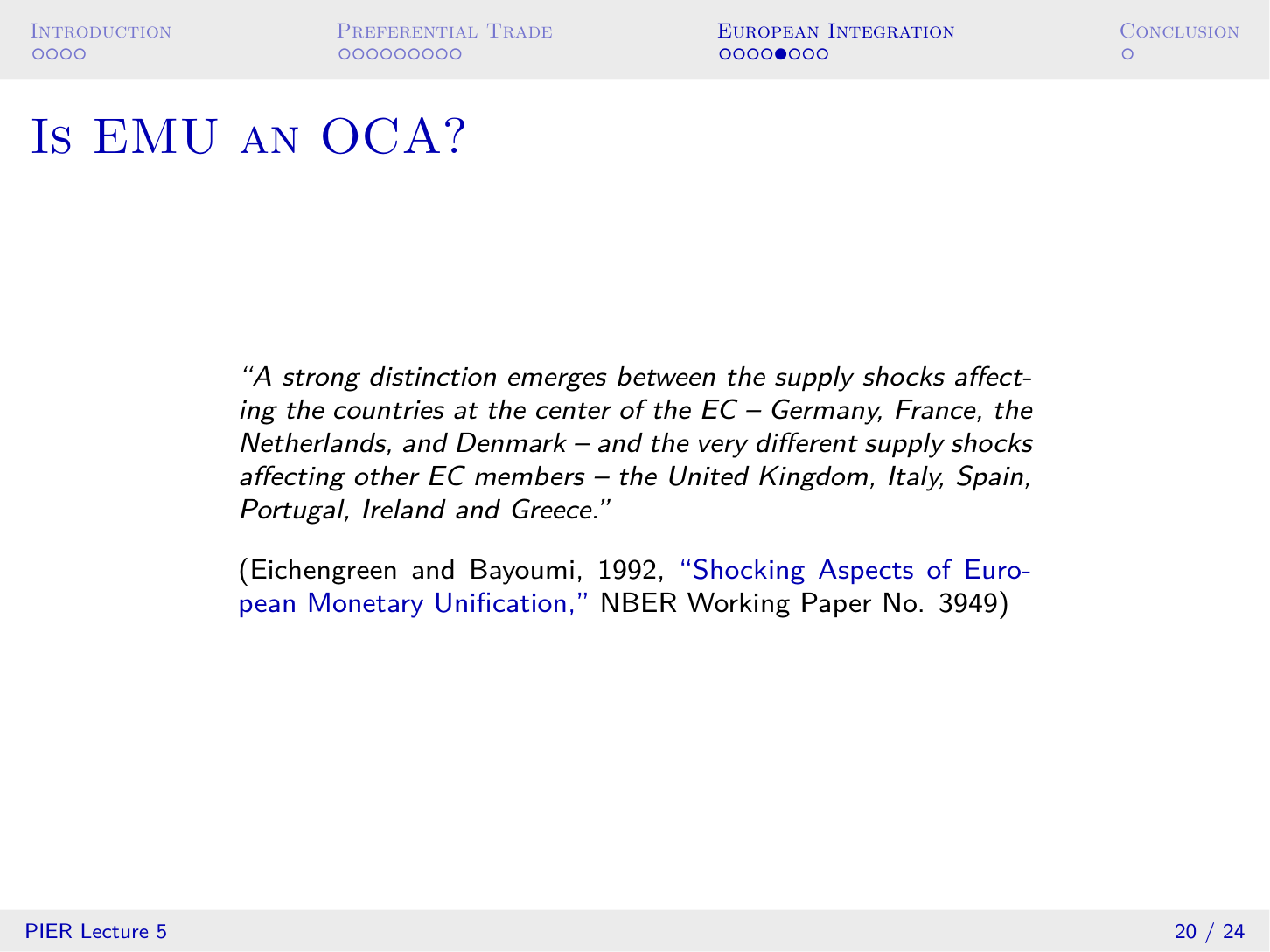
Asymmetric-shock problems were identified in 1992, before the euro. Several countries identified later became crisis countries.
OCA efficiency alone cannot fully explain monetary integration → political explanations.
The ‘Real’ Reasons
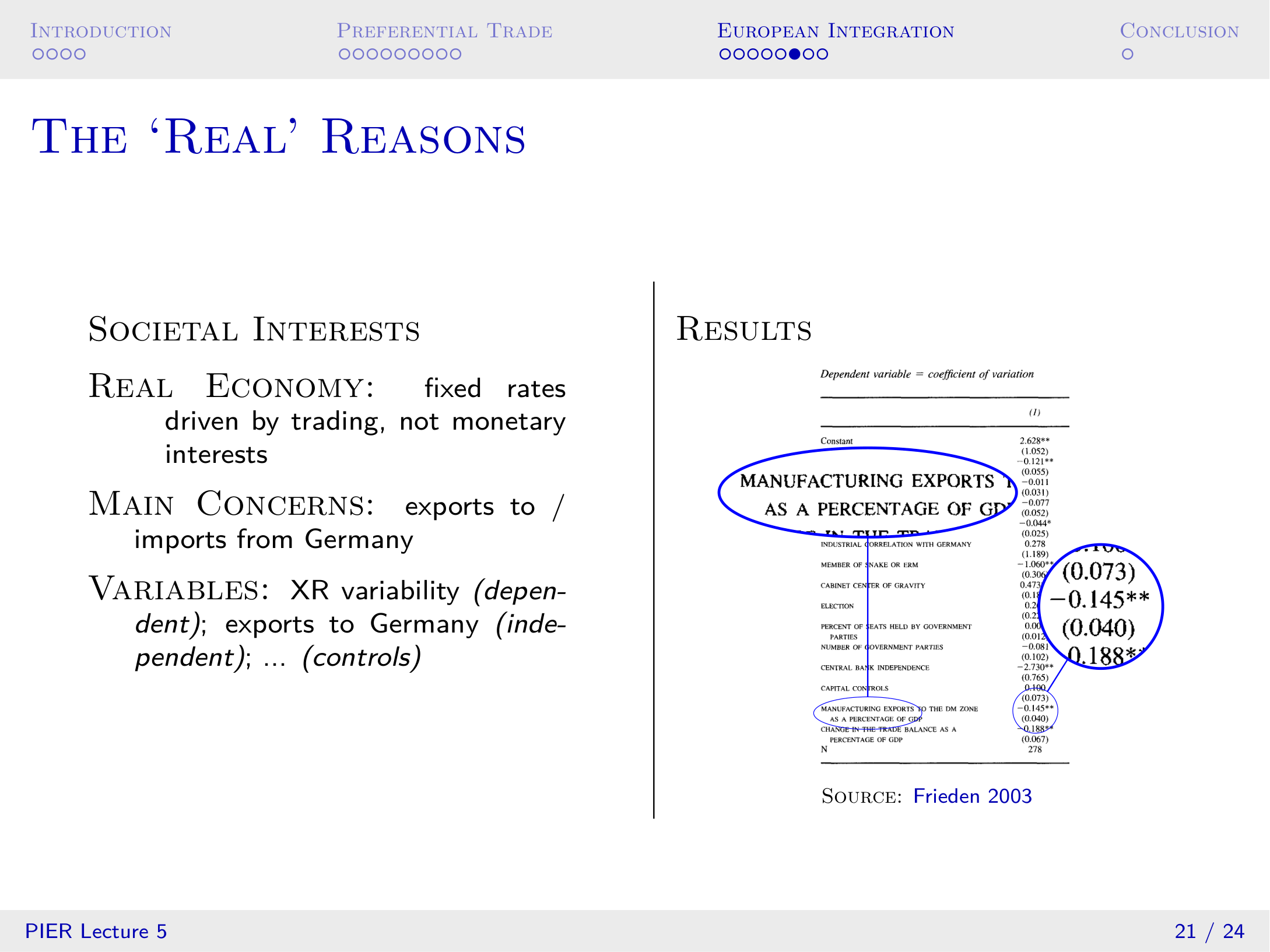
More trade with Germany → stronger demand for exchange-rate stability.
Regression: exports = independent variable; exchange-rate variability = dependent variable. −0.145: more exports associated with less variability. Stars indicate statistical significance.
Credibility
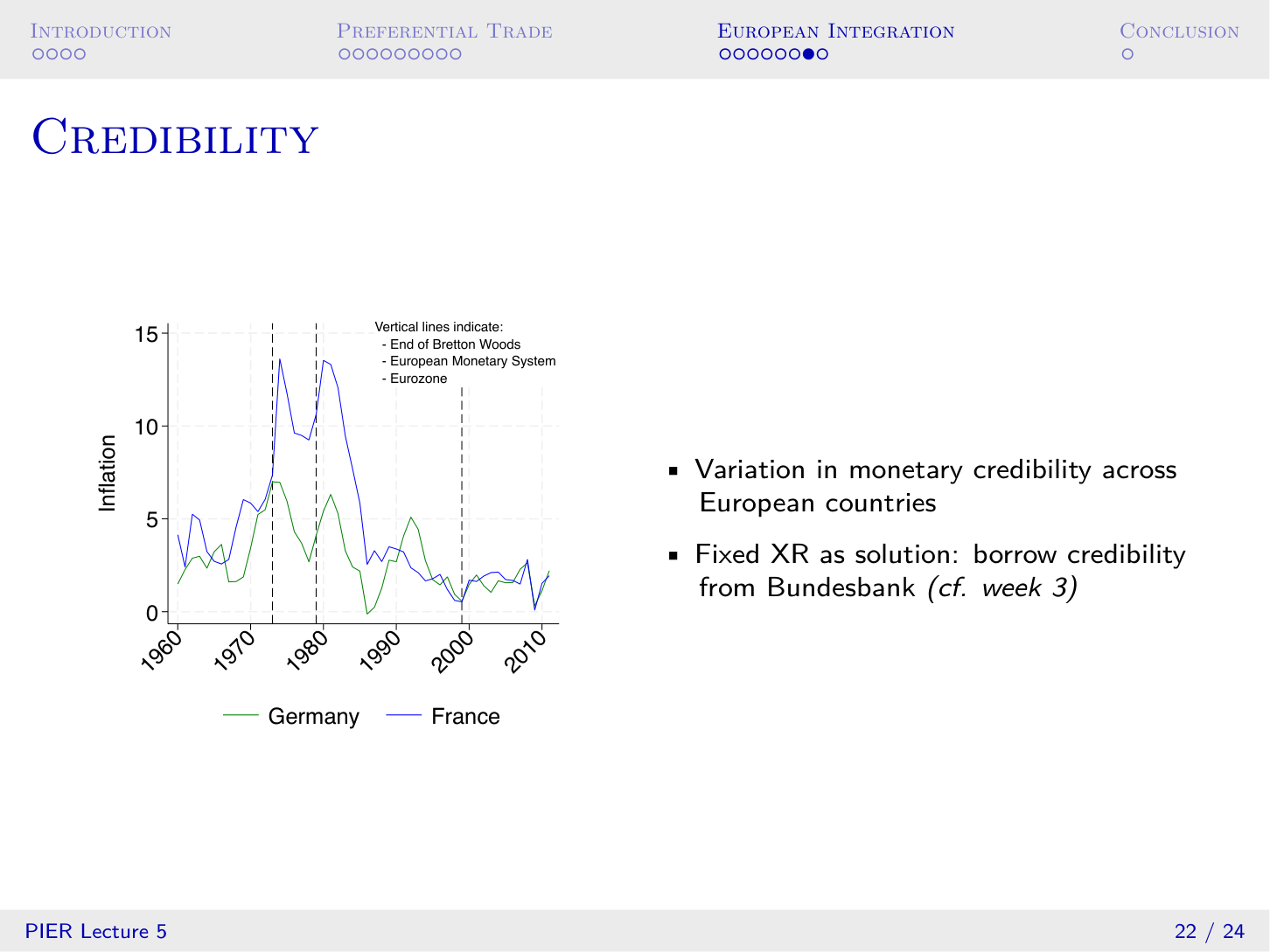
Political pressure for expansion creates inflation/credibility problems. Fixing to the Deutsche Mark lets governments borrow Bundesbank credibility and constrains monetary policy.
Convergence of Ideas
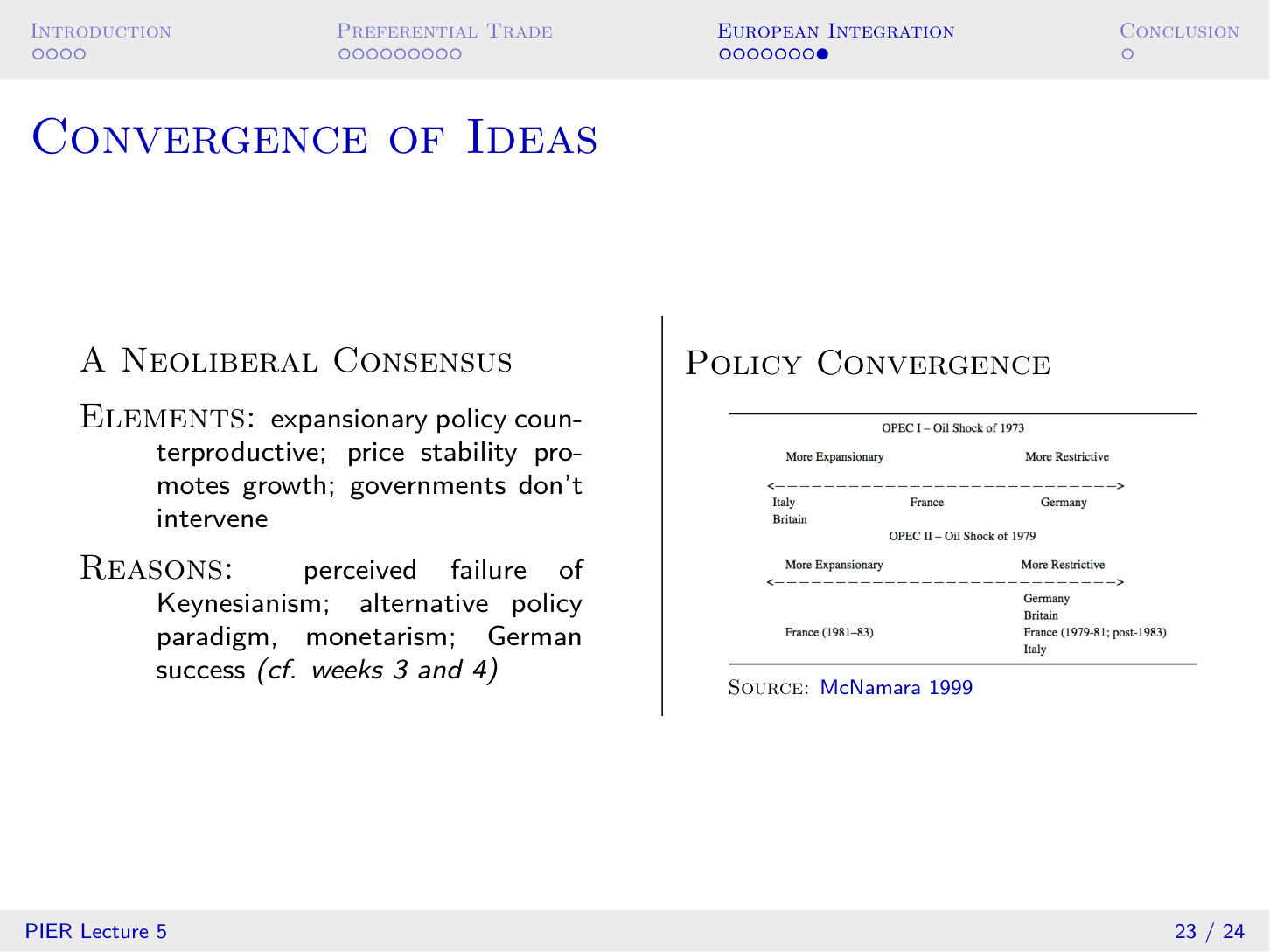
Germany’s perceived success + perceived failure of Keynesianism → shift toward monetarist beliefs → restrictive policies. France’s 1981–83 expansionary experiment was followed by a restrictive turn.
Institutional vs. ideational mechanisms
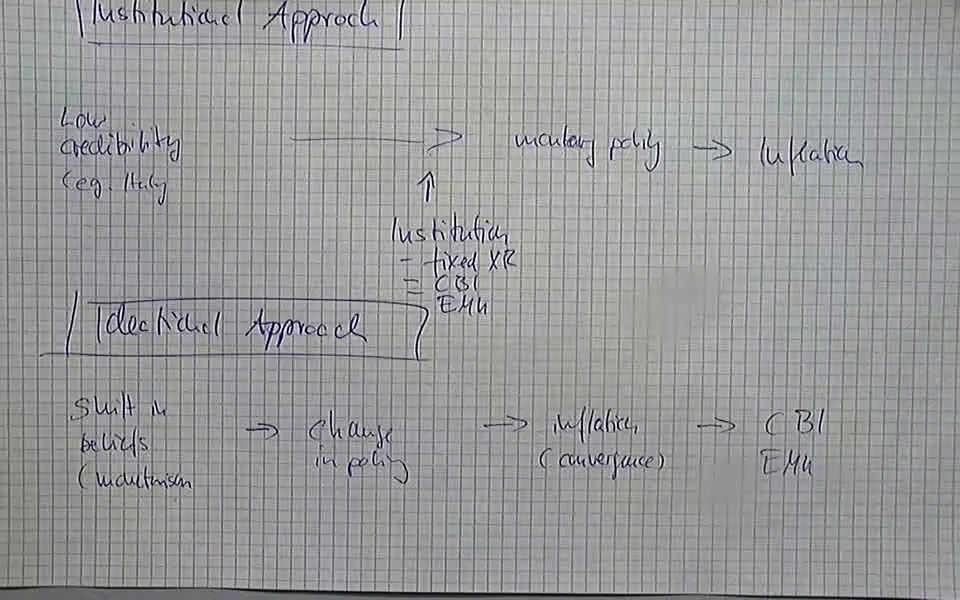
- Institutional: low credibility → monetary policy → inflation. Institutions moderate the credibility-to-policy relationship: fixed exchange rates, CBI or EMU weaken the effect of credibility problems on policy. Institutions are an explanatory variable.
- Ideational: shift in beliefs → policy change → inflation convergence → CBI/EMU. Institutions formalise prior changes; they are an outcome.
Same broad outcome, different causal mechanisms. CBI = central-bank independence.
Conclusion