Climate Change and International Law
In 1988 the IPCC was created, after a lot of literature and scientific material in general starts to look into human impact on climate: climate change. It wasn’t sure in the 1970s. And the doubts were anthropocentric, worrying about crop yields and all that.
The IPCC makes reports which come with summaries for policymakers, it’s not for scientists. It’s not just meant to clarify and develop the science but formulate recommendations to national policymakers and international negotiators. Indeed this is very fitting, in 1988 we have the very first UNGA resolution on climate change.
UNGA Resolution 43/53
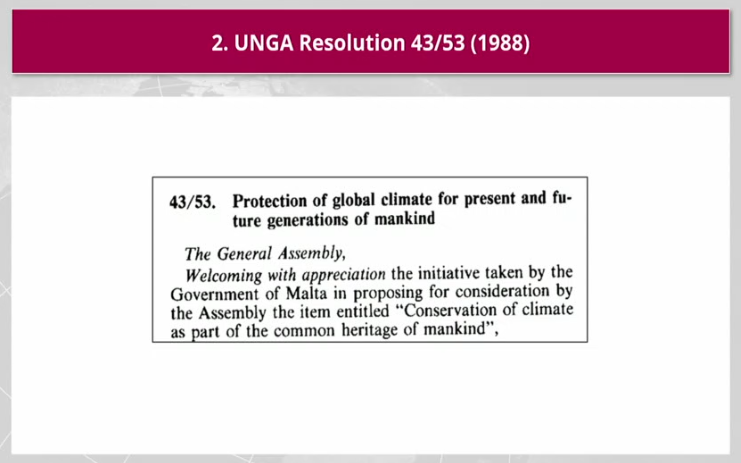
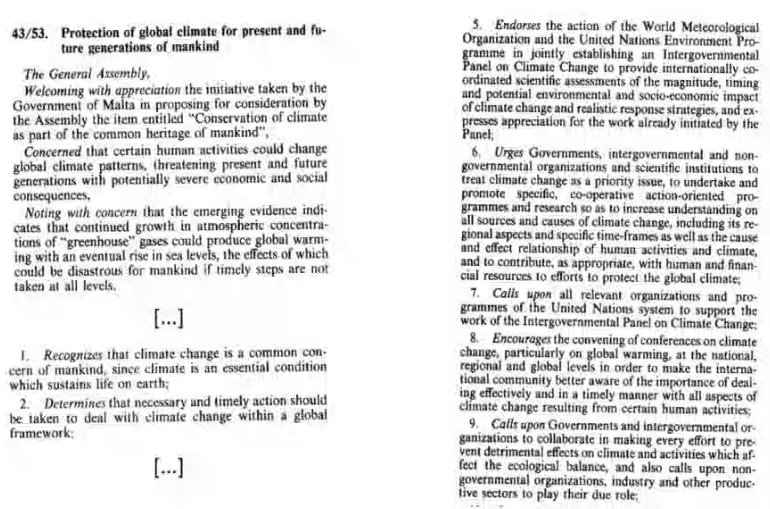 Welcomes the creation of the IPCC and all of that.
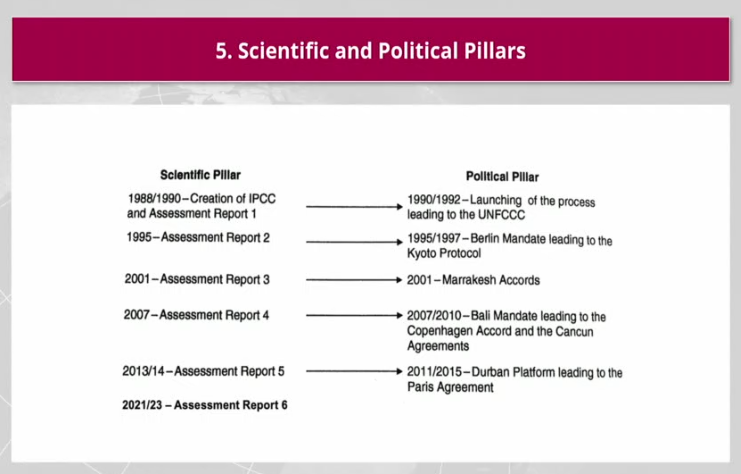
IPCC Reports and consequences
First in 1990.
UNGA resolution 45/212
Says despite scientific uncertainty countries should cooperate on it and a resolution of the UNGA recalls it:
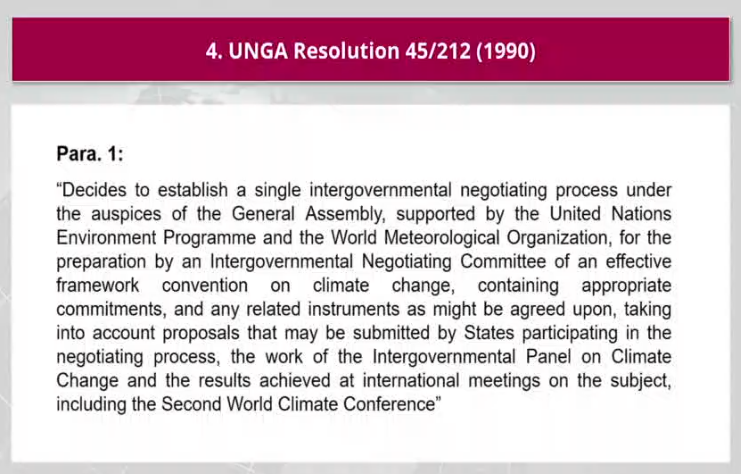 A great example of precautionary action: adopting an instrument. See the precautionary principle in the UNFCCC. And so they did. As often happens, developments in IEL follow scientific developments. Each report improves, and so does the law; we start with the more bare-bones UNFCCC and progress from there.
UNFCCC
 A framework convention is easier to negotiate, it isn’t really a treaty→more like soft law: vague objectives. You can’t implement without an additional instrument, you are setting up the grounds for a future protocol. Preamble quite problematic though:
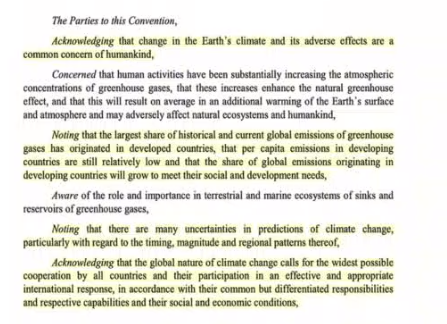 Some countries, particularly vulnerable, wanted climate as common heritage (like the deep seabed). But it was just written as a common concern… so they have to meet often (COP, once a year) to talk about it. But the part that is really tough is the one about developed countries. Like principle 7 of the Rio Declaration. Now many point to this and say not emitter historically=I do nothing. Here its CBDR&respective capabilities (key principle in the climate change regime).
Objective
Reducing the concentration of greenhouse gases to a level that prevents dangerous anthropogenic interference with the climate system.
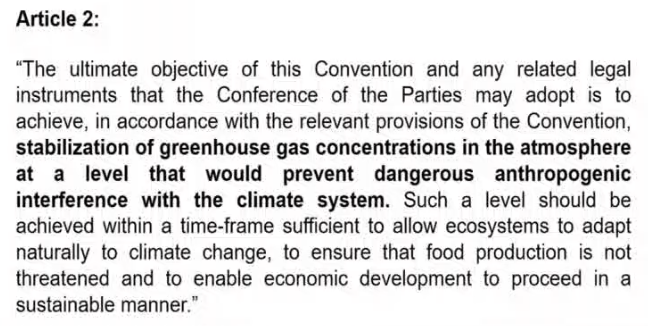 Even if now they understood that it was emissions… it was 1992, only based on the first report of the IPCC. They just don’t say what the level is, negotiators just didn’t have the science to be more ambitious.
Here we mitigate, but we don’t prepare for adaptation→learning to live with the problem (e.g. climate ready seeds that are resistant to drought). It isn’t until Copenhagen that we actually think also about adaptation.
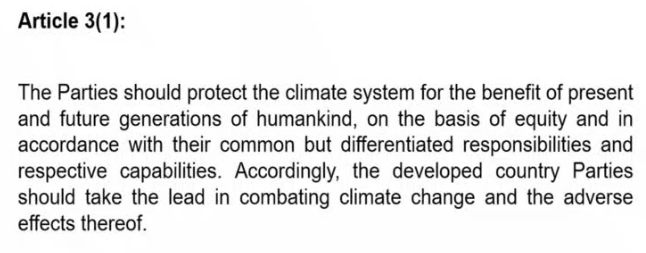 We can find the principles of intergenerational equity, CBDRRC, precaution, sustainable development (accent on promote!, and should only between commas which allows some to disregard).
Annex
You have countries (developed, OCDE members very developed… or some in transition, etc.). These are Annex 1 countries, the rest are non-annex 1. This way you have some obligations that are not common but only for some. Art. 4(1) is common (sharing national emissions data) and (2) is only for annex 1 (reducing emissions).
There is also a subset of the very rich in annex 1. For giving financial assistance.
Then you also have article 4(8) where another subset (of non-annex one countries) is created:
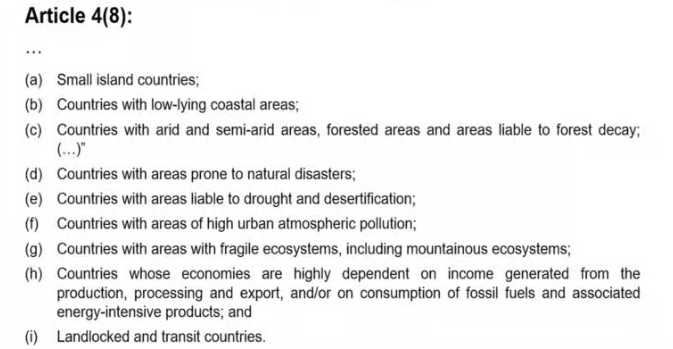 Weak countries in this domain so they get technical assistance first, shouldn’t be hurt by measures of another countries, etc.
Kyoto Protocol
 Entered into force in 2005, to give annex 1 countries more obligations. 8 years for only some countries to reduce emissions. There are 2 conditions, that made sense taking into account the goal, for it to actually come into force:
- 55 parties, easy developing countries ratified it as they had to do nothing.
- Annex 1 countries that make up for at least 55% of all annex 1 countries emissions, if not it doesn’t make a difference.
- USA were very active in the negotiations, signed it… changed the government and didn’t ratify it because of the rigidity of the annex 1 list. If India, China, etc… don’t change we don’t. And they were 25% of emissions in annex 1! Canada and Russia (EU convinced them, in exchange they made it easier for them to join the WTO) saved the day by joining.
Actual obligations
So those that ratify and are in annex 1 have to reduce their emission by a certain % relative to a certain period (1990). The gases to be reduced are in annex A and in annex B you got the list of annex 1 countries and their emission reduction percentages.
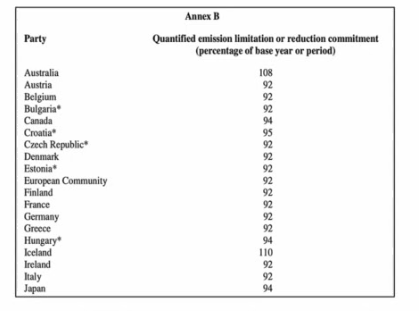 Some like Australia can even increase emission levels compared to 1990 but it’s still less than they did at the time as during that decade they increased them a lot. It’s really based on historical emissions whereas annex 1 was more about development (OCDE, etc.).
4th IPCC report
Most alarming, probably, report of the IPCC→stop annexes and subsets and adapt… the damage is done and is irreparable. Negotiators at COP heard this and did the
Bali Action Plan
First COP decision to refer explicitely to the IPCC.
 The idea was to adopt a treaty to get everyone to reduce their emissions in Copenhagen in the next COP.
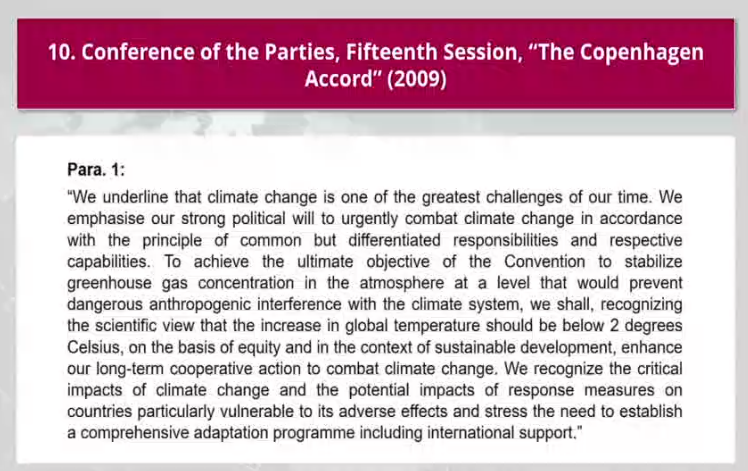
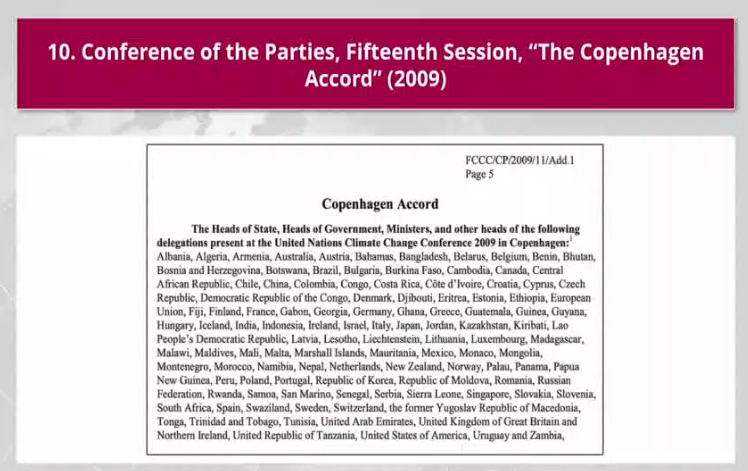 But nothing worked. Many signed it but the content was very soft. The only positive thing is that there is a figure for the first time: 2Cº (maximum increase in global temperature).
 2012 was approaching, the end of the Kyoto Protocol. It was thus amended for a new commitment period. The Doha amendment didn’t however enter into force until December 31st 2020.
Paris Agreement
During the COP (2015).
 Finally a global treaty, everybody reduces! In Paris we leave the top-up for a bottom-up approach, everyone reduces but we don’t say how much. They decide their emission reduction target. The only obligation is to communicate what you do. In the USA legal system it is an executive agreement, by their internal law and the way that the treaty works, so they can get in and out presidentially whenever they want. Now we see the issue.
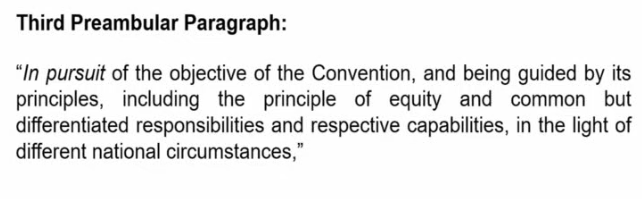 Paris abandons annexes and all that but doesn’t abandon CBDRRC, countries are a spectrum and special. They, on the basis of their context, decide on reduction. A bottom-up way of doing CBDRRC.
See the political and institutional analysis of Paris’s bottom-up architecture.
Article 2
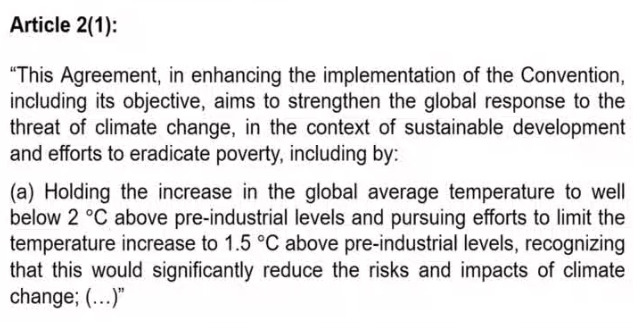
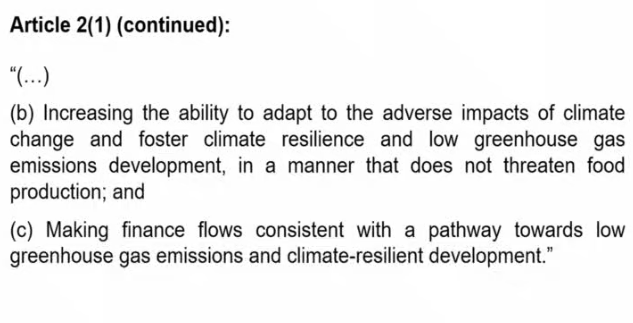 Here is the objective, much more sophisticated (adaptation as well as mitigation). Everyone’s efforts have to be directed to not getting over 2Cº and preferably 1.5Cº. Developed countries saw 2 as more realistic, 1.5 was aspirational (quite difficult) and the treaty would have just become useless. So they just did this to please everyone, some vulnerable or others did want 1.5.
Overtime, thanks also to a report of the IPCC, we consider 1.5 the actual objective and courts like the ICJ also use it.
Contributions
As they are quite bottom-up, they are nationally determined contributions (NDCs) to the global response. They need to help get to the target, be ambitious and reflect progression over time.
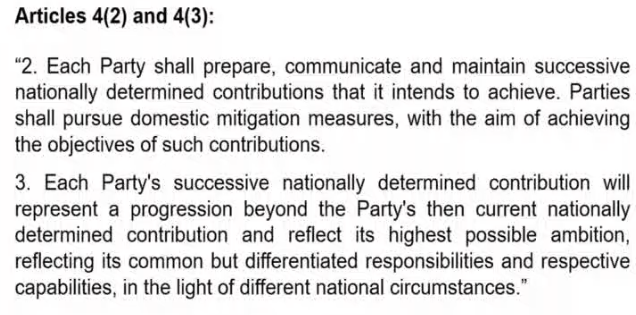 Then you need to implement domestic measures to actually meet your target. For a long time we just thought the content was freestyle (has to contribute and indeed advisory opinions of courts mobilised this to challenge this freestyling perspective). But the thing is that this is helpful, because you can challenge violations in national courts and not have to go international.
Withdrawal
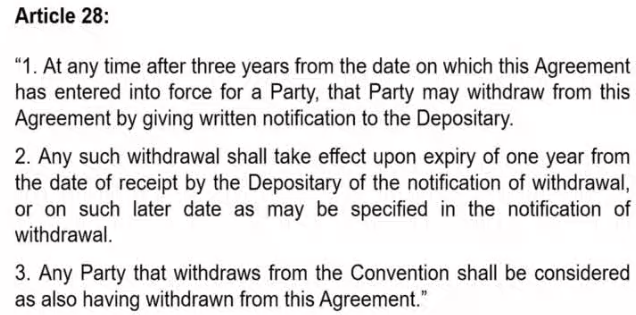 You need to wait 3 years and then it takes effect after one year. E.g. DJT:
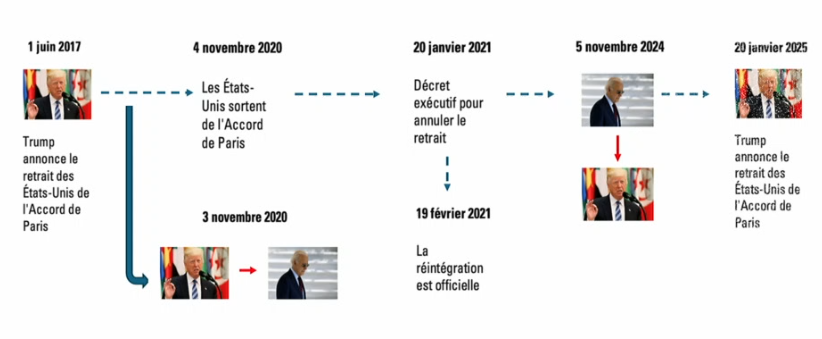
US withdrawal
The USA also withdrew for a lot of other organisations like the IPCC.
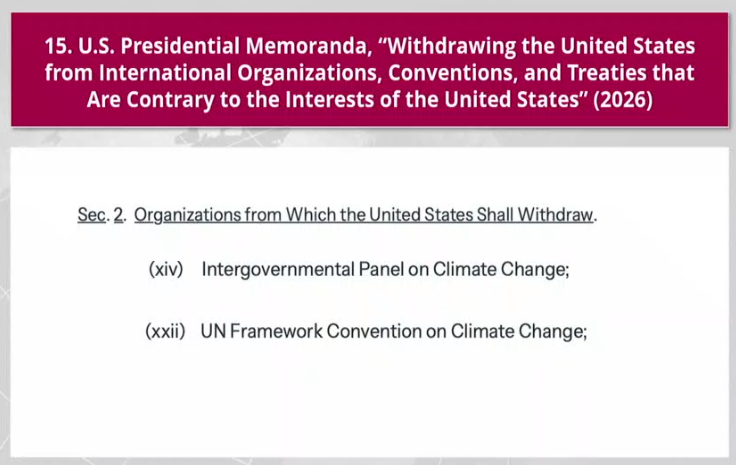 If they get out of UNFCCC getting in again requires congress and that’s hard to get, not presidential like Paris… and these issues with the framework are bipartisan (also 1992 treaty which is kinda dated). But obligations are also in customary law and other treaties, they still have to reduce emissions.
ITLOS advisory opinion
 Most courts have an advisory function indeed. It’s purely about the law, not specific questions. Interamerican court gave their opinion on instruments on the regional sphere, the ICJ also got the same request (even got to the UNGA) which responded quite surprisingly despite their conservatism and then we got the ITLOS one.
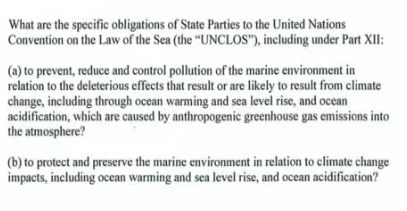
UNCLOS

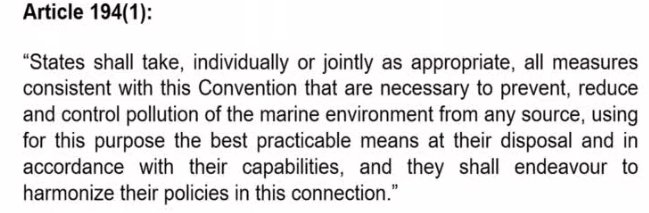 Protect and preserve, reduce pollution… But was the idea really pollution as in emission? This was way before IPCC. Nobody had them in mind the sources show this but ITLOS said yes whatever.
They also recognised the 1.5Cº limit and underlines the need for due diligence (but more stringent, because of the severe harm that is at risk of being made to the marine environment). Also says that complying with UNCLOS doesn’t mean you complied with Paris or all your obligations.
ICJ advisory opinion
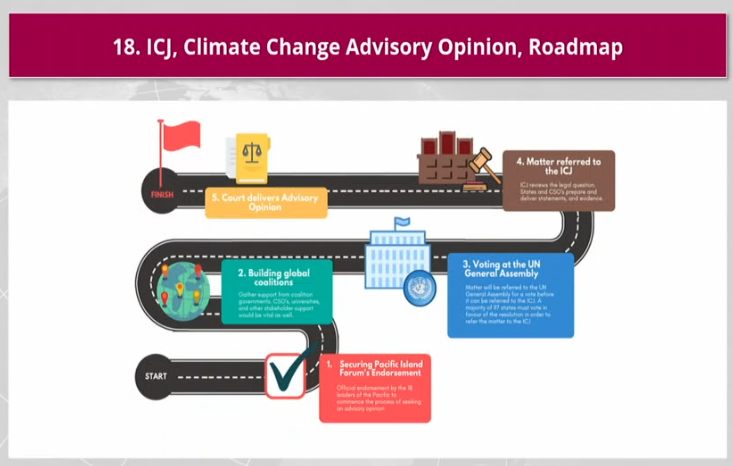
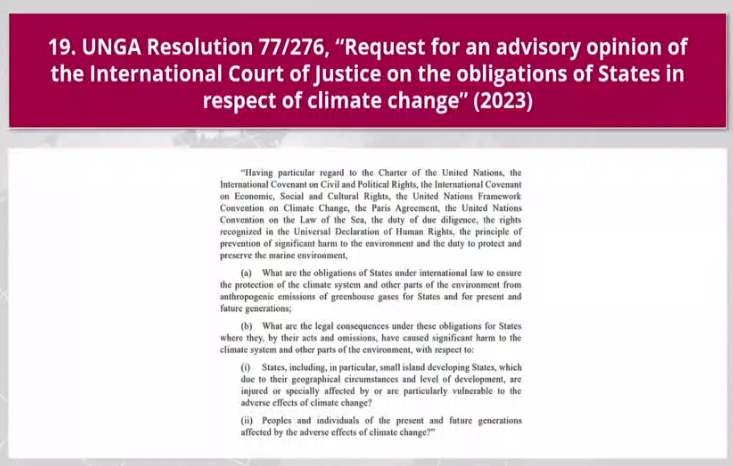 The preamble says which instruments should be looked at like UNCLOS, customary law, Paris, the 2 covenants on HR, etc. And the questions:
- What obligations?
- Which consequences in case of violation?
The ICJ considered the science, saying the IPCC is the best producer of science and it should be used for policy-making+1.5Cº limit recognition. The court said that withdrawing from all climate treaties doesn’t free you. There are other treaties that have to do with climate change and there are also HR laws, customary law or UNCLOS and many more. They also said that prevention can be applied to climate change.
And with Paris? How free are countries? The court said that it is clear that there has to be contribution and they recognise the target of 1.5Cº.
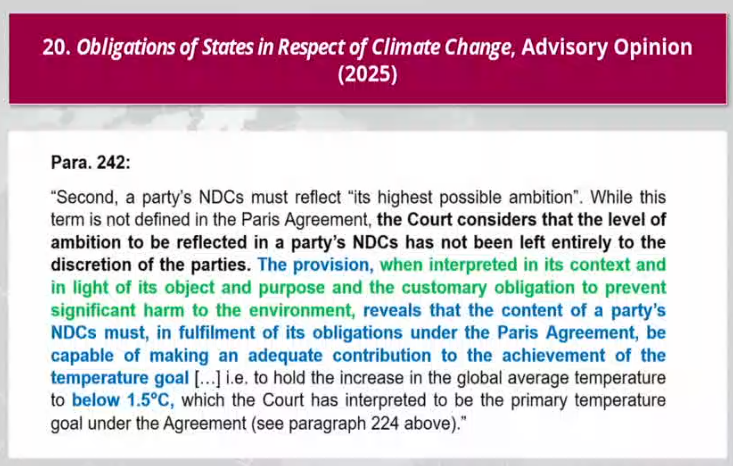 You got discretion but your target has to allow you to make an adequate contribution to the goal. Based on science, they have talked about carbon budget: how much we can still emit while still meeting the target. If you aren’t ambitious enough you aren’t satisfying customary law nor Paris.
And for consequences?
ICJ said we don’t care about causation, reducing the conduct to a state and normal legal consequences apply (stop and repair damage). How much to repair? No facts this is advisory, maybe in a specific case they’ll say. They’d probably try to asses it proportionally relative to contribution.
The court also singled out fossil fuels as an issue constitutive of violations (even grant of licenses for exploitation).
So?
Maybe this could be used in investment arbitration and that mainly it’ll need to change. Negotiation on fossil fuels or plastic could change.