Of IEL and Global Environmental Governance
Recap
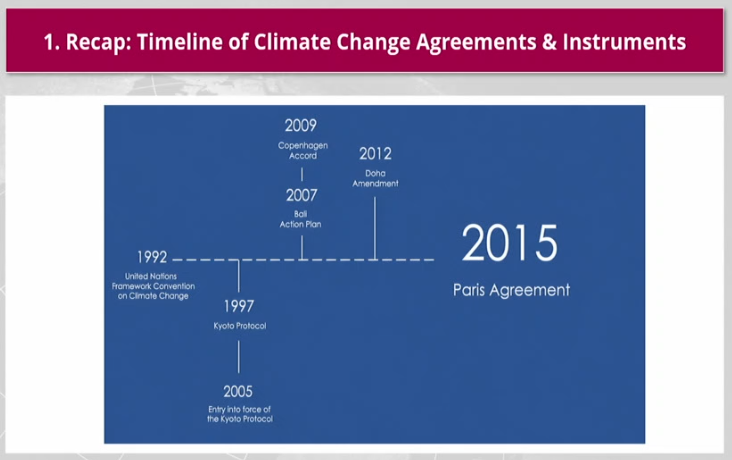
Soft Law/Hard law (normative governance)
Soft law
Frameworks (very used in IEL because of the dynamic it sets up as we saw in (Session 8-Climate Change and International Law), action plans (to implement certain principles like the SDGs… not about how to frame discussions but what to do in the future. Can be based on declaration of principles), declaration of principles, UNGA resolutions (general IL).
Some aren’t realistic and they are soft so not that constraining (e.g. SDGs are not going to be done for 2030). There is a target in the SDGs to call on the WTO to prohibit certain types of harmful fishery subsidies so as to protect the ocean. At the same time… after like 20 years of discussion for such an agreement nothing worked, until the SDGs were pushed though.
And it can become hard like a framework convention, content-wise→by adopting a treaty or becoming customary. For example EIAs became hard parallel (as a part of) to the prevention principle as we saw in Session 6-The prevention principle in international environmental law and the ICJ regulated them said conduct before the project f.ex. But you can have treaties and etc that go deeper.
Procedural governance
How to monitor and enforce the norms. There is a lot of soft responsibility, because the enforcement and compliance mechanisms in IEL are basically soft. Most treaties allow for solutions in a tribunal but this rarely happens, whole system set up for initial compliance.
Reporting
First part, to report information. All or almost all the environmental treaties have its own secretariat and parties have to provide them information on what they are doing to implement the treaty.
Examples
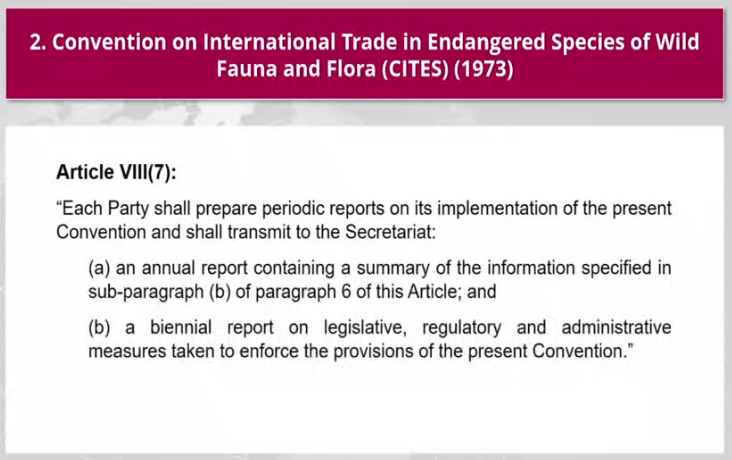 So yeah the idea is to prepare a report on what’s being done.
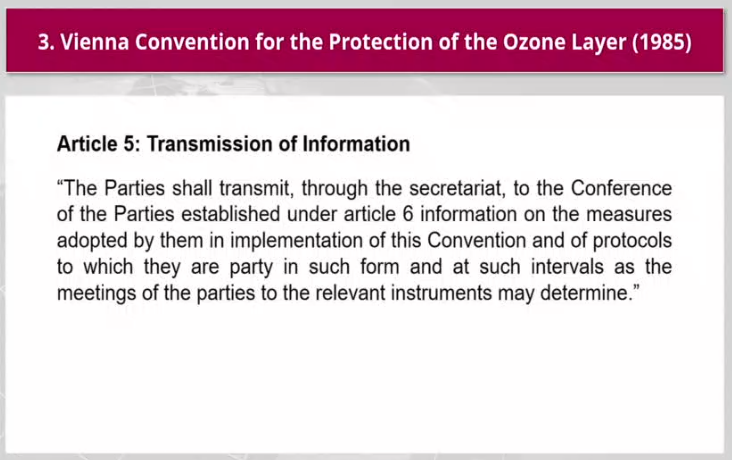 Same… Also happens with the NDCs of Paris. Not just reporting the ICJ already said there can be scrutiny over the content. But the NDCs are documents submitted every 5 years so that’s literally reporting on implementation.
Nobody checks what they write though, we trust them to be truthful, careful, etc… Entirely soft judging.
In some cases like Kyoto there can be verification (rare!), if the secretariat suspects something they can send experts to national territory. But sovereignty issues remain, in fact Paris abandoned it f.ex. because states don’t like it. Also makes thing look weird, IEL system should be based on trust, states know this.
Compliance
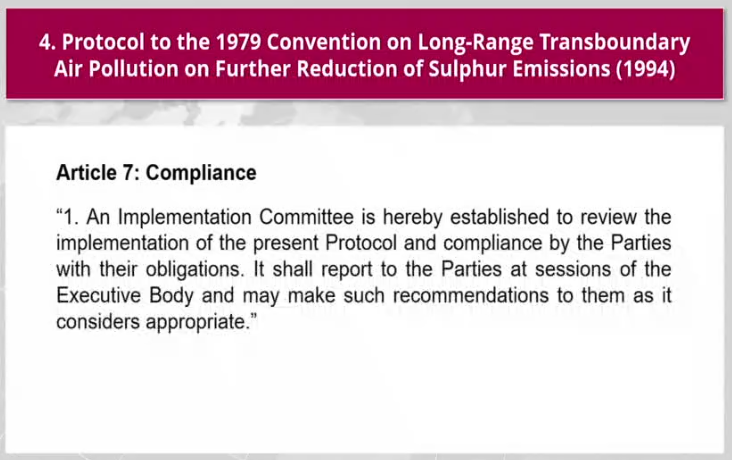
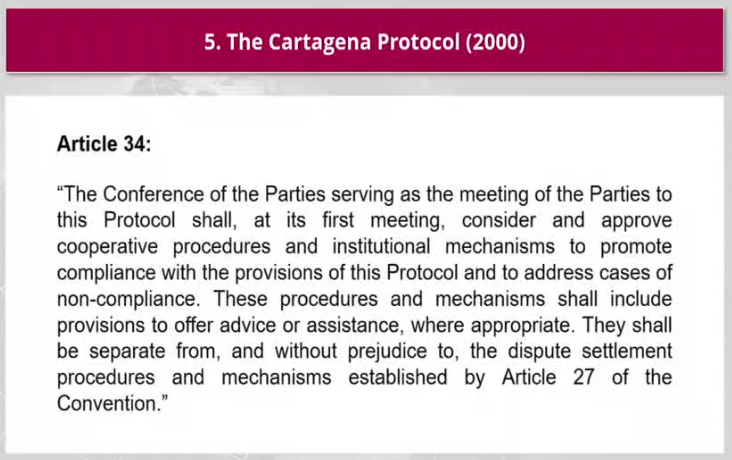 So there should be a mechanism to verify compliance and non-compliance. Many others like Montreal, Kyoto… You can establish them at first or later, each does it their way. States can raise non-compliance but they don’t like to point fingers, it is rather non-compliant states that raise it.
Many times countries don’t comply because of lack of capacity (technical or financial) to implement all obligations. Therefore a committee is setup and if this is the case they get financial assistance. Most treaties already have this but you can do more.
In Paris we have this but non-adversarial, non-punitive and transparent. The idea isn’t to punish, unlike some parts of IL. It’s about facilitation, since we can’t/don’t wan’t to really repair but we want to prevent. If not we can get to a point where it’s too late.
Enforcement
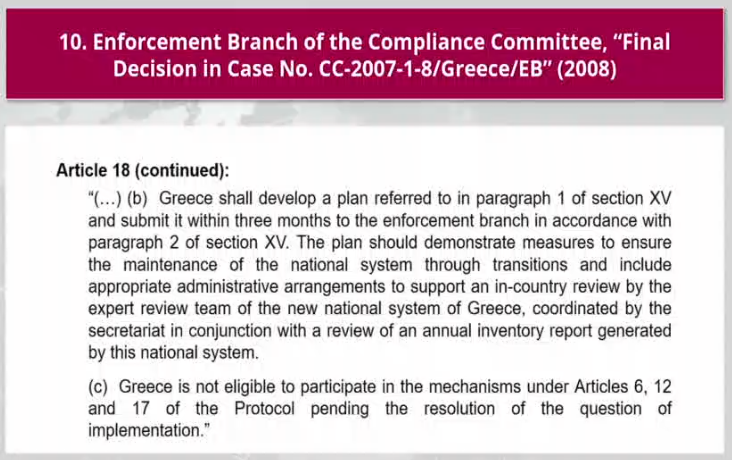 If not you can be named and shamed (through NGOs or other mechanisms), or sanctioned. F.ex. here Greece is prevented from using emissions trading until they fix this; basically stuff in the treaty. They also said what has to be done.
Institutional governance
Many instruments are soft by the way (instrumental governance), but as we know this isn’t necessarily weakness as it can be strong. Very fragmented alas, every convention has its own secretariat and they don’t necessarily talk to each other. Sometimes in different places even if many in Geneva. But there is UNEP.
UNEP
A programme not an organisation.
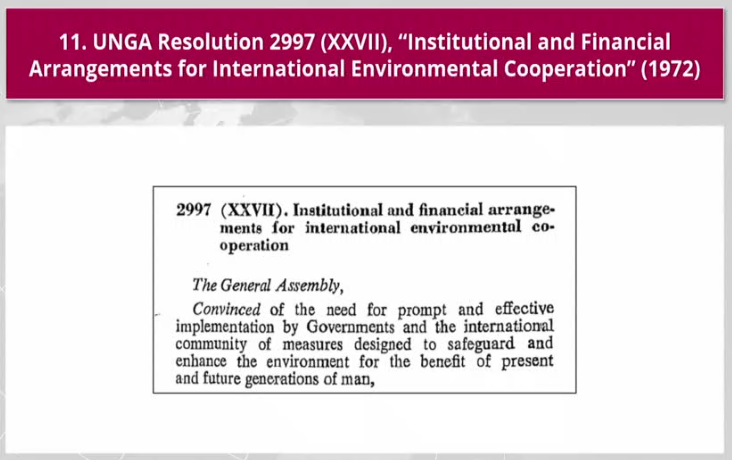 Many discussions in Stockholm so as to what to create: do we need a world environmental organisation? Do we need more than we have, like an international environmental court? Many like WHO or FAO already did environmental stuff (whether towards health, agriculture, etc.). So no new stuff was made, except a subsidiary organ of the UNGA.
This programme would have the mandate of coordinating global environmental policies but had no empowerment or was given the authority that was necessary for this. Its governing body had a composition that made it deficient from the beginning.
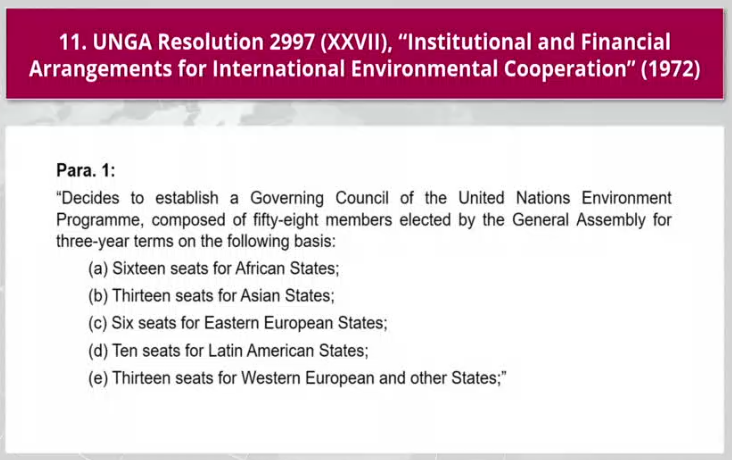 Non-universal membership, weird in UN as all members have to be represented. All countries don’t think alike… so no coherence or continuity.
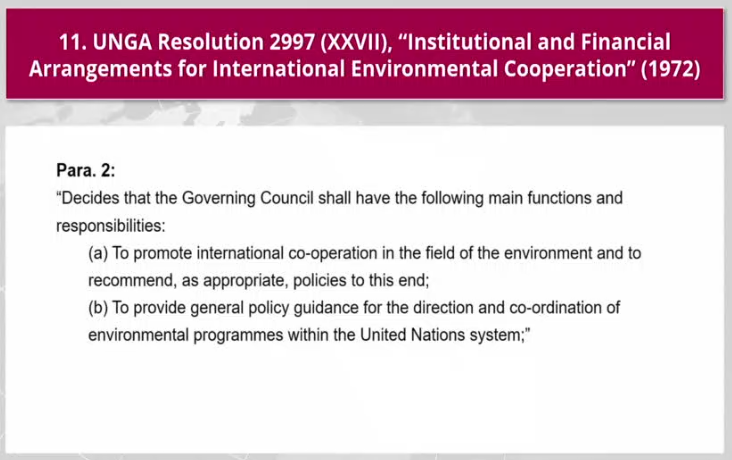 So how shall UNEP coordinate anything? Germany and the HC are like others very vocal about needing an actual organisation. But having a supranational supervisory body isn’t something that many countries like, sovereignty issues.
After Rio
Even more difficult after 1992 with sustainable development and its agenda. The greening of the UN system starts and many agencies start working on environmental stuff. Why would they listen to UNEP that is so tiny when they are universal? They integrate SD in their agendas on their own. For UNEP this was bad.
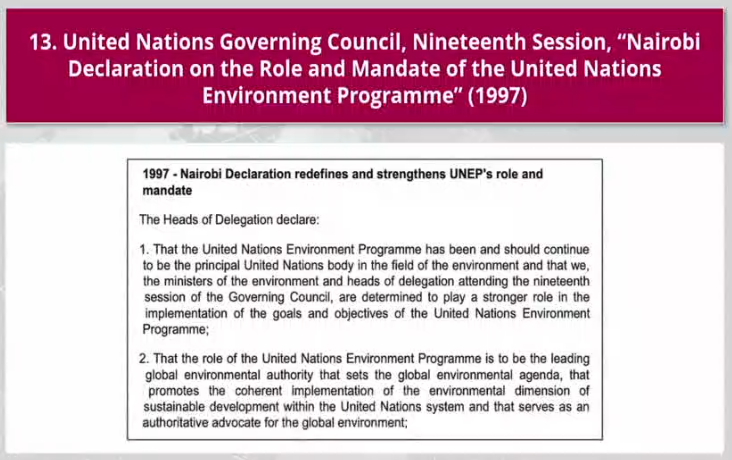 So in 1997 they do the Nairobi Declaration crying for help (empowerment). They stress their role (mandate) again and its relation to SD and advocating for the environment, to justify the need for help. 15 years later something does happen in the future we want (Rio +20).
 They answer, pretty much copy pasting what they had asked for. And they establish universal membership (40 years after its creation UNEP is universal like everybody else). Now its the governing body but to reflect its universality its the UNE(environmental)A(ssembly).
Global Pact for the Environment
Right now we have this, many experts met up and said that there are gaps that needed to be fixed. Like sustainable development where we got many definitions for one duty… the customary nature of environmental democracy, etc. This pact wanted clarity and many push it so that governments adopt it. Very few updates… not looking great.
Courts and tribunals are important though, if we never have a global pact we can count on them to help us understand. We have seen this a lot.